Friday, September 17, 2010

Zombie Review: Pride and Prejudice and Zombies Audiobook

Being a zombie parent means you don't have a lot of time for reading, so what better solution is there than an audio book? You can listen while pushing a stroller around or driving from la crosse practice to band practice to dance practice. Browsing through the shelves at the local library's audio book CDs, I shambled upon Pride and Prejudice and Zombies on the shelf. "Give it a try," I thought to myself. The children wouldn't let me browse any longer (they seem to think they are in some pre-apocalyptic version of The Road), so the deal was sealed. On to the review:

Pride and Prejudice and Zombies (Quirk Classic)

ZPAA rating

Tweenagers and up, i.e. if you're ready for Pride and Prejudice, you're ready to add some zombies in too.

Gore level

3 out of 10--Descriptions of the zombies, their feasting and their dispatching are more technical than graphic, as befits an Austinian sensibility. The narration is without any sound effects or mood music to enhance the mood or horror.

Other offensive content

Human on human violence; threats of self-mutilation (human on self violence?); a suicide; ridiculous romantic entanglements and complications.

How much zombie mythology/content

These zombies are the standard zombies, though the mythology is described in period vocabulary. The zombies are referred to as "unmentionables" (not to be confused with underwear), "stricken," "Satan's spawn," and other colorful and indirect epithets. The zombies are considered a plague though they do rise from the graves. I'm not sure how people who died long ago were infected and rose from their graves, but give the authors a break. This isn't science, it's literature.

How much fun

The story has a patina of gravity but is really full of light-hearted fun. Lots of characters have training and discipline from the Orient (hey, that's what they called it back then). Kung fu fighting and katanas abound, along with ninjas, nunchuks and throwing stars. The movie will probably be ridiculous and awesome. They should dub the fighting style "Jane Fu" if you ask me.

Synopsis & Review

A guess it had to happen eventually. Someone had the crazy idea of adding zombies into the most unlikely genre of literature, the Regency romance. The title "Pride and Prejudice and Zombies" sounds pretty hilarious but the execution of such a high-concept idea seems likely to misstep at least once, if not fall flat on its face. My wife read Sense and Sensibility and Sea Monsters and said it wasn't as fun as this story.

The revising author, Seth Grahame-Smith, had the brilliant idea of keeping Jane Austin's text and only adding new text in the style of Austin but with the content of Romero. So the plot (which I won't rehash in detail; if curiosity, school or a girlfriend hasn't made you read the book or watch one of the many movies, consider yourself unlucky) is essentially the same: The lovely Bennet sisters are more or less trying to get married off to eligible men in the vicinity. A lot of content is added: The deadly Bennet sisters are more or less trying to keep the countryside clear of zombies thanks to their martial arts training in China. Balls are still held in spite of potential (and seemingly inevitable) zombie attacks. People going for walks to have conversation are often also killing off unwanted interlopers (or should that be inter-shamblers). London is a walled city with constant battles defending the perimeter. The combination of drawing room intrigues and hand's on combat sequences is quite silly but well-executed and makes for a fun revisit to a classic story.

The narration is also well done. Katherine Kellgren has the haughty tone of a well-bred lady. She also gives the occasional zombie voice its due. The reading is enjoyable and lively, capturing the tone of Austin flavored with Asian martial arts and zombie mayhem. I would definitely recommend the audio book to any and all lovers of action and Austin.

Monday, September 13, 2010

Zombies Invade Baltimore...Well, Just the University

Recent articles in the Washington Post, Baltimore Sun and even the BBC have discussed the current (Fall 2010) English 333 course "Media Genres: Zombies" at the University of Baltimore. The course is part of a new pop culture studies minor being offered at the university. Regardless of how you regard the academic significance of pop culture, this course clearly is an important and worthy study not just for English major or people looking for cool minors, but for every man, woman and child in America.

The course instructor is Arnold Blumberg, who curates a pop culture museum at Baltimore's baseball stadium Camden Yards and has written Zombiemania: 80 Movies To Die For. He seems well qualified in pop culture trends and zombie lore and will make a good instructor. Consider this quote from the Baltimore Sun article:
Blumberg starts class with a deceptively complicated question: What is a zombie?
"I know that lately, a lot of zombies have been created by viruses," one student volunteers. "Is that a zombie?"
"Absolutely!" Blumberg says merrily. One of his key beliefs is that we use zombies to reflect contemporary dreads, such as our current fear of pandemics. He seems thrilled that a student has tapped this theme so quickly.
He also is open to all sorts of zombie manifestations, e.g. radiation, voodoo, etc. I'll have to send him a link to my blog.

The course materials are intriguing. Also from the Baltimore Sun:
Students will watch 16 classic zombie films (including "Zombi 2," in which a zombie fights a shark), read zombie comics and, as an alternative to a final research paper, have the chance to write scripts or draw storyboards for their ideal zombie flicks.
Working out the ideal zombie movie does sound like a fun activity, though I don't know how well it will prepare the students. Perhaps they will imagine their own homes or dorms as the battleground and consider how to secure them and best methods for fighting. I may also write with this concern.

Another awesome idea is to have a distance learning version of the course. Certainly a lot of people would be interested in taking the course without wanting the academic credit. I would sign up in a heartbeat. Or better yet, I could craft my own course...hmmm...if only I had the time! I think I hear one the children calling now.

Tuesday, September 7, 2010

Jacob Shows Who's in Charge

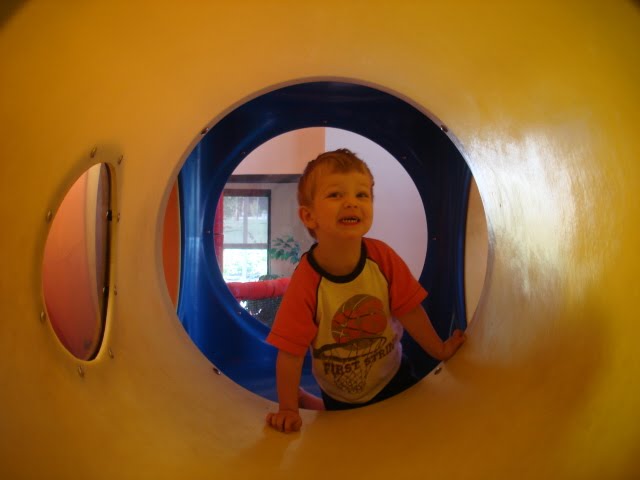
We went to our local Chick-fil-A for some play time. Since we were the only ones there, Jacob felt free to roam around everywhere. And to exercise his control over his dad. Here are the pictures to prove it. He started out innocently enough climbing to the top of the hamster maze and pretending to drive the car.

Look carefully in the front wheel, or just look at the next picture

He was delighted and distracted for quite a while. There's nothing like being in the driver's seat.

Jacob is behind the wheel in more ways than one

Of course, nothing lasts forever. He went to another part of the maze. Suddenly, he claimed that he was stuck. "Help, Daddy, heeelllpppp!" was his plaintive cry. Which meant that I had to go climbing up into the hamster farm designed for someone half my height. By the time I got to where he was, he wasn't stuck. He seemed quite pleased to see me:

my evil plan worked, mwhahahahahaha!

He even demanded to take a picture of me, presumably to blackmail me. I'll nip that in the bud by publishing it here.


I suppose the experience wasn't too humiliating. The only problem is, someone looks like she's following in her brother's footsteps:

Monday, September 6, 2010

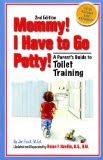
Book Review: Mommy! I Have to Go Potty!

Jacob made two breakthroughs last week: First, as he was getting in the bath, he asked to get on the potty to pee. He did in fact pee in the potty. It was very exciting for all. As a reward, we called Uncle Brian and Aunt Teresa and left a message on their machine. Also, Jacob had a special zucchini muffin as his nighttime snack. Second, Jacob asked to wear big boy underpants the next morning after breakfast. He wore them for about an hour and a half till we had to go out shopping. He kept them clean and dry. We have yet to capitalize on these advances, but we will. Onto the review:

Mommy, I Have to Go Potty: A Parent's Guide to Toilet Training2nd Edition, by Jan Faull, M.Ed., updated and expanded by Helen F. Neville, B.S., R.N. Raefield-Roberts Publishers, 2009, 176 pages, $14.95 US.

Brief overview of content:

The book begins by discussing the physical, social, intellectual and emotional readiness that a toddler needs to begin potty training. Parenting styles (take-charge, diplomatic, laissez-faire) are applied to potty training, showing the strengths and weaknesses of each. A brief review of necessary items (potty chair, potty training clothes, etc.) leads to describing three training approaches: part time underpants, child's choice between underpants and diaper, full time underpants. Different types of rewards (social/praise, tangible items) and whether rewards are needed lead the authors into emphasizing the importance of positive feedback and encouragement ("you did a great job trying") and avoiding negative tactics ("do you want to be a baby forever?"). Tips on how to deal with potty-training plan failure and power struggles are provided. Shifting from home to child care providers is discussed. Accommodations for special needs children are described. Problems with bedwetting, constipation and soiling are given practical resolutions. Early potty training (from 6 to 18 months) is also discussed.

Author overview:

Blurb from the back of the book: "Jan Faull is a well-known child development and behavior specialist. She is the parenting columnist for the Seattle Times and the author of four books on parenting. Helen Neville is a pediatric nurse and educator known for her parent-friendly books on child development and temperament. Also the author of Is This a Phase?"

Recommendations:

1. Read cover to cover vs. consult as needed.

While you could read this cover to cover at a slim 176 pages, it's also easy to skip over chapters or sections that may not apply in your situation. For example, the discussion of special-needs children or the early potty training don't apply to my situation since both children are past the age where we could start early and don't show any special needs. The index is good as is the reference section. The references are divided into several parts: first, children's books on potty training with brief descriptions; second, DVDs for children (though only two are mentioned); third, books for parents with descriptions; fourth, web sites for bedwetting alarms and early potty training support.

2. Readability.

The style of writing is informal and informative. Real life experiences (callout boxes titled "Stories from the Bathroom") and examples are woven into the content and support the ideas presented. Technical jargon is rarely used or in the occasional footnote (did you know bedwetting is medically referred to as "nocturnal enuresis"?).

3. Helpful to a parent?

The book gives a good review of the basics: getting equipment for potty training and making sure child and parents are ready to start. Especially good are the discussions of special-needs children and dealing with power struggles. The chapter on early training was interesting and had enough detail to get you started if you wanted to try. Another plus for the book is how much leeway it gives in going back to diapers temporarily if problems arise. The book is definitely helpful to a parent.

4. Did we use it?

We've been great at avoiding power struggles, mostly because we have been waiting for Jacob to show more interest. He has recently, so we are getting him on the potty more often (almost once a day). Plus, we've had a flood of books from the library to read to him about potty training, some from the list provided in the references.

Sample text

On the importance of avoiding power struggles: [B]e careful not to get into power struggles over toileting. An emotional battle can result in your child refusing to use the toilet and retaining his stool. Remember, ultimate control lies with the child. It's his body, he's the one in charge. You can encourage, reward, influence, and motivate, but you can't force a child to poop. [p. 141]

On hypnosis for children five and up: Hypnosis provides positive suggestion when the mind is relaxed. If you're interested in this approach, you can try it yourself or work with a child threapist who does hypnosis. A reputable book on this subject is Raising your Children with Hypnosis by Donald Mottin. The author points out that intention must be stated in the present tense and positively rather than negatively. The subconscious mind takes thing quite literally. If you say "My bed will be dry," this could mean tomorrow or a year from now. So instead, you say, "My bed is dry." [pp. 124-125]
How many science fiction experiments have gone awry without the proper phrasing? Or poor use of hypnosis?

Thursday, September 2, 2010

Max Brooks Vs. Daniel H. Wilson, Ph. D.

 Inspired by the recent non-successful Scott Pilgrim vs. the World movie, I’ve decided to write a couple of dual reviews that will also be duel reviews. Today it’s Max Brooks’ seminal work, The Zombie Survival Guide: Complete Protection from the Living Dead (hereafter ZSG), against Daniel H. Wilson’s How to Build a Robot Army: Tips on Defending Planet Earth Against Alien Invaders, Ninjas, and Zombies (hereafter HBRA).

Max Brooks, son of famous film maker Mel, wrote for Saturday Night Live for three years. He has also made a name for himself in zombie pop culture. In addition to ZSG and its graphic novel spin-off ZSG: Recorded Attacks, he’s written an oral history of a world wide zombie outbreak called World War Z. The story has been produced as an audio book and is on its way to the silver screen. He’s the sort of expert who you want to have quoted on the back of your zombie novel or reference work.

Daniel H. Wilson, Ph.D., received his doctorate from the Robotics Institute of Carnegie Mellon University and has written several other humorous tech books like How To Survive a Robot Uprising and Where's My Jetpack?: A Guide to the Amazing Science Fiction Future that Never Arrived in addition to writing for Popular Mechanics magazine. He knows the latest in state-of-the-art robotics. He definitely has the technical savvy for helping us deal with the undead.

Both books are humorous looks at practical advice for extreme disaster preparedness. ZSG is more thorough in this regard, looking at what causes zombies, what weapons work best and how best to deal with the hordes when on the defensive, on the run or on the offensive. The humor is very dry and far too sparse for my tastes. Brooks apes the survival guide style a little too well. The book is almost too serious and too thorough. Consider the list of public buildings reviewed as possible defensive strongholds: office buildings, schools, hospitals, police stations, retail stores, supermarkets, shopping malls, churches, warehouses, piers and docks, shipyards, banks, cemeteries, capitols and city halls. No less of an authority than my wife agrees with me that the best part of the book is the imaginative history of zombie outbreaks (starting from pre-historic times ending with 2002 A.D.) that follows the practical advice.

Wilson’s HBRA obviously focuses more on the current and expected development of robots. From pet robots and vacuum cleaners to micro-bots and unmanned vehicles, each bot is explained thoroughly. Then Wilson describes (less thoroughly) how to alter them for defense or offense. His humor is more constant and made me laugh out loud in several places, something I don’t remember while reading ZSG. He has a natural conversational style that is engaging and fun. The zombie content is pretty low but on the money. Consider this piece of advice: “Suffering a zombie bite is emotionally traumatic for humans--so let a cold, impartial robot make the logical decision to take you out. The robot will dispatch you with surgical precision and none of the sappy dialogue that usually accompanies violent partings between wives and husbands, best friends, or owners and pets.” [p. 163] Wilson definitely has his finger on the pulse of current robotics and current pop culture, with advice on how to use robots against aliens, vampires, Godzilla, werewolves, great white sharks, asteroids, ninjas, mummies, pirates and zombies. Clearly, he saved the best for last.

My conclusion is that Wilson’s HBRA is the more entertaining and technically astute read, while Brooks’ ZSG is a better preparation for the inevitable zombie apocalypse. If you can read only one, I’d recommend How to Build a Robot Army.

Winner:


Loser:

Tuesday, August 31, 2010

Sisyphian Task

Jacob got some balloons last night from Uncle Brian and Aunt Teresa. He loves them* dearly. You know the old adage: If you love someone, you have to let them go. So this is where one of the balloons wound up today:

As you can see, we have a nice cathedral ceiling in our living room with an open walkway on the second floor. Too bad the balloon was too far to reach from the second floor. Aus a tool was required. Here were the three I thought might do the trick:
A fan, a feather duster and a ball walk into a bar...
The fan was useless, since any breeze it generated was too weak to move the balloon. The string moved around a little. The telescoping feather duster seemed like it would do the trick. Appearances are deceiving:
Maybe a footstool would have helped (or a tripod)
I did think about using the vacuum cleaner's telescoping wand to suck down the balloon's string and thereby get the balloon, but I feared the balloon would get destroyed in the process. That left hitting it with a small, Nerf-like ball. The sort that Lucy likes to chew on because she can get chunks out of it. Luckily this ball has joined Raggedy Ann and Andy in WITSEC, so it was fully able to serve in a covert mission while the children slept. After two hits (shamefully the number of throws was many more than two), the balloon made it to a reachable spot:

In fact, I left it for Jacob to find. After his nap, he was delighted to grab the string and pull in his balloon. All is well until the next release. Or Lucy gets a hold of it.

*I realize the use of "them" is ambiguous. Of course he loves the balloons AND Brian and Teresa.

Friday, August 27, 2010

Product Non-Review: BugBite Teether

The folks over at ThinkGeek offer a wide variety of practical and impractical items to satisfy the geeky needs we all have. I assume you must have some level of geekiness in you if you are reading this blog post. You can assess how high you rate by considering how you are reading this: more points the more recently you purchased the reading item; still more points for how mobile the item is (desktop vs. laptop vs. handheld/smart phone); yet more if you actually are mobile right now. But I digress. Certainly you must have some idea of how much of a geek you are.

One of the items purported to be practical is the BugBite Teether. Consider their justification:
When babies are born, they really can't defend themselves from zombie invasion. About all they can do is hope that their brains are small enough to not be noticed in the teeming hordes of screaming adult humans. If that fails, they need to hope their supersonic screaming drives away the zombies. Luckily, at about six months, babies start to get teeth, giving them a line of defense. It's important for parents to encourage their baby to use these shiny white weapons by giving them a teether.

It's an interesting argument. By "interesting" I mean completely silly. The irony of using biting against zombies who are famous and fearsome for biting is not lost on me. Also not lost on me is the fact that biting a zombie seems just as likely to turn the biter into a zombie. It all comes down to the  mechanics of the zombie epidemic. If a voodoo curse or death has to occur before one can become a zombie, then the little biter would be okay. But if a virus or some such biological contaminate causes zombification, then your setting your child up for failure. And no one wants their child to be a failure, do they?

We have not purchased this product, so I can't comment on the quality or durability of the construction. Or how tasty it is. So I can't recommend or not recommend the teether. But don't think this is a panacea for the inevitable zombie apocalypse.

Maybe they should make some sort of teether that tastes like brains that you can throw at zombies to distract them while you make your escape. Hopefully they'd be sold in multipacks. Or the teethers could be so attractive that the zombies fight over the teether rather than mobbing you. I'll have to look for a suggestion box on their web site.