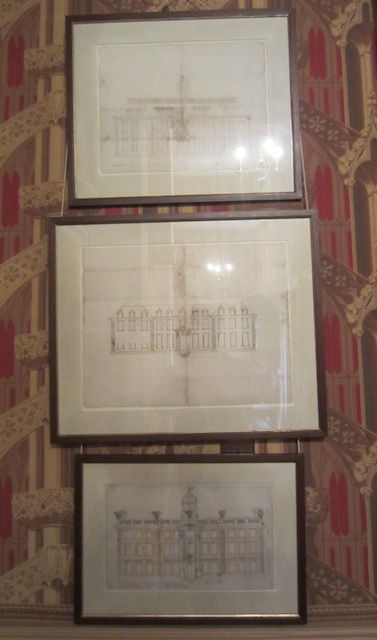
Hanbury Hall and Gardens was built in the late 17th century by Thomas Vernon. He was a successful lawyer and used his money to get a little house in the country. Three different designs were submitted to him. William Rudhall's design is the closest to what we see now, which is a classic example of the William and Mary style. The date 1701 is over the front doorway but that was added in the 19th century. No one is sure why the date is there.
 |
| The Hall |
Another unexplained feature that I noticed was some fake windows on the outside of the building on the east face. At one point, there was a tax on windows, so maybe this is an example of the classic way to dodge the tax.
 |
| The middle windows are fake; I guess I should have checked from inside! |
Going inside, the first room on the left, the Sitting Room, was originally two rooms. It was "My Lady's Parlour" and the withdrawing room. The parlour part would be used to entertain guests. The smaller withdrawing room would be for entertaining more intimate acquaintances. It also provided a discreet route for the lady of the house to leave off entertaining since a door led out to the garden. The rooms were turned into one around 1800 by Emma Vernon and Henry Cecil, presumably to have more space for entertaining, though there is no written evidence explaining the change. Another notable fact about the room is the 1721 inventory which listed 102 paintings in the room! The docent in this room gave us a quick and thorough history of the ups and downs of the Vernon family's fortunes. A thrifty Vernon was often followed by a spendthrift one who wiped out the family savings. Also, many romantic intrigues and kerfuffles pepper their history.
 |
| Sitting Room with docent |
The Main Hall is dark and welcoming. The fireplace is a later addition. The bust over it is Thomas Vernon in his lawyerly wig and robes. Underneath is a small sign "VER_NON SEMPER VIRET," which means "Vernon is always green," as in very prosperous. The underscore allows another interpretation: "Spring is not always green." This refers to the varying fortunes of the Vernon family. Paintings of various family members surround the fireplace.
 |
| Main Fireplace |
Behind the main hall is the Smoking Room, where the men of the house had offices for conducting business. They could also keep an eye on the back courtyard where the servants worked. It was used to store the guns for hunting.
 |
| Desk for doing business |
A small hallway connects the Smoking Room to the Dining Room. In it are two death notice signs from bygone eras. The signs were hung outside wealthy houses and showed the combined family crests of husband and wife, though if the deceased was single there was a single crescent. For a couple, if the left side of the sign was black, the husband died. If the right side, then the wife.
 |
| Two crests, one widow ("Rest in Heaven" is the translation) |
 |
| A dead bachelor (same inscription) |
The Dining Room is quite ornate and has an extensive collection of paintings of the Vernon family. Like the Sitting Room, it was originally two rooms, the lobby and a withdrawing room. The lobby was the everyday entrance to the house. The withdrawing room was an antechamber to one of the bed chambers. Again, it was a place to invite closer friends. The chimney piece is from the 1760s.
 |
| Dining Room |
 |
| Over the fireplace |
Connecting the Dining Room to the Main Hall is the Drawing Room, where the ladies would withdraw after dinner to let the men enjoy their port and cigars. It is now furnished as a sitting room with a rather delicate carpet.
 |
| Drawing Room |
 |
| See, I was right! |
The Great Staircase is perhaps the greatest thing to see at Hanbury Hall. Thomas Vernon commissioned
Sir James Thornhill to paint the staircase. Thornhill had done several other large scale projects, though his most famous work was to come in 1716 when he painted the cupola of St. Paul's Cathedral in London. He is a quality artist. The theme of the staircase is Achilles, appropriately mythological and grandiose. Covering the walls and ceiling, it is awe inspiring.
 |
| Nice staircase decorations |
 |
| Interesting facts (click to enlarge) |
At the top of the stairs is the Blue Bedroom, which has been painted blue throughout the history of the house.
 |
| Blue Bedroom with floating canopy |
The upstairs corridors are called the Gothick Corridors for the wallpaper, though the current wallpaper was put up in the 1990s. The pattern imitates the previous paper. Also, the hall contains the original three designs submitted for the house.
 |
| Wallpaper with Victorian house model |
 |
| The three original designs |
The Nursery and Day Room is where the governess would have cared for and instructed the children. The Day Room would have been a little retreat for the governess to relax without the children.
 |
| Governess's room (the cradle wouldn't have been there back in the day) |
The Cedar Bedroom was used by the last lady of the house, Lady Georgina. Sir Harry Vernon and Georgina were married in 1861 and he received a baronetcy in 1885. They performed extensive charitable works in the local town. On their golden wedding anniversary, over 400 Hanbury villagers attended the celebration. One of the guides told us that they have about 300 thank you notes sent from the villagers to Harry and Georgina, a rather unprecedented show of affection between the Lord and the locals.
 |
| Wedding Anniversary invitation |
 |
| The Cedar Room bed |
 |
| A charming fireplace |
 |
| Georgina's fabulous hair! |
The Hercules Bedroom, Closet, and Dressing Room were the suite for the master of the house. They are furnished in 18th century style. The Dressing Room has a corner fireplace with a small statue of Hercules at the top, hence the name.
 |
| Hercules Bedroom (n.b.: Hercules never slept here) |
 |
| Hercules statue (if it had one eye, I'd swear it was a Cyclopes) |
 |
| Hercules clock |
Outside is the final room, the Long Gallery. It is unclear whether it was ever attached to the house, but surely it was in regular use. For Thomas Vernon, it served as a gentleman's study. The walls were hung with maps, two globes sat on tables, some chairs and some books filled it out. Think of it as a 17th century "man cave." Later it was used as a picture gallery and an exercise space (though some stories persist that it was used to race the dogs when it was too wet outside). The family arms found over the fireplace are similar to that of Vernon-sur-Seine in Normandy, France, where the family originally came from.
 |
| Long Hall |
 |
| Inside the Long Hall |
 |
| Fireplace |
 |
| The family seal |
Our other favorite object outside the house was the horse mounting block by the front door. Four steps lead up to a small platform from which a person could easily mount a horse.
 |
| We're ready to ride! |
 |
| The steps up to the horse mount |
Speaking of horses, the nearby stables are now used for a tea shop, a gift store, a second hand book shop, a plant shop, toilets, and occasionally an ice cream cart is parked there too.
 |
| The Stables |
The favorite part of the grounds for the children was the playground, of course. That will be in the next blog post.
 I'm on Just a Catholic Dad again! This time I provide an audio report on a recent beer festival I went to. We had joked earlier that I should be a beer correspondent for the show, now it is actually happening! He is glad to take submissions from others (even about cider and perry!), so don't feel shy if you have a microphone and a favorite brew.




 Posts
Posts

