Monday, January 27, 2014

Book Review: Time Travellers Hidden Rome by Maurilio Tavormina

Time Travellers Hidden Rome by Maurilio Tavormina


Cicero the Cat has a friend, Ascanius Wells, who owns a time traveling Vespa. They go for a ride through the city and through history to tell stories about some of the monuments and locations in Rome.

Some stories are (I assume) historically accurate but quite fantastic, like how the Romans in the late 15th century would flood the Piazza Navona on August weekends so they could enjoy a cool and refreshing artificial lake in the middle of the city. Other stories are clearly folklore, like how the Devil plugged the hole in the top of the Pantheon with a giant golden pine cone. When the temple of all the gods was turned into a Christian church, the demons inside fled so fast that the cone popped like a champagne cork. All the stories are entertaining and nice bits of trivia.

The book is aimed at children with jokes about the clunkiness of the Vespa and the standard array of cat jokes. Cicero the Cat talks directly to the readers at several points, which might be off-putting for some but I didn't mind. The art is serviceable and the book has three transparent overlaps turning photos of current-day locations into what they would look like in ancient times (like the Colosseum, see my scans below). And there's a little historical quiz in the back with an email address to send in answers, which seems a little weird. I did not send in my answers.

The book makes a nice souvenir with some fun stories about places in Rome. Available for purchase from the publisher.

Today's Colosseum

Back in 212 thanks to that Vespa and a transparency

Ponte Vittorio Emanuele II, Rome

The bridge Ponte Vittorio Emanuele II is named after the first king of Italy, Victor Emmanuel II. The bridge was built in 1911 and was supposed to be an artistic and traffic-bearing partner to the nearby Ponte Sant'Angelo. A previous bridge built by Emperor Nero was still standing in the early 400s but was destroyed when the Goths sacked Rome later that century. A small bridge was built to the south.

Castel Sant'Angelo (sorry its bridge is not visible)

Southern view from Ponte Vittorio

The figures on the bridge represent the national identity. Winged Victories stand atop columns on either end of the bridge.

Winged Victories keep a bus at bay but not out of the picture

Groups of figures represent military valor, fidelity to the law, the father of the country, and the common people. The sculptures are nice but pale in comparison to the other bridge.

Military Valor

Respect of law?

Father of the country?

The plebeians?

Tomorrow's post is the more famous Ponte Sant'Angelo!

Sunday, January 26, 2014

Santi Luca e Martina, Rome

Between the Roman Forum and the Capitoline Hill is Santi Luca e Martina, a seventh century church that was rebuilt from 1635 to 1664 by Pietro da Cortona. The original church was dedicated to Saint Martina. In the late 1500s the pope traded it with the Academy of St. Luke, a group of painters, sculptors, and architects (St. Luke is patron of painters), who had a church in the Piazza S. Maria Maggiore. The pope wanted to expand the piazza so the academy moved to St. Martina. When they redid the church under Cortona they added St. Luke to the name.

Santi Luca e Martina

The interior is not large but is quite ornate. Plenty of sculptures and paintings adorn the church as well as a nice life-size statue of the martyred Saint Martina by the main altar.

Nave

Dome

Detail over the main altar

Unidentified statue

Main altar

St. Martina, who might fall out on the baby Jesus!

Since we visited over Christmas and New Year's, naturally there was a nativity set up.

Nativity

In the middle of the floor was a grating which made us wonder what was downstairs. Soon, we found a staircase leading into the crypt, where the remains of Saint Martina are buried in a small chapel.

What's down there?

View from below

One of the downstairs statues

Chapel of St. Martina

Who was Saint Martina?

Martina was the daughter of an ex-consul. Her parents died while she was young. She openly professed her faith and was subsequently arrested and tortured during the reign of Emperor Alexander Severus. She was beheaded in 228. Her feast day is January 30.

Saturday, January 25, 2014

Colosseum, Rome

An icon of Rome is the Colosseum, the largest amphitheater in Rome. Emperor Vespasian began construction in AD 72 and it was opened in 80 by his son Titus. It was originally called the Flavian Amphitheater but came to be called the Colosseum because of a large bronze statue (a colossus!) located nearby (which no longer exists).

Colosseum, Rome

The design is very practical, with 80 arched entrances around the bottom to allow easy access to the 55,000 seats. The emperor naturally had his own entrance.

The entrances and first vendors of the morning

A peak into the hallways

The emperor (or wealthy citizens) would sponsor the games so the public got in free. Not free are the guys standing around outside in gladiatorial garb who will take a photo with you for money.

Fee for foto!

We wound our way around to the entrance and waited on a not very long line to get inside.

We arrive

We wait in line--not like it was in the old days

The internal halls have archeological exhibits showing different items discovered in and around the Colosseum, including statues, mosaics, and other items.

Horse and rider, or what's left of them

Heads of statues

Mosaic

Carvings

Another display shows various coins and game pieces that were used by the crowd to entertain themselves during breaks in the action. Dice (aleae or tesserae) were popular though not always honest. The large crowd made good cover for people who wanted some extra entertainment between events.

Game pieces and dice and knucklebones from the excavations

The real attraction, both then and now, is the interior where the games were held.

L sees what it was like back in the day

L ready to go

The Colosseum floor

The arena held large crowds and had many different attractions. In the morning, the participants would parade in. Then hunters would go after wild animals who lurked in sets made to resemble the animals' natural habitats. At lunchtime, condemned criminals would be fed to the beasts. In the afternoon, the gladiatorial combats began. Combat was often to the death. Sometimes a badly wounded gladiator would appeal to the crowd. The emperor could give a thumbs up or a thumbs down signal depending on how merciful he felt. The floor was covered with sand so any blood could be raked over between combats. During the breaks, jugglers or magicians or acrobats would entertain.

The seating

More seating!

Excavations at the floor show a network of rooms where animals were caged and gladiators prepared for combat.

Workman's entrance!

Under the floor

One live animal still in the Colosseum!

Christians were also martyred here during the games and a cross has been erected in memory of them.

Archway to the Christian memorial

The cross

The views from upstairs are quite nice.

Arch of Constantine

The Roman Forum

J and L were fascinated with wandering around the ruins and were blissfully unaware of the bloody history of the place, so they had a lot of fun. We enjoyed seeing the history and the scale of the building. It is very large and well deserving of its iconic status.

Us at the Colosseum

Friday, January 24, 2014

Food Supply and Team for the Inevitable Zombie Apocalypse

Zombies are so popular, even Forbes magazine is reporting on them. They have a short article on their web site describing (and mocking) Costco's $4000 emergency food kit that will feed four people for one year. 

Yes, Costco will deliver a pallet of 378 #10 cans wrapped in black for the "security and privacy" of its customers. Items include grains, fruits and veg, protein, and some miscellaneous extras that have a shelf life going from a three years to twenty-five years. I'm just glad they include six cans of fudge brownies, though brownies from a can sound rather unappetizing. It reminds me of Thanksgiving Day cranberry sauce that retains the shape of the eight ounce can it plopped out from.

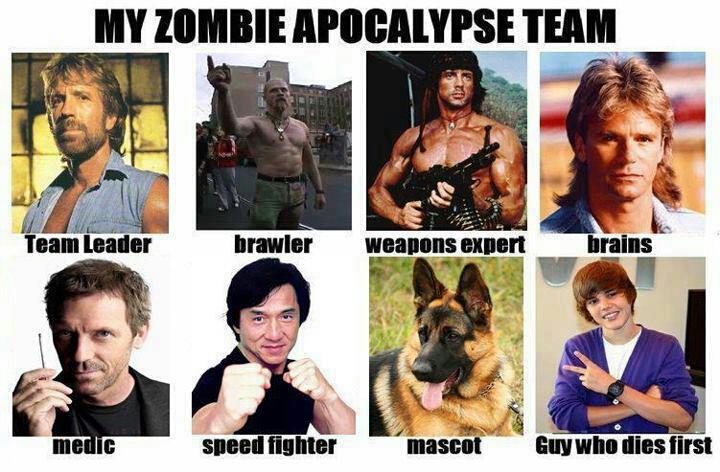
Speaking of mockery, perhaps you've seen this meme on social media:

From zombieapocalyseacademy.org

Well, I just saw Ravi Fahsa (who I don't know but it popped up on my Google+ feed) posted his or her own team, "because superheroes are too mainstream":

That has got to be the worst shot of Predator ever as weapons expert!

After googling to find the first image, I discovered this meme has gone crazy. Check out the different teams here.

For my own team, I'd probably go with the first team but make a couple of modifications: Harrison Ford for the Team Leader; Jason Statham for the Brawler; Chuck Norris for the Weapons Expert (gotta keep Chuck!); John Watson for the Medic; Chewbacca for the mascot. For the Guy who dies first--any number of politicians could fit the bill.

Any other team suggestions?


Movie Review: Much Ado About Nothing (2013)

Much Ado About Nothing (2013) directed by Joss Whedon


Yet another film I meant to see last summer (ref: Pacific Rim and World War Z). At least my excuse for this one is that it didn't play anywhere near where we are living in North Yorkshire.

One of the most popular and most absurd plays written by William Shakespeare is Much Ado About Nothing. The story is whimsical and the characters do quite ridiculous things. Audiences love it because it is full of joy, almost exploding with joy. It's easy to forgive the contrivances of the plot because the humor and the romance are so wonderful. The story follows a troop of men who return from battle to the home of Leonato where love is in the air. Claudio wants to marry Leonato's daughter Hero while Benedick and Beatrice have a "merry war of words" that inspires their friends to make them fall in love too. Madcap hilarity ensues with occasional moments of dramatic intensity.

Joss Whedon made this film during a two-week break in the middle of making The Avengers. The actors are his friends, mostly from his previous TV shows. The set is his house and backyard. He'd been having friends over for Shakespeare readings for years and years, so it is not such a surprise that they could put something together quickly and still do a good job.

The actors are good if not always outstanding. Alexis Denisof (Benedict here; Wesley from Buffy and Angel) might be a little too buffoonish at points but nails it in others; Amy Acker (Beatrice; Fred from Angel) does a great job and has natural chemistry with Denisof; Nathan Fillion (Dogberry; Mal from Firefly) steals the show. As a fan of Whedon's previous work, it was a little distracting seeing all the different actors popping up. But I got used to it after a while, just like people get used to the Shakespearean language.

The black and white photography works well, giving it a style appropriate to the timelessness of the story. The story is ultimately relevant to generation after generation because it touches on truths and experiences that happen all the time because people are, in fact, people. We've all experienced unrequited loves, the joy of discovered love, the hope of a happy ending in even the craziest circumstances. Hopefully not this crazy.

Parental Advisory: All the characters drink quite a bit; a little bit of smoking (probably some weed); some frisky sex scenes without nudity; that difficult Shakespeare language.

Thursday, January 23, 2014

Trevi Fountain, Rome

Trevi Fountain is a rather legendary spot in Rome. People go there to toss in coins over their shoulders, which is supposed to guarantee that they will come back to Rome in the future. The fountain is the one featured in Three Coins in a Fountain (both the song and the movie) as well as Roman Holiday and La Dolce Vita.

Trevi Fountain

The most surprising thing about the fountain is that it was built relatively recently, in 1762. Designer Nicola Salvi went a bit wild with an exuberant display of water and stone. The central figure is Neptune, god of the seas. On his right is a Triton trying to master a difficult sea stallion; on his left is another Triton leading a docile sea stallion. The two represent the storminess and calmness of the sea.

Center of the fountain

Tame that horse!

So tame, he could blow a horn and not spook the horse!

We took turns tossing coins in the fountain. J and L both asked who threw the farthest. Since they didn't see and I wasn't paying that close attention, I told the most palatable result to keep the peace among them.

J's toss!

Fountain and family

My toss with authentic blur

The fountain is an amazing sight and does draw massive crowds, which also draws many merchants trying to push their wares. The most annoying item is the little gel pig that the salesmen throw to the ground. The pig makes a funny noise and then is smashed flat. The pig then reforms into pig shape, ready for another go. One fellow kept following us around. When I asked my wife about it, she said L was interested in getting one. It would truly be the worst souvenir ever if we bought one. We bought her some gelato instead.

The crowd at Trevi

Crowd-eye-view