Showing posts with label Cold War. Show all posts

Thursday, June 16, 2022

Book Review: Nathan Hale's Hazardous Tales: Cold War Correspondent by Nathan Hale

Nathan Hale's Hazardous Tales: Cold War Correspondent written and drawn by Nathan Hale

Marguerite Higgins, a reporter for the New York Herald Tribune, covered the outbreak of the Korean War. She was a correspondent in World War II and witnessed the liberation of some of the concentration camps. Stationed in Tokyo, she and other correspondents flew over to Seoul as the North Korean army came pouring south. Many of her personal experiences are told, e.g. dealing with supportive and unsupportive military leadership (some didn't want her anywhere near combat). The battle scenes are exciting and frequent. This book only covers the first year of the war (1950), with the South Korean and American/UN forces pushed all the way back to the southern shore of the Korean Peninsula. General Douglas MacArthur executed a bold plan to retake the capital, launching an amphibious assault at Inchon, eighteen miles west of the capital.

As with all the Nathan Hale's Hazardous Tales books, this is introduced with a little comedy by American patriot (and narrator of the series) Nathan Hale and his executioners. Ms. Higgins takes over narrating duty since she is a reporter and it's a natural fit for her. Her real-life account is riveting. I learned a lot about the Korean War from this book even though it only covers a third of the war. As usual, there's a bibliography and some pictures of the real Higgins. The inside cover gives a map of Korea and explains the language changes by the South Korean Ministry of Culture and Tourism that happened in 2000, when spellings changed, e.g. Inchon to Incheon and Pusan to Busan, among others. This book is a better text than a lot of textbooks!

Highly recommended.

Friday, March 20, 2020

Movie Review: Invasion of the Body Snatchers (1955)

Invasion of the Body Snatchers (1955) directed by Don Siegel


Doctor Miles Bennell (Kevin McCarthy) is called home from a conference to the small California town of Santa Mira. His nurse is overwhelmed with patients needing help. The most intriguing cases are the people who claim their relatives are not really their relatives--they've been replaced by emotionless copies. Bennell sees one or two and refers them to his psychiatrist friend. He's a bit uneasy about the situation since the problem is wide-spread in Santa Mira. His unease turns to paranoia when an author friend discovers a body in his closet that appears generic but is slowly looking more and more like the author. Later, Bennell discovers giant seed pods in his greenhouse. The pods spawn bodies of the doctor and his girlfriend (Dana Wynter). To avoid being turned into soulless and emotionless copies of themselves, the two go on the run from the townfolk.

The movie is a science fiction classic. Pod People has become an idiom for emotionless or soulless individuals. The penultimate scene of Bennell running through a highway trying to warn all the drivers that they are about to be assimilated ("You're next! You're next!'), even shouted into the camera, is famous as well. The movie was based on a novel and had three remakes (1978, 1993, and 2007). The story plays as a great parable against conformity and indifference. It's also a harrowing adventure for the main character.

Weirdly enough, the film has been interpreted as condemning the dehumanizing effects of McCarthyism and the dehumanizing effects of communism. The film makers did not intend a political interpretation. Perhaps it is best to look at it with some perspective and acknowledge that it condemns dehumanization in contemporary society regardless of political persuasion. The "better life" offered by the pod people is one without love or joy or pain or sorrow. Such a life may be less chaotic but it is also less rewarding and less adventurous. The pod people offer an unreal world that everyone should reject.

Highly recommended.


Friday, February 21, 2020

Movie Review: The Manchurian Candidate (1962)

The Manchurian Candidate (1962) directed by John Frankenheimer


An American patrol unit is captured by the Chinese Army during the Korean War. The Chinese take them into Manchuria, where the Americans are given psychological conditioning. After three days, they are returned to Korea with no conscious memory of what happened, only a cover story that Lieutenant Raymond Shaw (Lawrence Harvey) took out a Korean unit single-handedly and saved the patrol after they had gotten lost. Shaw returns to the United States and receives a Medal of Honor from the president. His mother (Angela Lansbury) and step-father (James Gregory) try to horn in on the photography at the ceremony. His step-father is Senator Iselin, a fire-brand anti-Communist who is campaigning for a higher office in the upcoming party convention. Raymond can't stand him or his ideology, which he calls Iselinism (clearly meant to stand for McCarthyism). Raymond takes a job in New York with a newspaper that opposes Iselin's ideology. Then Raymond gets a call from his mysterious Chinese friends, who bring him in for testing to make sure he's still ready to be used as a assassin.

Meanwhile, the captain of the patrol, Marko (Frank Sinatra) has had a hard time adjusting to State-side duties. He constantly has nightmares where he half remembers what happened in Manchuria, including Raymond killing two of his fellow soldiers. Marko knows Raymond was unpopular and a cold fish but also says, "Raymond Shaw is the kindest, bravest, warmest, most wonderful human being I have ever known in my life." Marko's work in the military PR department is very stressful. We see him failing to manage a general who gets shouted down by Iselin who demands to know how many communists are in the department of defense. Marko's superior sends him to New York City on leave, where Marko looks up Raymond, only to find the mystery of the dream becoming more odd and sinister.

The story has many twists and turns. It's also soul-crushingly bleak. The black and white cinematography creates sweaty, oppressive environments, adding to the tension. Frankenheimer's camera angles are often very stylish and evocative. The visuals make the genuinely shocking moments all the worse. The ending is tough to watch in a heartbreaking way. The story comes to a satisfying if unhappy conclusion.

Harvey and Sinatra give great performances. Their characters are very odd but still have humanity and sympathy. Angela Lansbury also stands out as the manipulative and horrible mother. The rest of the cast is good, each with their own little quirks or oddities. Janet Leigh plays a proto-manic pixie dream girl--her character is a girlfriend for Marko, providing some comic relief and someone for him to bounce ideas off of.

Highly recommended.


Tuesday, November 26, 2019

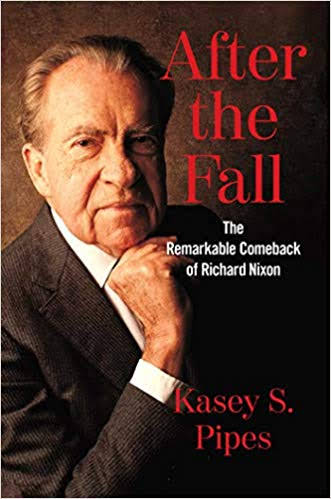
Book Review: After The Fall by Kasey S. Pipes

After The Fall: The Remarkable Comeback of Richard Nixon by Kasey S. Pipes


When people think of Richard Nixon, most automatically think of Watergate. A lot of people stop thinking at that point and stay locked into the idea that Nixon is a soulless, immoral monster who got away with it. The fact is Richard Nixon was a human being and had a lot of life and experiences after he resigned from office in 1974. This book chronicles that time and Nixon's efforts to find redemption and relevance after disgrace.

The book begins with Nixon's departure from the White House. He went back to California as an exile. His health deteriorated and he nearly died from an embolism. In desperate need for money, he made a book deal for his memoirs and agreed to be interviewed by David Frost. Both actions were more than just a chance to pay his bills, he also wanted to reform his public image. He put his efforts into foreign policy, the area he had been most successful in during his presidency. He'd ended the war in Vietnam, opened relations with China, and began the brief era of detente with the Soviet Union. Nixon stayed in touch with people in Washington and slowly became an advisor to presidents (including Clinton) and a public pundit especially on Cold War issues. He traveled to the Soviet Union and to China as an elder statesman and attended many foreign state funerals. He died in 1994 and was eulogized by Senator Bob Dole and President Bill Clinton.

Pipes is the first researcher given access to the Nixon family's records, so he reveals a lot of inside information and opinions. The pro-Nixon attitude is understandable as the reader sees the ex-president fight back against his failure (he came to see himself as morally guilty if not legally guilty of the Watergate disaster). Nixon elaborated three principles which helped him through the dark years after his resignation:
"1. Put the past behind you. Analyze & understand the reasons for your defeat, but do not become obsessed with what was lost. Think instead about what is left to do.
2. Don't let your critics get to you. Remember that they win only if they divert you into fighting them rather than driving toward your goals.
3. Devote your time to a goal larger than yourself. Avoid the temptation of living simply for pleasure or striving only to leave a larger estate." [p. 217]
Nixon moved on and found a new purpose in his life by writing books about foreign policy and traveling internationally to assess and smooth over relations when he could (like in China after Tiananmen Square). He helped Reagan, Bush, and Clinton behind the scenes.

Before reading this book, I'd thought of Nixon as an unredeemed failure of a president. Learning more about his life after his presidency was eye-opening for me. I heard about this book at the History Unplugged podcast, which I highly recommend.

Recommended.


Wednesday, August 3, 2016

Movie Review: Bridge of Spies (2015)

Bridge of Spies (2015) directed by Steven Spielberg


Tom Hanks plays Brooklyn lawyer James Donovan who gets drawn into the Cold War. He is selected by the bar association to represent Rudolf Abel (Mark Rylance), a Soviet spy active in New York City. Donovan was chosen because no one wanted to defend Abel. Being an honest, honorable, and precise man, Donovan gives Abel the best defense he can, in spite of encouragement from family and the firm to get it done as quickly as possible. Donovan builds a little friendship with Abel, enough to find out that the U. S. government did try to get information from Abel or turn him into a double agent. Abel keeps quiet and refuses to cooperate, telling Donovan that the Americans have men just like Abel in Russia doing the same thing. The evidence is fairly overwhelming and the judge is completely unsympathetic, so the guilty verdict is no surprise.

Meanwhile, the U2 spy plane program has started. American pilots in Pakistan are flying U2 planes at 70,000 feet over Soviet airspace, taking pictures of facilities and other locations of interest to the U. S. Government. One of the planes is shot down and the pilot, Francis Gary Powers, is captured by the Soviets. Powers goes through a quick trial to parade him in front of cameras, showing how evil America is.

The two stories intersect when Donovan receives a letter from East Germany. Someone claiming to be Abel's wife has written and is hinting that they are willing to trade Powers for Abel. Donovan is drawn into the negotiations as an unofficial representative of the U. S. Government. That means he has to travel to Berlin just as the Berlin Wall is being constructed. An American graduate student is caught behind the eastern side of the wall and is held by the communist East German government. Donovan decides he wants to trade Abel for both Powers and the student, though the respective governments are not interested in extra complications. What follows is an exciting struggle by Donovan to get both the Americans home.

The movie is a sort of Cold War version of High Noon. Donovan is a man of integrity and uprightness, even in the face of social pressure to do the expedient and shallowly patriotic thing (either letting Abel go to the electric chair like the Rosenbergs did or accepting just Powers and not the student too). While he agrees the Cold War is a war of cultures, he insists that the Americans hold to their principles, like due process for Abel and protecting all lives including the student's. Otherwise, how is American culture different from Soviet culture?

Donovan is also intelligent and disciplined, able to read situations and either coax or strong-arm others into doing the right thing. Often, such actions are not convenient for Donovan but he does them anyway. He's an inspiring character.

Highly recommended!


Tuesday, September 1, 2015

Book Review: Unpopular Essays by Bertrand Russell

Unpopular Essays by Bertrand Russell


Betrand Russell is a philosopher and author who has the strange combination of a strict logical background (he wrote the seminal text on symbolic logic Principia Mathematica with A. N. Whitehead) and a breezy and familiar (i.e. not academic) writing style. He is both a strict thinker and an entertaining writer. So why would these essays be "unpopular?" According to Russell, he argues against errors on both sides of the political landscape, debunking both the left and the right. He thinks his writing is unpalatable to many, possibly the majority, of people. At least that's his contention in the preface.

He is quite excellent at analyzing the biases of various groups from all periods of history, including today. Two main arguments come up several times in different essays. First, he argues that men should seek an honest understanding of each other. They should recognize the fundamental equality of each nationality, race, religion, and sex. A lot of suffering and injustice could end immediately. Charity towards and tolerance of others would go a long way in establishing a more peaceful and harmonious society.

His second argument is that one world government is needed to create the sort of unity the human race needs. Governments naturally conflict with one another. When he wrote these essays (the late 1940s), the looming conflict was between the United States of America and the Soviet Union. Russell feared another world war would be far too devastating to the world population. He favored the Americans for their more liberal and less repressive form of government.

I found his style in the book both entertaining and caustic, much the way I feel about Rush Limbaugh and Michael Moore. Russell is willing to argue from oversimplifications to bolster his arguments (e.g. did no one treat women fairly before the twentieth century?). He says there's no scientific evidence for the human soul and therefore dismisses it. But what theologian (other than a crackpot) would say there is scientific evidence? Plenty of arguments can be made in favor of the human soul, but not mathematical proofs. I found myself agreeing and disagreeing with him at various points throughout the book.

His predictions are interesting in their inaccuracy. America did win the Cold War but did not establish a world government, an objective that seems as intangible as the human soul. The book is a fascinating bit of intellectual history but not as relevant as it surely seemed seventy-five years ago.


Thursday, May 14, 2015

Game Review: Twilight Struggle by GMT Games

Twilight Struggle by GMT Games


The Cold War is a rich resource for many different stories and games. One game encompasses the whole conflict--Twilight Struggle. Two players take sides as either the Soviets or the Americans and then vie for world domination. The game is played over several rounds where the players try to increase their influence in the various countries and continents without dropping the DefCon Status to the point of Global Thermonuclear War. At the beginning of each round, players are dealt a hand of card which they play during the round.

A game in progress

The cards have an operations value (from one to four points) and an event (which can be pro-American (like the John Paul II Elected Pope card), pro-Soviet (like the Fidel card), or favorable to either (like the Host Olympics card)). The player chooses whether to use the card for the event or for the points. An event has a specific effect. For example, the John Paul II Elected Pope card removes two Soviet influence markers from Poland and adds one American marker, which can shift the balance of power in Poland substantially.

The operations points can be used in one of three ways. First, the player can put influence markers in countries where they already have influence or in countries adjacent (so strengthening or spreading influence). Second, the player can attempt a coup in a country anywhere on the board, possibly flipping the country's alliance to their side. Third, the player can make several realignment roles in an attempt to reduce the enemy's influence in a country. Any of these actions will cause shifts just like the events can. The trick is that if the Soviets play a pro-American card for the operations points, the event also happens (vice versa is true--if the Americans play a Soviet event for points, the Soviets get the event). If the Soviets play a pro-Soviet card for points, the event doesn't happen (though the card goes in a discard pile and may be used later when reshuffling a new draw deck). Balancing out what's best for your own side against possible beneficial effects for the enemy becomes an important tactical decision.

One card per turn can be used to advance on the Space Race track (as long as a die roll is lucky). Using a card this way is a good way to get rid of especially helpful events for an opponent, though again the card goes in the discard pile and may come back later.

The game's mechanics are simple but have a lot more depth and elegance as the game goes along. The game is weighted in favor of the Soviets which we found in playing and from a helpful podcast. In our first game, the Soviets had more points at the end. In our second game, the Soviets hit the twenty point victory margin half-way through the game, ending it early. In tournaments, players bid to play the Soviets, i.e. they give a certain number of extra influence points at the beginning to the American player. The game is a bit unbalanced in an ahistorical way!

On the other hand, the game is well-researched and provides information about the various event cards which are all things that happened in history (though obviously they can be played out of order--in one game the Lone Gunman event happened then subsequently a JFK event was played!). Creating an alternate history can be fun. The tension in battling over a country or a region is exciting and enjoyable (though more so if you come out ahead).

This is a fun, intense, informative game. If you like a challenge, play as the Americans.