Showing posts with label Czech Republic. Show all posts

Sunday, November 11, 2012

Saints Cyril and Methodius Church, Prague

Guest post written by my wife since she made it to this church and I did not. This is the last post of the Prague series, honest!

Our guidebook had a few lines describing the Saints Cyril and Methodius Church and mentioned that it contained a monument to an assassination team from World War II.  That peaked my curiosity so I headed over one day while the kids were taking their naps.

Sts. Cyril and Methodius Church, Prague

The church is a Cathedral for the Eastern Orthodox church in the Czech Republic. The church was locked, but a large glass window allowed a view of the interior. Although not large, it is beautifully decorated. 

Nave

Ceiling

A large sign pointed to the basement crypt "National Memorial of the Heroes of the Heydrich Terror."  For a small fee, the museum shows you a series of large signs and photos (and a few artifacts) explaining what happened here in 1942.  I really knew nothing about these events, but the museum did an excellent job explaining the background, buildup, assassination, and aftermath. I won't be able to cover it all here, but I'll give the 10,000 foot version.  If you're in Prague, I strongly recommend visiting the site.

During World War II, the Czechoslovakian government was in exile in London. The exiles needed to prove to the Allies that they were serious about fighting the Nazis. With the British, they developed a plan to assassinate the Nazi governor, Reinhart Heydrich. Heydrich was an incredibly evil and ruthless guy, and one of the main architects of the Holocaust.  

Heydrich arrives at Prague Castle with Hitler

Heydrich in power

The dots in the picture below were used to measure skin tone.  The Germans wanted to purify Czechoslovakia and reward the Aryan elements there.

Nazi display

Meanwhile, in Scotland, some Czech soldiers were given paratrooper and assassination training by the British and were kitted out with weapons, equipment, and contacts in the Czech resistance. They parachuted into a farm area near Prague where they hid with various families and members of the resistance. After months of preparation, they attacked Heydrich while he was driving. They succeeded in their mission, but at a terrible cost.

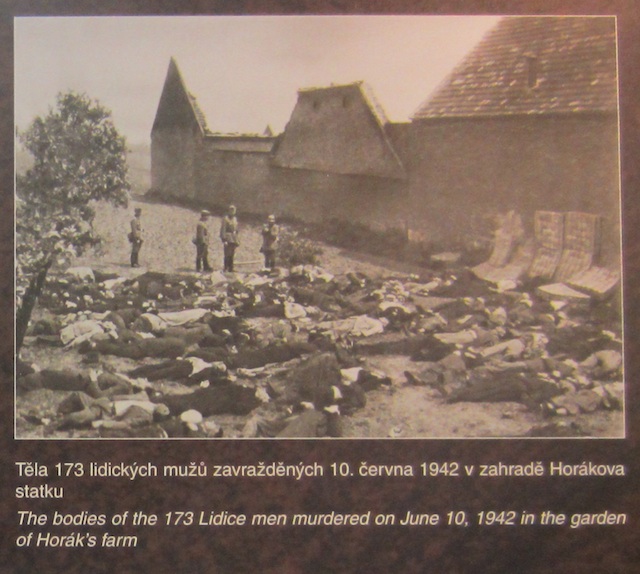
Reprisal on one of the towns thought to have sheltered the assassins

One of the local resistance members who was helping the assassination team knew the priest at the Sts. Cyril and Methodius Church. He arranged for the team to hide in the crypt of the church after they killed Heydrich. Eventually, the Nazis found them and attacked. They wanted to capture the paratroopers alive, so that they could be tortured and interrogated. Then they could roll up the whole resistance movement. The crypt of the church was almost impregnable, and the paratroopers held out for several hours against a huge number of Nazi soldiers. After several hours of machine guns and tear gas, the paratroopers used their last bullets on themselves.

Stairway where some of the fighting took place

The crypt

Memorials to the heroes

The memorial outside

The most moving part of the museum, for me, was seeing the pictures of the Czech families that helped the paratroopers, giving them lodging or food during the time when they were preparing for the operation. Almost all of those families were caught and killed by the Nazis.  They killed the children with their parents. I couldn't help but think of my children when seeing the beautiful innocent faces of these Czech families.


For more information, there is an excellent wikipedia article on this.

Saturday, November 10, 2012

Prague to Budapest by Train

Our last day in Prague became our first day in Budapest via a seven-hour train trip. We took a cab from our hotel to the train station, which was very picturesque on the outside.

One of the three Prague train stations

Inside, it was more mundane, like most other train stations in Europe. There was a floor with shops and money exchanges and fast food and lots of crowds. Above that was the platform area which is not so pretty.

View from our train

On board, we had a long ride. The kids were okay for the most part. they didn't nap which made it a little longer. Luckily the books and the iPad didn't give out before we arrived.

Ready to go!  (Playing with Thomas the Tank Engine conductor kit.  Badge, coins and tickets)

Lucy shows her cousin an activity book

Food is a good entertainer too!

We were seated at the end of one of the cars, the end with the toilet. It was out of order and it started giving out a funky odor. About five hours in, it started seeping some sewage, even though no one was using it. It was rather unpleasant. We chalked it up to a bit of the Communist-era care and efficiency still lingering. We all took turns going to the dining car to get snacks and some fresher air.

The train passed through Slovakia, so we technically were in three new countries on this trip, though we have no passport stamps or other proof (other than there's no way to get from the Czech Republic to Hungary on land without going through another country). I'm not even sure where this church was, other than it is along the way.

Random church in eastern Europe

We arrived after dark and took a cab sent for us to our new apartment. The apartment was large enough to accommodate our family and the cousins too! But that is a story for future posts.

Thursday, November 8, 2012

Prague Leftovers

Here's what didn't make it into its own blog post but I thought was worth sharing from our trip to Prague.

There are plenty of churches we didn't get to in Prague, some because they were closed or time was short.

Franciscan Church that was part of the ghost walk

"Old Catholic" church near our hotel

Another random church somewhere in the middle

Also, I did get to see the outside of the Spanish Synagogue, built in 1868 and featuring Moorish decor inside (according to my guide book).

Spanish Synagogue

Some of the restaurants/pubs also caught my eye, especially since the signs were in English and were humorous.

Primate Pub

Mad cow disease probably started here

The town features many murals, including a famous of John Lennon. We didn't see the Lennon one but we saw this one.

Not sure what to make of it

Lucy also demanded a picture in a phone box for some reason.

Phone a friend?

A few other bits of architecture made it too.

Maybe an embassy?

Cut those plants back!

A heavy doorway (I love doors within larger doors for some reason)

Wednesday, November 7, 2012

Wenceslas Square, Prague

Wenceslas Square was a horse market in medieval times. It has also been the site of many rallies, uprisings, and demonstrations, including a giant Mass in 1848, a celebration in 1918 for the creation of the Czechoslovak Republic, and the 1989 protests that culminated in the collapse of communism in the country.  It is now a blend of historical monuments and commercial enterprises.

We came into the square from the northwestern end, with a nice view down to the National Museum dating from the 1880s.

Entering Wenceslas Square

View down the square

As close as we got to the National Museum

Calling it a square doesn't really do it justice, since the boulevard is 820 yards long, nearly half a mile. The first thing we ran across in the square was a long line of small buildings that served food, especial for the thronging nighttime crowds, which we completely missed on our morning adventure.

Booths closed at 9 in the morning

Whatever it is, it looks good

A good variety of beautiful buildings line the street, typically with restaurants or stores on the ground floor. We eventually found snacks at a cafe.

Pretty in pink

I'm guessing this was built during the Communist-era

Jacob was excited to have his picture taken!

More pretty buildings

Can someone move the food stands?

Many of the details of the buildings are striking as well.

Lions and soldiers!

I think this was a bank

Me and my statue

We could also see the Powder Gate, one of the gates of the old city, down a street.

Powder Gate, Prague

Many commercial enterprises are found on Wenceslas Square as well. Here are the few that caught our eyes.

Only one dancing girl?

Bookstore!

Yes, you have to pay to pee

GE has banks, too?

We enjoyed this last morning visit before we got on a train to head to our next destination, Budapest!

Tuesday, November 6, 2012

Art from St. Agnes Convent, Prague

Turns out that I didn't lose the postcards I'd bought at St. Agnes Convent.  I couldn't take pictures or buy a catalogue/picture book of the great works kept there so that was the only way to get images of some of them (aside from hunting all over the internet). Having my trusty scanner, I am able to share them with you. I left the images at full resolution, so click on them to see more detail.

The first is Virgin Mary Expectant Standing, a statue circa 1420 that depicts Jesus's mother while she is still pregnant. Considering all the Madonna with Child statues, frescoes, mosaics, and paintings there are, this is a refreshing change from what you expect. No artist is listed.

Virgin Mary Expectant Standing, c. 1420

Speaking of the Madonna with Child, here is one from an altarpiece by the Master of Trebon called the Madonna of Roudnice, Prague, from about 1385.

Madonna of Roudnice, Prague, c. 1385 by Master of the Trebon

Continuing on in Jesus's early life, here is an Adoration of the Magi, also an altarpiece, but from the Master of the Vyssi Brod around 1350. I like the way the magi is kissing the baby's hand.

Adoration of the Magi, c. 1350 by Master of the Vyssi Brod

Probably from the same altarpiece is this Christ on the Mount of Olives, also by the Master of Vyssi Brod from 1350.

Christ on the Mount of Olives, c. 1350 by Master of the Vyssi Brod

This next piece is St. Jerome. It's by Master Theodoricus painted around 1360. I love how the image spills out onto the frame, matching the larger than life character of St. Jerome.

St. Jerome, c. 1360 by Master Theodoricus

Another larger than life figure painted by Theodoricus is Charlemagne, the 8th century emperor who reunited western Europe after the fall of the Roman Empire. He is depicted as a saint, though his canonization was by the anti-pope Paschall III. Not being officially the pope means Charlemagne is not officially canonized. He was beatified by Pope Benedict XIV (that's two Benedicts before the current pope), so he is a blessed and on his way to canonization. Read more about him here.
 
St. Charlemagne, c. 1360 by Master Theodoricus

Last we have proof that medieval women were hot! This is Portrait of Eleonora of Toledo by Agnolo Bronzino in 1540. I love the detail on her dress, her serene face, and her penetrating eyes.

Portrait of Eleonora of Toledo, c. 1540 by Agnolo Bronzino