Showing posts with label English Heritage. Show all posts

Tuesday, July 18, 2023

Stonehenge 2023

One of the most famous landmarks in England is Stonehenge. It is also quite probably the oldest. It is an ancient structure that was built almost 5000 years ago, though its development and construction took almost 800 years. The stones are so old, there is no written history and scant archeological information. As a pre-historic construction, it is an amazing accomplishment. Some of the stones came for a short distance, only a few miles away. Others came from Wales. All the stones weigh multiple tons and would have been extremely difficult to transport without modern machines (they'd probably be difficult to move even with modern machines). The alignment is surprising with an opening that shows the rising sun on the summer solstice or the setting sun on the winter solstice. 

The area is a World Heritage Site under the care of English Heritage. Visitors come to a small museum complex to learn as much as we know about the creation and purpose of the stone circle before visiting it.

Museum bragging about the site

The people who created the henge did not have metal. Their tools were all stone and wood. This display shows various ways they used rocks, like using flint as a cutting tool.

Tools of the pre-historic trade

One intriguing detail discovered by archeologists is a ring of small holes inside of the outer ditches and banks (or henges). They are thought to be post holes. Many of them have cremated remains in them. What was the reason to use the site as a burial ground? Convenience? Sacrifice?

Marking where human remains were found

Other remains have been found in the area, including this skeleton.

A local stiff

A set of models show the progress of the creation of Stonehenge, from circa 3000 BC to 2200 BC.

The initial henge and wooden posts, then with the stone in the middle

Adding to the avenue/entrance, then the current state

A nearby wall collects various quotes about Stonehenge. I took a picture of the one I thought most accurate.

Truer words were never spoken

Outside the visitor center is a sample of the large Sarsen stones that make up the central ring. It's assumed they were brought on sledges that were pulled by a hundred or more men.

Posing with the stone

Trying to move the stone

Another sample is the smaller, bluestones from Wales. They came much farther and were erected inside the ring of sarsen trilithons.

Bluestone

Recreations of thatch-roofed huts show how the constructors of Stonehenge probably lived. The hut below on the left is flanked by a lower hut that may have been used like a barn, i.e. to store live animals.

Recreated homes

Inside

Working on a project outside

We opted not to take the shuttle bus to the henge, walking along a path that led us to a sleeping cow.

No bull!

A more recent stone monument that was near the cow

Stonehenge is noteworthy also for the large number of barrows in the area. Dozens of barrows, or burial mounds, are within a mile of Stonehenge. Most of them date to the period after Stonehenge was built, from 2200 BC to 1600 BC. 

Three barrows in the distance

A long path leads up from the bus stop to Stonehenge.

Almost there

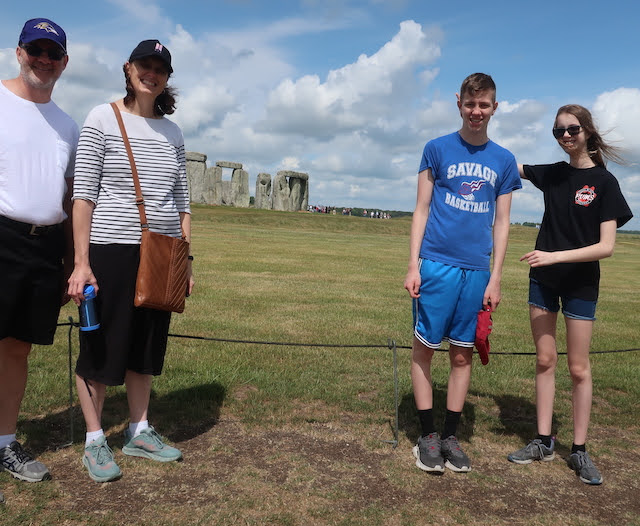
The stones

A pretty lady

Another view

Birds can get closer than people

The path goes all the way around the henge, enabling visitors to see from many angles.

Another side

My daughter took this picture

My youngest took this picture

Just outside the henge circle, a stone stands out on its own. Called the Heel Stone, it marks off the summer solstice. When standing inside the henge on the solstice, the sun comes up directly over the Heel Stone.

Heel stone

We visited on June 19, two days before the summer solstice. The site is closed to the general public on that day, though they were setting up many areas for visitors. 

Getting ready for someone to come

Stonehenge certainly has an air of magic about it, partly from its ancient, unknown history and partly from imaginings of that history. It is well worth visiting.

Monday, August 25, 2014

St. Augustine's Abbey, Canterbury, England

St. Augustine's Abbey is located just outside the walls of Canterbury. It is one of the oldest monastic sites in England, founded by St. Augustine of Canterbury. He was sent by Pope Gregory the Great to reintroduce Catholicism in southern England (it had made some inroads before the Romans left). Augustine founded the monastery in 598. It became a great center of learning. After the Normans took over in 1066, the abbey was transformed into a typical Benedictine Abbey. Around this time, the abbey became known as St. Augustine's Abbey (you don't think he named it after himself, do you?). In 1538, the abbey was taken over by King Henry VIII during the Dissolution of the Monasteries. He turned into a royal palace in preparation for the arrival of wife number four, Anne of Cleves. The abbey saw little royal use after Henry VIII. It was rented out to noble families and slowly sold off over the years. By the mid-1800s interest grew in restoring the site. St. Augustine's College was built on the land, later becoming King's School. The surrounding land was slowly acquired through the 1900s and now English Heritage manages the site.

St. Augustine's Abbey

The entrance goes through a small museum with a collection of decorative bits found by archeologists.

Statue and gargoyles

More statues and a cross

Heads from statues

The museum displays also explain life for people who lived here throughout the ages.

Medieval garb

The abbey grounds are a mixture of the two abbeys (the original Saxon monastery and the Norman abbey) with a sprinkling of the royal palace. The north wall of the church's nave still stands. The base is from the Norman abbey but the brick top is from the royal palace.

Nave north wall

The nave

Adjoining the north nave wall is the remains of Ethelbert's Tower, one of the main towers of the church.

Ethelbert's Tower ruins

Beyond the nave is the Crypt area, which served as the foundation for the central tower.

Crypt

By the crypt several graves are marked off. In addition to the abbots who were buried here, many of the local kings were also buried at the abbey.

Graves

Graves of Anglo-Saxon kings of Kent

The base of a staircase shows where monks would go up the tower.

Stairs

The crypt itself is accessible and contains some interesting floor tiles and the Chapel of St. Mary and the Angels, one of the earliest bits of the site.

More of the crypt

Floor tiles

Chapel of St. Mary and the Angels

View from the chapel

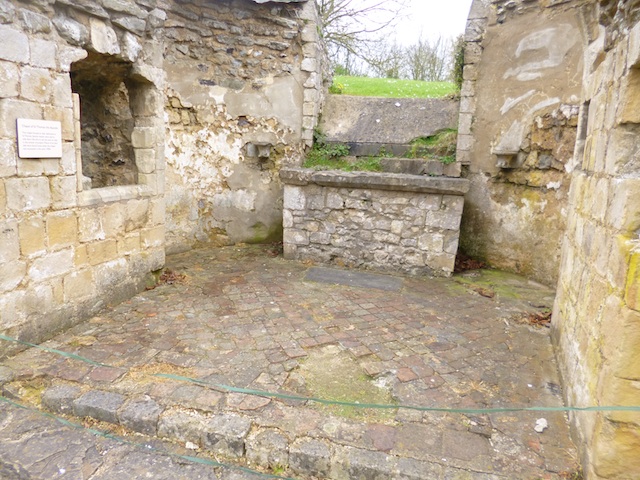
A side chapel in the crypt was dedicated to St. Thomas and the altar is still in reasonable shape.

Altar of St. Thomas

To the north of the church is where the cloister and various domestic buildings of the monastery were located. The cloister was a small square green surrounded by a covered walkway. The walkway provided access to the various rooms of the monastery, such as the refectory (where the monks ate) and the chapter house (where the monks met for daily instruction, including the reading of a chapter from St. Benedict's Rule (hence the name "Chapter" house)).

Cloister area

King's School

Norman doorway

Beyond the monastery on the east end of the grounds is St. Pancras's Chapel, one of the Anglo-Saxon churches that was not integrated into the larger monastic church. The Normans used it as a cemetery chapel.

St. Pancras's Chapel

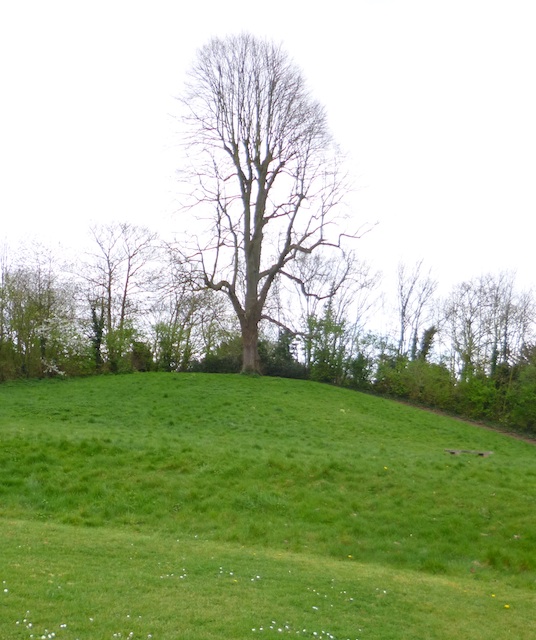
Next to the chapel is a small mound that was probably the location of the Abbey's bell tower or campanile.

Campanile Mound

The abbey is a fascinating place to visit and well worth the trip.

Abbey with Canterbury Cathedral tower in the distance

Tuesday, February 28, 2012

Mount Grace Priory

We took a Saturday morning to visit Mount Grace Priory, the remains of the youngest Carthusian monastery in England (founded in 1398). It wasn't a very far drive from our home. We did stop off in Thirsk to slake our thirst. The town square was bustling with activity. Market day held no sway over us as we headed to the White Rose Books and Coffee Bar for a snack. Jacob was totally amazed that it was a book store AND a restaurant all in the same building. He did check out the potty which was upstairs. He called down to us from the upper level balcony. Lucy and I waved back. We had a nice cup of tea and scones and soon were back on our way to the priory.

The priory is of interest for many reasons. First, it is the most accessible and best preserved of the Carthusian priories in England. Second, since it was built so late, they had a rather sophisticated plumbing system providing fresh drinking water as well as sanitation and latrine service. Third, they've reconstructed Cell 8 so that visitors may see the standard living quarters for the monks from the 16th century.

The first thing we saw on arriving was a field of snowdrops blooming in late February. This flower is quite common and is a happy herald of the coming Spring. Jacob also discovered part of the water works--a small channel of water running down from the priory. Water was definitely his favorite part of the priory.

Field of Hibernation Dreams

Snowdrops close up

Yay for running water!

From there, we could see the manor house, which originally was the guest house of the priory. After the dissolution of the monasteries by Henry VIII in the 1530s, the guest house was converted to a manor house by the seventeenth century owner. The house was expanded again in 1900-1901. It now has several late 19th/early 20th century rooms and some exhibits on the history of the priory, as well as the ticket office and shop.

The guest house/manor house

Interior fireplace

Jacob has a future as a flue inspector!

Long time resident of the house

The upstairs exhibit explained the history of the priory, the life of the monks, the water system, and other interesting bits. The most interesting thing to the children was their ability to go through the exhibit and walk down the hall to the exhibit's entrance, making a nice loop. At one point, Jacob wanted to show me something and we made a full circuit as I tried to catch up to him (or maybe he was trying to catch up to me). Here are the highlights:

Artifacts and manuscripts from the priory

The cycle of prayer at the priory

Model of the Monk's Cell

Interior of Monk's Cell

The cycle of water at the priory

The priory in its glory

After exploring upstairs we were ready to explore the priory grounds.

The church on the grounds is rather small (and in ruins). The Carthusians said most of their prayers individually in their cells, only coming together for Matins (morning prayer), Mass, and Vespers (evening prayer). The church holds the central spot on the priory grounds and divides the monks' cloister in the eastern part of the priory from the lay brothers, who served the monks in various capacities and lived in the western part. The ruins were fun to explore and Jacob found more running water.

Jacob and Lucy near the church

View from the western wall entrance

Family in church!

View up the tower--alas, no spiral staircase!

Jacob finds another waterway!

From there, we crossed the cloister and explored the restored Cell 8 to see what life was like for the monks 500 years ago. Each cell had a door and a small access window or hatch where food could be dropped off without disturbing the monks.

Typical cell entrance with hatch on the right

Jacob and Lucy went in first

Jacob in the hatch

Inside we found a living room with two smaller rooms to the side. One was the bedroom. The other was a study.

Living room

Bed room

Study

Studying in the living room

Lucy in the bed room--guests were not allowed!

Up a staircase was the workroom where the monk would practice a trade. This monk made cloth.

Going up!

Spinning wheel and loom

Hard at work or hardly working

Out back of the cell is the enclosed garden and a covered passage which leads to the latrine that had water running underneath back in the day.

Cell garden

They collected rainwater too!

Jacob did not ask to use this potty, lucky for us!

The cell was not far from the church though it looks far in the view from the front door.

View from the cell

Us outside the cell

From here we went back past the church to the Lesser Cloister where the lay brothers lived and the Inner Court, where the stables and kiln for the priory were located.

Dividing line between Lesser Cloister and Inner Court

Gatehouse that was the main entrance back in the day

With that, our visit was done. We returned to the shop to look for some gifts. The shop lady said we could sample the Chartreuse, which is a liqueur made by Carthusian monks in France since 1605. It is green in color (chartreuse the color gets its name from the liqueur) and is made from over 130 herbs and flowers. I will write another blog post about this since we bought a bottle and I have begun experimenting with it. It is quite potent (55% alcohol or 110 proof) and strikingly flavorful.

After our purchases we headed back home. Driving out of the parking lot, we saw some geese by the driveway that were noisy and unafraid of cars.

"Come back," they seemed to say, or maybe "Feed us!"

We had a wonderful time at Mount Grace Priory and definitely recommend it to others for an interesting visit.