Showing posts with label Holy women. Show all posts

Thursday, March 28, 2024

Book Review: The Witness of Early Christian Women by Mike Aquilina

The Witness of Early Christian Women: Mothers of the Church by Mike Aquilina

Aquilina has written many books about early Church history. Here, he profiles many women who were examples of the radical shift in attitudes towards women instituted by Jesus Christ. In the ancient world, women were, at best, secondary people. They had no direct influence over government and could not testify in court. They were esteemed for their beauty and their ability to bring new men into the world. By contrast, Christ treated women as equals and ministered to them as much as to men. Only one male disciple was at the foot of the cross; four to six women were there (including His mom). In the first four centuries of the Christian era, many women witnessed to their Christian faith in diverse ways.

Aquilina groups these mothers of the church according to those ways. Some were martyrs to the faith, including popular ones like Saint Agnes, Saint Perpetua, and Saint Felicity. Others are less famous, like Saint Thecla, who was a contemporary of the apostle Paul. Her story comes down from the earliest centuries though The Acts of Paul and Thecla are not canonical. Like many other virgin martyrs, she defied her parents' and her society's wishes, refusing to marry and instead following a life a prayer into her old age.

Other women were writers and thinkers, roles almost unheard of for women in antiquity. Proba the Poet wrote an epic in the Roman style but she retold Christ's life. Saint Marcella started a monastic group for herself and other women, learning and praying together. Aquilina includes Saint Monica in this group, who not only prayed for her son Augustine's conversion but also argued with the great doctor of the Church. 

The final group is independent women, of whom Saint Helena is the most famous. She was the mother of Emperor Constantine, the ruler who legalized Christianity in AD 313. Helena embraced the Faith and went to the Holy Land to find the sites where Jesus lived and died. She ran the expedition herself, the first archeological effort in Israel, which had fallen into ruin. I found Egeria the Tourist the most charming. She wrote letters to her community at home (southern France), describing her pilgrimages to holy sites around the Mediterranean. She was free to travel and had no regular group with her. No male companions are ever mentioned. She climbs Mount Sinai and visits Thecla's tomb, drawing inspiration and grace from her adventurous life.

This book is a quick read at 160 pages. It provides a lot of interesting insights into how the world changed for the better with the coming of Christianity and how women played important roles in the early Church. Aquilina's style is easy to read and he presents many passages from ancient texts describing these mothers of the early Christian Church.

Highly recommended.

Wednesday, March 27, 2024

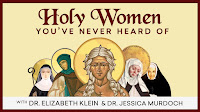
Review: Holy Women You've Never Heard Of

Holy Women You've Never Heard Of by Dr. Elizabeth Klein and Dr. Jessica Murdoch

This original content from Formed (a Catholic video streaming service) caught my eye. Doctors Elizabeth Klein and Jessica Murdoch host a short series about female saints from the past two thousand years you probably have never run across. I knew about two of them, so I met three new sisters in the Lord through this series. The visual is just the two doctors at a desk having a conversation, describing the lives and virtues of these women who should be better known. 

Episode One is about Saint Macrina the Younger (died 379). She's actually the older sister of Saints Basil the Great and Gregory of Nyssa. The family is described as the "second holiest family" by the hosts. Basil and Gregory are famous especially in the Orthodox and eastern churches. Macrina took over managing the family's affairs when their father died. She was engaged but her fiance died before the wedding. She took this as a sign that she should be devoted to a life of virginity and Christian perfection. She took care of their mother and managed their various estates, paying taxes in three different provinces and to the imperial government. She turned the main estate into what today would be a retreat center. She developed a semi-monastic prayer life and gave hospitality to other Christians who would visit. She often gave good advice to her brothers. Her life story is known through The Life of Macrina by her brother Gregory.

Episode Two is about Saint Mary of Egypt (344-421). Her job was prostitution, which she enjoyed a lot, living the life of a party girl. She decided to leave Egypt on a sort of anti-pilgrimage to Jerusalem where she would be a temptress for actual pilgrims. She tried to enter the Church of the Holy Sepulcher but was prevent by an invisible force. She had a moment of conversion, confessed her sins, and went into the desert beyond the Jordan River to live an ascetical life. Years later, a priest discovered her and gave her communion after hearing her life story. She asked him to come back the next Easter so she could receive again. When he came back, she was dead with a note to the priest. He spread her story, which is very popular in Eastern churches. The commentators brought up the insights that no matter how decadent you think modern times are, there's been plenty of similarly decadent times before. More important, no matter how vile a lifestyle one has, God always offers forgiveness and redemption. He loves all of us, even the most hardened sinners.

Episode Three is about Saint Scholastica (480-543). She was the twin sister of Saint Benedict, the founder of western monasticism. Benedict went to live as a hermit in the Italian hinterlands only to be followed by others who wanted to imitate his holiness. Scholastica also went into the wilderness and drew a crowd of women. Benedict made his famous Rules for a monastery; his sister used them for hers about five miles away. They would meet in a farmhouse once a year for pious conversations. At their last meeting, she wanted him to stay, but he demurred. She then prayed to God. A sudden, violent storm came up, preventing Benedict from returning to his monastery.

Episode Four is about Brigid of Sweden (1303-1373; also known as Bridget or Birgitta). She was the daughter of royalty and had a vision of Jesus as a ten-year old. She raised a family with a pious husband. They had eight children, including a saint. She had a good reputation in their society. She and her husband split up so he could join a monastery while she founded a new order, the Bridgettines. She went on a pilgrimage to Compostela and had more visions. She even advocated for the pope to return from Avignon to Rome, much like Catherine of Siena. She had two vocations, an unusual situation. As her life circumstances changed, she changed with them. She did what God wanted her to do in her life.

Episode Five is about Blessed Marie-Anne Blondin (1809-1890). She grew up in Quebec on a farm. She learned to read and write at the age of twenty. She formed an order to teach the rural poor so they could benefit from getting an education as she did. The order grew quickly. The bishop assigned a young priest to help but he turned out to be controlling and made false accusations against her. The bishop eventually sided with the priest and asked Marie-Anne to step down from leadership of the order. She was very reluctant but obedient. She spent the last forty years of her life in humble service to the order. She carried a bitter cross for a long time. She is a great example of living a mundane life with charity. A subsequent chaplain found out about her heroic virtue (this was after she died) and gathered a lot of information about her, the beginning of her canonization process.

I found the series very entertaining and easy to watch. The set-up with just two speakers talking to each other is fine since each episode is ten to fifteen minutes long. It would have been nice to throw up some icons or other images on the screen, but it was not really necessary. 

Recommended.

The series is available on Formed, a Catholic streaming website. My local parish sponsors subscriptions for parishioners; maybe yours does too?