Showing posts with label Jack Kirby. Show all posts

Tuesday, January 24, 2023

Book Review: Fantastic Four Masterworks Vol. 2 by S. Lee et al.

Fantastic Four Masterworks Volume 2 written by Stan Lee and pencilled by Jack Kirby

This volume includes issues 11 to 20 of the original run of the Fantastic Four along with their first Annual issue, a 72-page extravaganza. As the cover suggests, the stories highlight appearances by other Marvel characters like the Hulk, Ant-Man, and Spider-man. Villains reoccur too, like Doctor Doom and the Skrulls. The Annual features a story where Prince Namor, the Sub-Mariner, reconnects with his lost underwater kingdom. He rallies the people to fight the humans on the surface of the Earth, leading to a global conflict that the Fantastic Four has to stop.

The stories are okay, some are more entertaining than others. Namor is an interesting villain since he is looking out for the good of his people and the ocean in general (though he does not come off like an environmentalist--he's far too aggressive). The storytelling gets a little to self-referential, especially when the characters talk about their comic books or the stories are flagged up as requests from the readers. The writing is bombastic, claiming each new issue as "the greatest challenge for our heroes" or "the direst threat the world has faced." The Fantastic Four are famous for their bickering, family-like relationships. When troubles happen, they work together well; during their down time, they get on each other's nerves. The camaraderie is playfully handled. As a writer, Lee struggles with Sue Storm/The Invisible Girl's character. At moments, she's treated very much like a damsel in distress or a woman focused on her appearance rather than a member of the team. At other times, she uses her abilities effectively, turning the tide against a foe. Overall, it's a mixed bag.

Mildly recommended--this is more for people interested in the original stories of the characters.

Wednesday, September 7, 2022

Book Review: Jack Kirby: The Epic Life of the King of Comics by Tom Scioli

Jack Kirby: The Epic Life of the King of Comics by Tom Scioli

Jack Kirby, most famous as a comic book creator who teamed with Stan Lee, had an amazing life. He grew up in New York during the Depression. He started working in comics and animation in the 1930s and was drafted to fight in World War II. When he got back, the grim experience of being a soldier convinced him that the horror genre of comics was of no interest. He returned to comics writing in New York, working with Joe Simon (a pre-war collaborator) at various companies. He had a lot of creative output and was able to transition from superheroes to other comics (like romance or westerns) as the public's tastes changed through the years. He wound up working with Stan Lee and they revived superhero comics with the introduction of Marvel's classic heroes--Fantastic Four, Incredible Hulk, Iron Man, The X-Men, etc. Kirby had a lot of tension with Lee, who was more of a publicity guy, about credit for the creative work. With a family to support, Kirby often had to make hard choices about what work to accept and when to stay at a job that had less and less satisfaction for him. He led a full life and was appreciated by fans up to his death in 1994.

This biography tells Kirby's story from his point of view in this graphic non-fiction. Kirby was a creative genius but also had a lot of angst and a big chip on his shoulder. Very early on, Kirby gets peevish about other comic creators taking his creations or his ideas and running with them. Later, he feels ripped off by various publishers and collaborators but has a hard time fighting back because of family obligations. All the while he says that the work he is doing is the best and he is under-appreciated by his peers and the comic-reading public. The book shows this inferiority complex by drawing Kirby as smaller than other characters in many of the frames. And yet he has the face and hairstyle of The Fantastic Four's Reed Richards--the brilliant scientist who funds their amazing adventures with royalties from his many patents. By the end, the reader gets the sense that this book is the truth but not the whole truth of Kirby's life.

Recommended for fans of comics, it is probably of less interest to others.

Monday, July 4, 2022

Book Review: Fantastic Four Masterworks Vol. 1 by S. Lee et al.

Fantastic Four Masterworks Volume 1 written by Stan Lee and pencilled by Jack Kirby

The original Fantastic Four stories were the beginning of Marvel Comics. Stan Lee and Jack Kirby decided to try a new idea. The team-based comic The Justice League was popular but the superheroes worked and played together fairly well (this was the early 1960s, not today). Lee and Kirby wanted to make a team that was more realistic--when they weren't fighting bad guys, they had problems and got on each others' nerves. Sometimes they'd have personal problems as they were fighting the bad guys, making a different kind of drama, a different kind of comic book.

The team naturally has four members. Reed Richards is a brilliant scientist who wants to fly a rocket to Mars. He works with Ben Grimm, the ace pilot to fly the ship. Reed also brings along Sue Storm, his girlfriend. She brings along Johnny Storm, her hot-headed brother. They fly up out of the atmosphere and are hit by Cosmic Rays, which transforms them. Reed's body becomes super-pliable and calls himself Mr. Fantastic. Sue gains the ability to turn invisible and takes the name the Invisible Girl (later she becomes the Invisible Woman). Johnny turns into living flames for short periods of time and calls himself the Human Torch. Ben is transformed into a rock monster with incredible strength and endurance, called the Thing. They use their powers for the good of others. 

But Johnny has a smart mouth that really annoys Ben (and sometimes Reed). Ben is a bit of a sad sack, wishing he'd turn back into a regular guy. He's very grumpy and constantly threatens to leave the group. Ben has also taken a liking to Sue, creating another tension. Reed can be a little full of himself or a little too scientific in dealing with personal problems. They all have some difficulties with their celebrity status too.

The villains have more character than the usual supervillains. Mole Man starts removing atomic power plants (an early eco-terrorist?) though that's mostly to support his overthrow of a world that rejected him for his bad looks. The Sub-Mariner mourns the loss of his Atlantean underwater kingdom and wants revenge on the surface world. Sue Storm catches his eye and he catches hers, making her sympathize with the villain. On the other hand, Doctor Doom just wants to rule the world and show off how great he is (he's the sort of guy that talks about himself in the third person). He was a scientific rival to Reed back in grad school but a horrible accident disfigured him. Doom is interesting in his mixture of science and "dark arts," i.e. sorcery, so he has some extra challenges when fighting him. I feel compelled to state that a lot of the science in the book reads like magic (which I think is true of modern fiction as well). 

The book also shows its age a bit. The team uses flare guns to signal each other (Reed should get to work on some walkie-talkies or some such devices). A couple of the villains are finished off only to come back two or three issues later with some barely plausible excuse of how they survived. Sue starts off as more girl than woman, i.e. as a romantic interest, but she does her share of fighting and using clever tactics. The plots show a lot of creativity, sometimes too much like the story that involves Lee and Kirby for a couple of pages as they play a part in Doctor Doom's plan to take down the Fantastic Four. The aliens from space look pretty goofy. If you make allowances for its time (like you should for the 1930s special effects in King Kong), the book is a fun read and it's easy to see how it became a hit.

Recommended, highly for Marvel fans.

Wednesday, June 9, 2021

Book Review: The Eternals Vol. 1 by Jack Kirby

The Eternals Volume 1 written and drawn by Jack Kirby

Humanity discovers it is not alone on Earth. In pre-historic times, the Celestials came to the Earth and created three races of men. First are the Eternals, an undying people who have superhuman powers and have been mistaken through the ages by mere mortals as gods like in the Greek pantheon. Second are those mere mortals, humans who live and die and have rather normal lives. Third are the Deviants, a genetically unstable people who become more and more monstrous with each generation. They have been mistaken for devils and other horrors from folk lore. The Celestials are returning to check up on their work, forcing the Eternals out of hiding on the surface world and the Deviants out of hiding from the underwater cities (the main one seemingly being the lost city of Atlantis). Typically the Eternals and the Deviants fight each other, but will they have to unite against a common enemy, their creators?

The storytelling is a bit choppy, jumping from one plot line to another. The imaginative homes of the Eternals and the Deviants are fun to see. The characters are not that interesting and seem a bit overpowered. For example, Sersi (she claims Homer spelled her name wrong) can rearrange the atoms of any being, thus she can make men into pigs at will. Somehow she has a hard time fighting the Deviants. The story didn't get to the big confrontation between the earthlings and the Celestials but I am not interested enough to continue on. Maybe the movie will be better.

Not recommended--there's a lot of creative ideas here but they don't gel together as a convincing whole.


Wednesday, February 5, 2020

Book Review: Essential Thor Vol. 3 by S. Lee et al.

Essential Thor Volume 3 written by Stan Lee and art by Jack Kirby


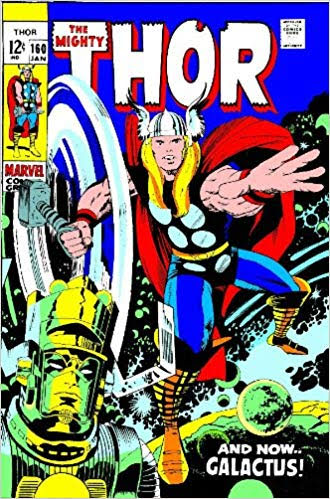
This extra-thick volume includes issues 137 to 166 of the original Thor comic. These stories were published from 1967 to 1969. The story starts with Thor admiring fellow Asgardian deity Sif, who takes over as his romantic interest now that Jane Forster is out of the picture. The origin story of Thor (which is recounted in this book) has Thor banished to Midgard (that's Earth to us Earthlings) with amnesia by Odin, the main god and Thor's father. Thor shows up as Donald Blake, a medical student with a bum leg. He graduates from medical school, has a successful practice, and learns humility and service for others along the way. Blake takes a vacation in Europe and winds up in a cave where he finds a walking stick that, once struck to the ground, turns Blake into the Mighty Thor.

In these issues, he faces a good variety of opponents and challenges. Loki, Norse god of mischief, is a key background player. He endows the Wrecker with magical power at a time when Thor is deprived of his divine power, so the battle is close, but naturally Thor wins. He also faces Galactus (a world-devouring giant), the Ringmaster (a criminal mastermind who runs a carnival as a front), Kang the Conqueror (a time traveling villain), and the Super-Skrull (a Skrull who has all four powers from the Fantastic Four), among other villains. He also faces the loss of his powers because he's not obedient enough to Odin; the kidnapping of his girlfriend more than once; and a short stint in jail(!). Through his persistence and courage, he manages to win out every time.

The stories are interesting but have a particular style. Sif is a goddess and warrior who does a lot of fighting, but she's also an object of affection for Balder the Brave (another Asgardian hero). The situation is not so much a love triangle as an unrequited love on Balder's side. Sif is probably too self-assured and aggressive for stereotypical modern-day conservatives and too protected and submissive for stereotypical modern-day liberals. A lot of the dialog is pseudo-Shakespearean, with nods to the King James translation of the Bible thrown in. The style is fun but it gets a bit thick at times. Reading it once a month rather than back to back might make it easier. The outfits look a little weird. I understand they are supposed to be otherworldly but the minor characters look a bit blocky and awkward. Sif and Balder have caps that look dorky by modern standards. The action sequences are fun and have a good variety. Thor doesn't always win by brute force; sometimes he uses his wits too.

A set of thirty comics is bound to have better and lesser stories but overall I found these enjoyable if quaint.

Slightly recommended.


Thursday, September 13, 2018

Book Review: Ant-Man/Giant-Man: Growing Pains by S. Lee et al.

Ant-Man/Giant-Man: Growing Pains written by Stan Lee, Steve Englehart, George Perez, and Christos Gage with art by Jack Kirby, Don Heck, George Tuska, Jeff Moore, and Tom Raney


This anthology of stories focuses on Hank Pym, the scientist who discovered Pym Particles and was the original Ant-Man. The first story reintroduces him as Giant-Man--he uses the particles to make himself bigger rather than smaller! In the second story, he renames himself Goliath. In the third story he's going by the moniker Yellow Jacket. In the fourth and fifth stories, he's back to being Giant-Man (with occasional moments of being ant-sized if not Ant-Man).

In case you didn't deduct it, Hank Pym is both a brilliant scientist and a man suffering from a massive insecurity complex. So he has to fight both super-villians and his own feelings of inadequacy and self-doubt--often at the same time. The balancing of the two is hard to do from a story-telling perspective. The fourth story is the longest (a four-parter, the rest are single stories) and most successful at telling a story that combines outer conflict and inner conflict. Hank is working with a partner to use a variant of Pym Particles to end world hunger. Some side-effects cause monstrous insects to appear and various other characters exposed to Pym Particles (like The Wasp and second Ant-Man Scott Lang) to have serious difficulties with their powers. The overall problem is labyrinthine and eventually Hank Pym figures it out, but not until he's gone through a lot (including a stint in a straight-jacket).

Mildly recommended-the book is interesting but full of hits and misses.