Thomas Jefferson's Monticello is the home Thomas Jefferson built just outside of Charlottesville, Virginia. He built it in 1773 following the neoclassical designs popular at the time. The site has been declared a
UNESCO World Heritage Site, along with nearby
University of Virginia, which was also designed by Jefferson.
 |
| The house |
The house is part of a plantation where Jefferson grew cash crops. At first the main crop was tobacco; wheat took over later. Jefferson inherited the property from his father. He also inherited most of his slaves. Near the parking lot, archeologists discovered an African American burial ground with over forty graves.
 |
| The African American burial ground |
The house is situated on top of a hill ("Monticello" meaning "little mountain"). A modern visitor center is located lower on the hill by the parking area. Visitors can buy tickets, get food at the cafe, visit the shop, and see a movie about Jefferson's life.
 |
| Plaza of the visitor's center |
Just down a staircase is the Griffin Discovery Room, an area where children can get a hands-on experience of what life was like on the plantation.
 |
| Going down to the discovery room |
Jefferson was a bit of a scientist, inventing many things he needed to make life easier or to accomplish specific tasks. He made a cipher wheel to send encoded messages.
 |
| Trying out the cipher wheel |
Sometimes he wanted to send duplicate letters and invented a device to write two letters at once! He called it a "polygraph," but that name has been taken over by
a more modern invention.
 |
| Twice as much scribbling in the same amount of time! |
The room also had some recreations of plantation jobs, including a nailery where they made nails. After trying out many things, my daughter also tried out the bed, which was cosy.
 |
| After a hard day's work |
We took a shuttle up to the house for our tour. The view from the top was quite nice.
 |
| View of the mountains |
 |
| East Walk to the house |
 |
| Side view of the back of the house |
The house also incorporated several inventions and clever devices to make life easier for the family. The wind vane on the roof is fairly typical. To make it easier to read, even on rainy days, Jefferson had the shaft of the vane go down through the house to the porch ceiling, so he could look up (or even just outside the door) to see the wind's direction.
 |
| Weather vane |
 |
| Outdoor ceiling fixture! |
We weren't allowed to take pictures during the inside part of the tour, but we did see the main floor. The dining room features a dumbwaiter built into the mantlepiece for delivering bottles of wine from the wine cellar! The library room still has some original books that Jefferson owned, behind protective glass.
Back outside, we saw the cistern that held water for the house.
 |
| Cistern |
The grounds have many flower gardens. Since we visited in April, many blooms were in full glory.
 |
| Flower bed |
 |
| West lawn |
On the north pavillion of the house, a small gap in the tree cover shows the University of Virginia.
 |
| Kid holding UVA photo |
 |
| UVA in the distance |
 |
| More beautiful flowers |
Just behind the north pavilion is a small farm shop with more children's activities. A popular one was writing with a quill pen. All of our children tried it out. After writing with the wet ink, the paper needed to dry. A clothes line was set up for hanging writings and drawings. We dutifully hung the children's up to dry and forgot to come back and pick them up later.
 |
| Trying the quill |
 |
| Using an old shirt for protection |
 |
| "Wait, I could have had ice cream!?!" |
 |
| Drawing |
A wash house is at the end of the north pavilion. Now it is the home of an orrery. It shows the relative position of objects in the solar system. The kids loved looking at this (and being out of the hot sun). Jefferson had one to help in his astronomical observations.
 |
| Explaining the orrery |
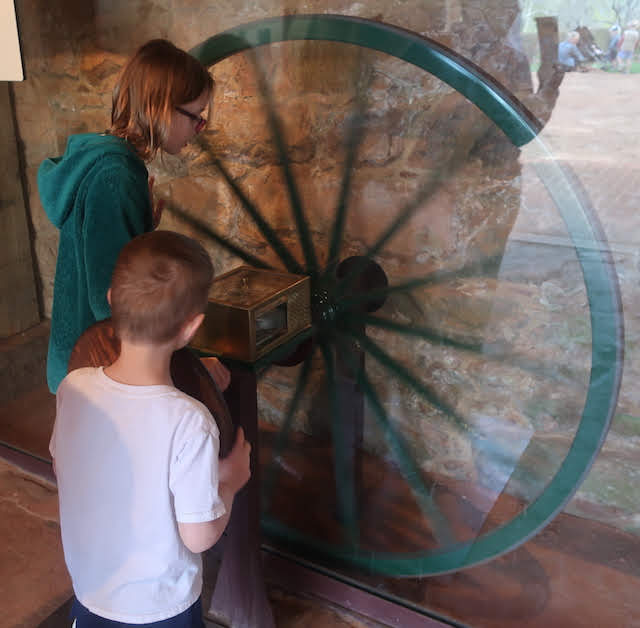
The north pavilion was also the storage area for carriages and the stables for the horses. One carriage is still on display.
 |
| Carriage |
 |
| Demonstration wheel |
The ice house was right nearby. Ice was stored there in the winter and used to keep meat and dairy products fresh, as well as to make ice cream in the summer. Sometimes the ice would last through a whole summer!
 |
| Ice house |
A privy is also located at the near end of the pavilion, so people could take care of business before heading into the house.
 |
| North privy |
We told the kids that the north cellar passage was a secret tunnel underneath the house. They were excited to explore.
 |
| Secret passage! |
More on this in the next post!




 Posts

