Showing posts with label Stuttgart. Show all posts

Friday, April 19, 2013

Our Stuttgart Hotel (and Surroundings)

Our hotel in Stuttgart wasn't really in Stuttgart. More of a suburb. The area had a few hotels and two major entertainment centers, as well as a train stop for convenient travel without a car.

Our hotel was the SI-Suites, which has spacious apartment-style rooms. We had a small kitchen (refrigerator, sink, and microwave), a large dinner table, two bathrooms and a nice view of some park area.

SI Suites, Stuttgart (sort of)

View from our window

The entertainment complexes include several restaurants and bars, a movie theater, and two live theaters. Musicals seemed to be the order of the day when we were there. The movies had Les Miserables and the two theater shows were Mamma Mia! and Sister Act. We didn't get to see any shows.

We did find an underground tunnel that went from our side of the road to the train station's side of the road. It was a little spooky with black lights and funny patterns projected on the walls. J and L loved it.

Spooky floating balls

Watery blue lights

The underground fountain, with a black and white movie showing

On our last day, J was feeling poorly and I had to go find medicine. The weather at this point was sub-zero temperatures with a harsh wind. I walked to the local grocery store but the only medicines they had were herbal homeopathic stuff. So I walked back to the hotel to ask the front desk for a pharmacy. They found a few in the nearby town and printed out a google map for me. A pharmacy in Germany are called an "apotheke." So I walked back past the grocery store further into town. Finding the apotheke wasn't hard. Inside, the only items available for browsing were cosmetics. All the medicines were behind the counter. I wanted the equivalent of Children's Tylenol (the active ingredient is acetaminophen). My wife looked it up online and in Germany acetaminophen is called paracetamol. The pharmacist (or apothecary, I suppose) spoke a little bit of English and I was able to communicate my need. She asked if I wanted a liquid-based or suppository. I chose the liquid. It wasn't too expensive, only 4 euros.

On the walk I saw a cool ramp at one of the train stations and a helicopter!

Stroller/Wheelchair-accessible stairs!

What is that helicopter doing up there?

Back at the hotel, J would barely take the medicine. It was a tough morning, but soon enough we were off to the airport. Luckily, we had already planned to check a bag so we didn't have to throw away the rest of the paracetamol. Getting through security was pretty easy, but the other side of security had some interesting items.

Stuttgart International Airport is actually Stuttgart Interplanetary Airport

Backgammon with chocolate pieces! I guess you only play once.

The flight was uneventful and we made it home safely. It was a great trip.

Thursday, April 18, 2013

German Food 2013

On our trip to Germany we had some delicious food. Our favorite restaurant (since we went there twice) was the inaptly named Schlossturm, which means "Castle Tower" though it was actually one story underground. Maybe the castle was buried? Anyway, the food was really good, with waiters and waitresses dressed in traditional German garb. We didn't get any pictures of the clothes but we did of some of the food.

Pig's knuckle with dumplings and sauerkraut

J, me, boiled sausage, yummy pretzel

L with spatzle

J and Allison have good times!

Medieval-looking wall decorations

We also bought some pastries from a local bakery and chocolate shop.

Chocolateria, much better than a cafeteria

Pretzel roll, berliner, pretzel

When I saw the berliner, a type of jelly donut, in the store I had to get it and try it. I've heard the probably apocryphal story of when U.S. President John Kennedy gave a speech in Berlin during the Cold War and at one point said, "Ich bin ein Berliner." He was saying he was a Berliner, like the crowd in front of him, showing his solidarity. Some people thought he was claiming to be a jelly donut, perhaps making a joke or a faux pas. I give little credence to this story, so little that I am not bothering to check it at snopes.com or anything.

We ate lots of wonderful food. Unfortunately, the trip was during Lent when I had given up drinking beer, so I am unable to report on any wonderful beers I would have had. I'm sure we'll have another Germany trip before too long!

Tuesday, April 16, 2013

Junges Schloss at Altes Schloss, Stuttgart

By dumb luck or Divine Providence (and I don't believe in dumb luck), we happened upon a children's museum while we were exploring the more medieval part of Stuttgart. We wandered over to the Altes Schloss, or the Old Castle, on the Schillerplatz and saw some cheerful signs indicating that Junges Schloss had just opened in September 2012. So we went up the stairs to check it out (as I describe in the last post).

The very first room is where children switch from their shoes to socks. The museum offers especially rugged socks for kids to wear over their regular socks (or if they have no socks, which seems unlikely in March when we visited). The sides of the room have sloping paths with bits of carpeting. J immediately assumed they were obstacles in an obstacle course. He and L were off and running in no time!

Racing through the "obstacle" course

Art house photographic moment on the course

Further on was the main exhibit, all about the Celtic peoples who had once lived in the area long ago. All sorts of interactive exhibits kept the children entertained. The most popular with J and L was the blacksmith's workshop. The sign by the workshop reads: "Irons in the fire. The Celts made beautiful things with bronze, gold and silver. They also knew how to use iron, which in those days had just been discovered. Iron was harder than the other metals they used. Their blacksmiths used iron to make tools and weapons. In order to forge the iron, they needed a fireplace, bellows and an anvil." Yes, they had signs in English!

Working at the forge

Lovely iron works from the good old days

L's favorite thing was to use the hammer and anvil to bang a sheet of metal flat. The museum provided little sheets of high-grade aluminum foil, some of which were gold foil. She'd happily shape her metal all day if I let her.

Another popular spot was the cooking pot. The long wooden spoons attach to the pot with little magnets. A large pile of plastic cards listed the various meats and vegetables we could add to the stew to make a fine supper.

L can feel the yummy dinner in her tummy already!

J has a hard time deciding which ingredients to add

Uh-oh! Wrong one!!

They also had a maze that resembled a forest. At least, that's what J called it after he explored it once. He went through several times while L was working in the smithy.

Overview of the maze

L eventually came away from her work and tried out life as a soldier.

L, Celtic Warrior

Further down was a room simulating a town's wall. L set to work on the wall as well.

Just one more panel to finish!

L is too busy choosing bricks to smile for the photo

The room had some rocks to climb on, which quickly turned into a "king of the mountain" game for the children.

L is queen while J begins his ascent

King of the Mountain in his red museum socks!

Pretty soon the call of lunch time drew us away from the museum. Luckily they had a handy horn for calling people far and wide.

Horn o' the beast

We heartily recommend the Junges Schloss at the Altes Schloss!

Monday, April 15, 2013

Schillerplatz, Stuttgart, Germany

One of the most picturesque spots in Stuttgart is the Schillerplatz. The plaza is supposedly the location of the 10th century stud farm that gave Stuttgart its name. The plaza has a definite medieval feel about it. We came to it from the Stiftskirche which we had just visited.

In the middle of the plaza is a statue of Friedrich Schiller (18th century poet, philosopher, historian, playwright, friend of Goethe) by Danish sculptor Bertel Thorwaldsen. The statue was erected in 1839 and is now a fun spot for kids to climb.

Friedrich Schiller statue

L poses

The Old Chancellery (built in the 1540s) now has a restaurant downstairs and another statue just outside the plaza.

Old Chancellery, with outdoor seating for its restaurant!

Other side of the Chancellery

On the east side of the plaza is the old castle or Altes Schloss. The Wurttemberg's castle burned down in 1311 and the family moved to Stuttgart. By 1325, they expanded this small castle into a larger residence. The real overhaul came in 1553-1578, with a Renaissance remodeling, including the square courtyard and the first chapel built specifically for the Protestants.

Entrance to the Altes Schloss

Schloss courtyard

Courtyard statue

The castle is now home to the Wurttembergisches Landesmuseum, which has a lot of folk art from past centuries. At the top is a new exhibit aimed at children. We bought our tickets downstairs. I went to the elevator but J asked to take the stairs. I'm glad we did, because the staircase was a wide, tall, covered passage that seemed large enough for a horse and rider to go up and down. The walls had some interesting art.

Taking the stairs

Some people going down

A family crest, probably the Wurttembergers

We did see one or two things in the museum on our way to the Junges Schloss exhibit, including this toy duck.

Toy Duck on display

Next post, we will see the children's museum.

Sunday, April 14, 2013

Stiftskirche, Stuttgart

On the Schillerplatz is a Protestant church dedicated to the Holy Cross, a collegiate church of stiftskirche as the locals say. This 15th-century church includes some of the walls from the pre-Gothic church it replaced. The church was substantially damage during World War II but still retains much of the early decorations. The style has been altered to a more modern aesthetic, the blending of old and new is not as smooth as one would want.

The exterior is quite impressive still. The west tower (with the clock) was completed in 1531 at a height of 61 meters.

Stiftskirche, Stuttgart

View from the Schillerplatz with J

A small balcony on the side of the church above the Apostles' Gate

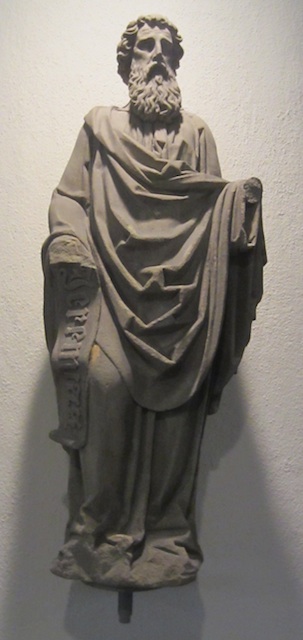
Christ and His twelve apostles surround a small balcony. The figures are from 1494 but had been moved after World War II when the south wall was rebuilt.

Moving inside the church, the nave is open and airy and very modern looking with occasional bits thrown in from the history of the church.

Nave

Main altar and pulpit

Angel on the pulpit column

The altar, though it looks primitive, was built and installed in 2003. An angel of justice looking on from the pulpit column dates from 1957. He seems like he's ready to blow his horn if anything goes wrong.

Of course the real guardian of what comes from the pulpit is Johannes Brenz (1499-1570), buried in the church and memorialized by this epitaph.
 
Epitaph of Johannes Brenz

He was an early Reformer who studied in Heidelberg where he met Martin Luther. He was persuaded by Luther's teaching and had a successful career as a Protestant preacher and theologian. It's said he was laid to rest next to the pulpit so he could leap up and correct any deviations from Bible teachings.

Some of the other wall decorations come from the original choir screen, as this montage from the gospel infancy narratives.

Nativity, Visit of the Wise Men, Presentation in the Temple

Annunciation, Meeting of the two pregnant women (Mary and Elizabeth)

The high altar in the front has some fantastic stained glass dating from the period immediately after World War II.

Choir with sculpture of Wurtemburgs

Front pulpit with carving

The carving next to the pulpit is the tombstone of chancellor and collegiate provost Ludwig Vergenhans, who helped to found the University of Tubingen in 1477. He died in 1512.

The statues of the various counts of Wurtemberg dates from the late 1500s and represents all of the counts buried in this church. The statues have armor accurate to their period.

Counts of Wurtemberg

Closer detail

Another tomb in the church is a table tomb of Count Albrecht of Hohenlohe who died in 1575 during a tournament accident.

Table tomb of Albrecht of Hohenlohe

To the right of the central altar is the Founders' Chapel, where Count Ulrich and his second wife Agnes are buried. They died in 1265. Their tomb survived the ravages of time and wars and this is the oldest gravestone in the church.

Tomb of Count Ulrich and Agnes, 1265

Wathcing over them is a Renaissance-era memorial to house steward Hans Herter von Hertneck, who was a church advocate in Sulz.

Tomb of Hans Herter von Herneck

By the entrance to the church are two pillars installed after World War II to stabilize the clock tower. Two 18th century sculptures were added, the prophets Jeremiah and Daniel.

Daniel

Jeremiah

Above them is the organ.

Church Organ