Showing posts with label barn. Show all posts

Tuesday, September 22, 2026

Woodlawn Manor Cultural Park, Maryland

Woodlawn Manor Cultural Park was a historic farm in Montgomery County, Maryland. Doctor William Palmer built the house in the early 1800s and ran a farm here. The family also ran a boarding school for a while. Francis Scott Key, writer of the American National Anthem, visited several times since his daughter was enrolled there. The construction of the manor house follows the Federal style popular then. Tours are available on the weekends, but I visited on a weekday. 

Woodlawn Manor

A double side porch!

The back of the house

Lawn with gazebo but not much wood

Fairly soon after building the manor house, Dr. Palmer had the Stone Barn constructed. It is a large, multi-level structure that houses the on-site museum (which was also closed). It is one of the most impressive barns in the area.

Stone Barn

The back of the barn

Another view of the back

Several of the minor outer buildings are still extant. A smaller stone structure, thought to be a springhouse or meat house, is just behind the manor house. Possibly it served as the kitchen back in the days when a hot and hazardous kitchen was kept separate from the main house, to prevent summer overheating and the spread of a fire. 

Too small to be another barn

A board and batten tenant house and a log building may have served for the school and for the enslaved farm workers. The tenant house has a statue nearby. "The Inner Light" by Marcia Billig is a bronze sculpture installed in 1988. A Quaker woman holds a child up who has a bird landing on his upheld hand. 

Two nearby structures

"The Inner Light"

The carriage house has been turned into the visitor center for the property. Happily, the bathrooms were open to the public even if the center wasn't!

Carriage house

The property is part of the Rachel Carson Greenway. 

Rachel Carson Greenway sign

This particular part of the greenway is also the Underground Railroad Experience Trail, which we visited a while ago (see the blog post). The nearby town of Sandy Spring had large Quaker and African-American populations. Thanks to their religion, most Quakers freed their slaves, resulting in a large free Black community in the area. African Americans owned and worked on farms, ran schools and churches, even the local Odd Fellows Lodge. All of this made the area a natural path for escaped slaves to find assistance on their way North to freedom. 

Underground Railroad Experience Trail

The Montgomery Police department have a training facility here as well. There are no visiting hours there!

The forbidden zone

Thursday, September 24, 2020

Underground Railroad Experience Trail, Montgomery County, Maryland

The Underground Railroad Experience Trail is located in Montgomery County, Maryland. It starts at the Woodlawn Manor Cultural Park, which has some historic buildings of the sort we'd usually visit but they were closed for the pandemic. We will probably go back to visit again in more amenable times.

The trail is outdoors with signposts identifying various features and giving history of the area. The trail begins at the Woodlawn Manor and Barn.

The start of the trail

The home was built in the early 1800s by a Quaker family named Thomas. Dr. William Palmer got the house in 1822 and had Isaac Holland built the stone barn in 1832. Palmer was a Quaker but his membership was revoked because he used slave labor at the farm. The barn is now a museum.

Across the road is the beginning of the trail, a wide greenway next to some horses.

Horse pasture

Guidepost

Having a snack

Can they share?

The next posted spot on the trail is the entrance into the woods. Escaping slaves would use the woods rather than open fields as they headed north on the Underground Railroad. The sign said that slaves often ran at Christmas, if they had some time off from work and would not be missed for a few days. Another good time to run away was during rain storms. The rain covered over the trail by erasing both the tracks and the scents that dogs would follow.

The woods

The only drawback to the woods was obscuring the sky. The stars were handy for finding the way north.

Explaining the value of the woods and sky

Further on we discovered a geocache named Happy Hauntings, presumably because the history of the area probably has some tragedy involved. We spent time searching and then gave up. On our way back to the main trail, we came upon the cache!

In there somewhere

Back on the main trail

The next postmark is a bramble patch. Fleeing slaves would hide in such patches or under thorny bushes. Pursuers like dogs, horses, or men avoided such spots.

The brambles

A nearby bridge

We found a bench on which we took a little rest.

Relaxing

Another sign warned of a hazard along the Underground Railroad--crossroads! Moving stealthily through the woods might disorient the traveler, especially when the markings for the trail are hidden. Going in the wrong direction could turn into a big mistake!

Crossroads

Another spot in the woods had two features. First, a hollow tree makes an excellent hiding spot, especially at night. A small fire would only be visible from one direction. It's also good for hiding supplies or food. The stone in front of the tree marks the boundary between Woodlawn Manor and Snowden's Manor.

Tree and stone

My son doesn't know what side to be on

Further down the trail we came across a blocked part of the trail. We assumed some storm damage washed away the trail, making it hazardous.

A blocked path

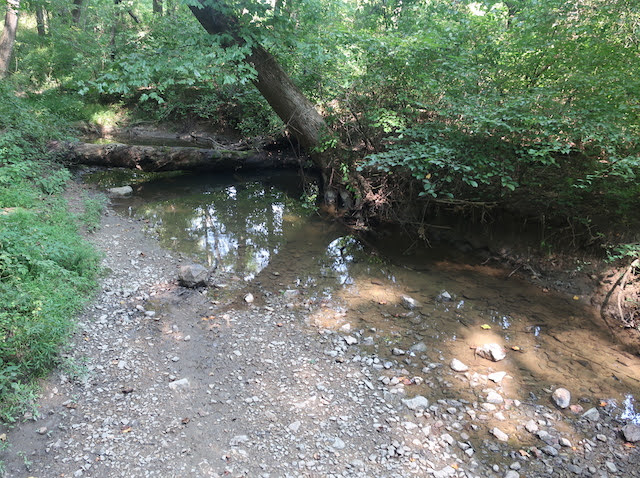
A period bridge is built over a small creek. Slaves might not be able to swim, turning a large creek or river into an impassable barrier. It was important to know where bridges and fords were located. 

Bridge across troubling waters


Actually, not so troubling waters

Another hazard was an open farm field. Being exposed in the open was not safe. The only time a farm was safe was when the crops, like corn or tobacco, were tall enough to hide people.

An open field

Walking down the field's trail

At the north end of the field is The Sandy Spring, for which the town of Sandy Spring was named.

Entrance to the spring

The spring itself

The arch over the spring has the date 1745, the year that the local Quakers formed the Sandy Spring Friends Meeting.

The area also has some benches.

Bench

An old road leads north to the meeting house (a newer one stands at the end of the road).

A road north

The end of the road also has a housing development. Just on the edge of the development is the Champion White Ash Tree. The tree is estimated to be 300 years old, dating back to the time when the first residents cleared the land and founded the village of Sandy Springs.

Champion white ash

The top of the tree

The memorial stone

View from the tree

The trail was not a loop, so we had to walk all the way back to Woodlawn Manor. By the time we got back, new horses were out in the field!

New grazers

A view to the farm

The visit was fun and educational.