Showing posts with label prison. Show all posts

Thursday, June 18, 2026

Easton Maryland Ghost Tour

Last Thanksgiving (that's Thanksgiving 2025 for any of you reading this long after it was published) we went to Maryland's Eastern Shore for the extra-long weekend. We had booked a ghost tour for Friday night but the weather was awful and a couple of us were sick. The company was gracious enough to let us reschedule, so I picked a date at the end of the school year when the kids were supposed to have a half-day of school. That meant we could leave home early and be on time for our appointment. So we had a mini-vacation that featured the tour (finally).

Eerie Echoes of the Eastern Shore: Easton Ghost Tour starts at the Talbot County Free Library. When we arrived, we saw our guide coming toward us holding a lantern. The tour started by the library, which has a haunted item inside. Patty Cannon was an Eastern Shore resident in the late 1700s and early 1800s. She was also a serial killer. Her story was recorded, well, embellished in a book called The Entailed Hat, or Patty Cannon's Times. The library has copy 496 of the 500 printed in the initial run. The book is in an atmosphere-controlled room under glass. A librarian once touched the book and her fingernails blackened and fell off. Our tour guide had the opportunity to touch the book and was quite nervous about it. They didn't even offer her gloves! Her fingernails were okay, though.

Talbot County Free Library

Back to Cannon's story. She ran a kind of anti-Underground Railroad. She had a home where she hosted travelers. She had a freed black man as a compatriot who would encourage escaped slaves to seek shelter in her home. But then she would chain them and threatened to sell them down south. She did not restrict her crimes to black people. If rich people came, like slave traders, she would often poison them or have them shot and then steal their money. She buried a lot of people in her basement and some in the yard as well. Once, a man was traveling by and his horse got stuck in a hole outside her house. He started digging to get the horse out and discovered human bones. He got the sheriff who arrested Cannon. She wound up in jail for two weeks and then died from poisoning before going to trial. Did someone try to take a short cut to achieve justice? Did she off herself to avoid the coming ordeal? No one really knows.

Across the street from the library is the old prison. Easton was originally called Courthouse Town, because it had the only courthouse on the Eastern Shore. It was inconvenient to take criminals across the Chesapeake Bay to Annapolis or Baltimore, so this was a nice solution. The prison at one time housed Frederick Douglass, the famous freed slave who spoke about his experiences all over America and beyond. In the Easton jail, he was threatened with return to his owners. Slave traders would come and taunt him. The building was rebuilt in the late 1800s, including the installation of an elevator. The elevator is said to be haunted, traveling between floors on its own. A woman in a blue dress sometimes rides the elevator or walks the halls of the prison. The guide said it might be the wife of one of the jailers (who lived on the first floor of the jail), or it might be a prisoner.

The town's prison (at least it used to be)

Across the street is a fine restaurant that used to be a hotel. The hotel was on the carriage route and not far from the railroad that came later. With its proximity to the jail, a lot of disreputable types stayed there. Those were the men who taunted Douglass. The building has the usual haunting problem--upstairs lights, the sounds of people walking around when no one is there, the sounds of chains.

Can't stay here anymore

Further up the street is Tidewater Inn, a fine establishment that hosts events and has had many famous people stay there, including the likes of Elvis, Bing Crosby, and John F. Kennedy. The hotel, with so many patrons and such a long history, has its own ghosts. Staff don't linger long in the basement because they can often hear the sounds of a party--old-time jazz music and clinking glasses and the hubbub of the hoity-toity. They also have a haunted elevator, this one with a woman in a yellow dress who folds her hands in prayer and disappears when the elevator doors open.

Tidewater Inn

Across the way is the Avalon Theater. The theater served as a movie theater but is now a performance venue. It too has a haunted elevator. A young actress sometimes gets off and vanishes. An actress was murdered in the theater with her body discovered in the elevator. The building owner once spotted the ghost. Later, he saw a picture of a line of actresses and recognized one of them as the ghost he had seen. The upstairs bar has also had some odd activity with knives. A bartender once brought his young daughter to work and left her by the bar while he went on an errand. He came back to find her terrified and a large knife plunged into the bar. She was ten or twelve and would not have had the strength to impale it so deeply. Another worker was surprised when a knife flew behind her head while she was working alone at the bar. Our guide speculated it might be the ghost of the fellow who murdered the actress.

Avalon Theater

Our final stop was at Thompson Park. The guide told us about seven different fires that happened over the span of 150 years. Each fire burned down one or two blocks of the city with no fatalities. Another circumstance that holds the instances together is the presence of a woman in a red dress preceding each fire. In the 1900s, someone bought the property and happened to be walking along when a lady in red passed and said this would be a good area for a park. Not knowing the history of the fires, the owner considered the idea and went ahead with it. There have been no fires since.

The park in daylight the next day

The tour guide took our photo

So the moral of the story for this ghost tour is clear. Don't ride elevators in Easton and avoid women in anachronistic dresses, especially when they come out of an elevator (which you should have avoided in the first place).

Thursday, August 22, 2024

Alcatraz

While in the San Francisco area, we visited Alcatraz, the most famous jail in the world. It's now owned by the National Parks Service, though they don't run the ferries out to the island. We used City Experiences to get there. On Pier 33, the launch point, they have a large model of the island we were about to visit.

The far side of the island/model

More of the model

The long view

The ferry was a fun, quick ride. We rode in front which normally would have wave hazards but the bay was fairly calm.

My kids on departure

The top of the bridge is in the clouds!

The bay was still windy

A good view of the island from the boat

Housing and the prison at the top

Since the island has almost no natural resources (they have to ship in potable water!) and bad weather can make the boat ride challenging, the people who worked at the prison lived there too. Later on in this post, well see what's left of the warden's house.

From 1850 to 1933, the island was occupied by the United States military and used as a fort to protect San Francisco. The entrance was heavily guarded, though the watch tower is from the prison era (1933 to 1963).

Watch Tower

The main way in from the dock

A canon aimed to repel invaders

Fresh water tower

One of the buildings was turned into a mortuary for the prison, though very few prisoners died while incarcerated, even though a lot of them were "lifers."

Mortuary

The prison tour features an audio guide (in multiple languages). My brother-in-law worked for the audio guide company back in the day and stayed on the island, providing background noise like prisoners shouting and stuff. 

Prison entrance

The audio guide walks visitors through the incarceration experience. The first room is the shower room, where prisoners got their prison clothes and had to shower in front of everyone to make sure they weren't smuggling anything in.

Shower room

The prison had four cell blocks, A through D.

Hallway between blocks B and C

All the prisoners had individual cells, ten feet deep and four and a half wide. They don't provide much space considering the bunk, toilet, and sink using up a lot of room. Of course, the inmates had minimal possessions, so they didn't need a lot of space.

A typical new cell (toilet missing!)

The end of the blocks by the entrance to the cafeteria was called Times Square. 

Times Square

Another famous spot (that we were not able to visit) is the recreation yard. Prisoners would spend a few hours outside. They would play sports or games or just hang out in the sunshine (if there was any). 

Picture of the yard

D Block was the solitary confinement area of the prison. Any misbehaving prisoners were moved here. Some of the cells were completely sealed off from daylight, making time served there very difficult.

Door to D Block

Regular cells on D Block

A typical cell

Famous inmates (Al Capone on the far left!)

The "no light" cell

The prison had a library. Convicts could read magazines or books, sometimes getting a better education than they received on the outside.

No more books in the library

Inmates worked at menial jobs at the prison and made menial salaries. They could spend the money on cigarettes (though they received a couple of packs each week regardless of whether they smoked or not) though many inmates took up hobbies like painting or playing musical instruments.

A cell for a painter

The prison did have an area for visitors to see prisoners. The windows are very small and allowed no physical contact.

Visiting area

Only four bays for visitation

Some of the cells are more decorated with what was typical back in the prison years. A cell is made up like Frank Morris's. He's the guy who lead two other prisoners in an escape in 1962; they were never found. The cell shows the hole in the vent and a fake head used to fool guards into thinking he was still in his cell.

An escapee's home

The final stop on our inside tour was the cafeteria. This room was one of the most dangerous in the prison. The inmates had utensils and they were all together in a close space. A handful of guards would be in the room. The walls had tear gas canisters attached in case a riot broke out (though the handful of guards would be out of luck!). The cooking area is behind bars and the set of larger knives was hung with silhouettes behind them so the cooks could know if any potential weapons were missing.

In the cafeteria

Knife rack

As I mentioned earlier, Frank Morris and two other inmates "disappeared" from the prison in 1962. The next year the prison was closed without much fanfare.

Photo of the last day

The exhibit just before the gift shop provides information about prisons and prison populations in the United States and abroad. They also discuss various laws and show some "tools of the trade." 

Handcuff technology through the ages

Wants his sister to stay

Outside, the landscape has pockets of flowers and vegetation, brightening up an otherwise dreary island.

Roses of Alcatraz

More flowers

The administration building has some exhibits on the guards and other workers on the island.

Entrance to the Admin building

Guard's uniform

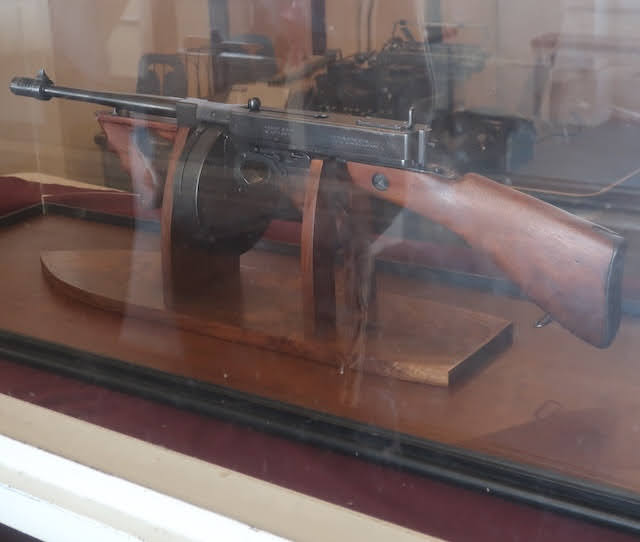
 A Thompson sub-machine gun (popularly known as a "Tommy gun") is on display with an ad that claims "It's the safest gun to shoot in city streets!".  

"Safe" if you are holding it

The administration building give a good view to the city.

View of San Francisco two miles away

Mom and son

Right by the administration building is the lighthouse and the warden's quarters. The home was originally for the commander of the fort then used by the warden. It has not been maintained. 

Lighthouse and warden's house

No entry allowed, just like in the prison days!

Another angle on the warden's house

A small garden by the warden

On our way out of the island, we got another view of the watch tower and I saw a cool passageway that sneaks around the house with the canon.

Didn't Dirty Harry blow that up?

Follow that costumed docent!

The island is also famous because it was occupied by Native Americans in 1969 for nineteen months. They were protesting the U.S. Government's treatment of their people.

Alcatraz is a fascinating place to visit.