Showing posts with label satire. Show all posts

Friday, September 18, 2026

Movie Review: Galaxy Quest (1999)

Galaxy Quest (1999) directed by Dean Parisot

"Galaxy Quest" was a canceled science fiction television show that looks an awful lot like Star Trek. The actors still go on the convention circuit, where they sign autographs and answer arcane technical questions that obsessive fans have. At one convention, lead actor Jason Nesmith (Tim Allen) shows up late yet again, a habit annoying to everyone else. Two other things happen at the convention. In the bathroom, Nesmith overhears some people making fun of him and the Galaxy Quest fandom as nerds who are completely pathetic. Second, Nesmith is approached by what seems like a quartet of cosplayers who beg him to come to their homeworld and save them from an oppressor. He assumes it is some gig he is scheduled for and demands a limo pick him up tomorrow. They come to his house with the limo, then take him into space to help with their negotiations. He still isn't quite sure what's going on (partly because he is hung over) and blusters his way through, firing all weapons at the baddie. They send him back to Earth in a gel pod, which is when he realizes he was actually in space and the "cosplayers" are real aliens who think he and the other actors are intergalactic heroes. Nesmith has a hard time convincing the other actors about what happened until they all get sucked up into space to help with a second round of negotiations.

The movie does a great job spoofing Star Trek in its entirety. The TV show has the cheap look of a 1960s production with the typical diverse crew including an alien first officer (played by Alan Rickman). That actor is tired of the role since he used to do Shakespeare and has a lot more self-importance than everyone else. Rickman and Allen are great together. Sigourney Weaver plays the female lead who is in the show more for fan service than for checking a diversity box. Tony Shaloub and Sam Rockwell also give great performances in lesser roles. The premise is a bit bonkers but very entertaining, doing a good job balancing the satire, sci-fi, and action. The movie is so much fun and easily rewatchable. It's both a science fiction and comedy classic.

Highly recommended, even if you aren't a Star Trek fan.

Friday, September 8, 2023

Movie Review: Murder by Death (1976)

Murder by Death (1976) directed by Robert Moore

Five world-famous detectives are summoned to the isolated mansion of Lionel Twain (Truman Capote). Twain challenges them to a battle of wits--someone will be murdered at midnight and anyone who can solve the mystery by morning will get one million dollars. Twain wants to defeat them all to show that he is the greatest criminologist in the world. The detectives include familiar though renamed fictional detectives: Sam-Spade clone Sam Diamond (Peter Falk), Hercule-Poirot facsimile Milo Perrier (James Coco), Miss-Marple mimic Miss Marbles (Elsa Lanchester), Nick-and-Nora doppelgängers Dick and Dora (David Niven and Maggie Smith), and Charlie-Chan copy Wang (Peter Sellers). The emphasis is entirely on comedy as the cast moves through a lot of standard murder mystery situations, unpredictable plot twists, and low-brow comedy.

While the Neil Simon script is funny and a clever send-up of classic detective fiction, it has some problems. It both complains about and features overly-complicated plots with nonsensical twists and endings that are impossible to guess, much less deduce. Viewers need to be at least somewhat familiar with the characters to get some of the jokes. Sellers' stereotype-inspired performance does not fit with contemporary sensibilities (not on the level of Mickey Rooney in Breakfast at Tiffany's but in the same neighborhood). On the other hand, the movie is very funny and is just an excuse to poke fun at classic detectives and the genre. I did laugh a lot. I probably shouldn't have thought a lot about it.

Mildly recommended.

Friday, January 28, 2022

Movie Review: Don't Look Up (2021)

Don't Look Up (2021) written and directed by Adam McKay

Two astronomers, one a teacher (Leonardo DiCaprio) and one his grad student (Jennifer Lawrence), discover a comet that will hit the Earth is six months and fourteen days. After getting extremely stressed out, they take the information to the White House. They have to wait for over a day since the president (Meryl Streep) is dealing with other important issues. She's trying to get a Supreme Court nominee through the Senate even though the nominee is plagued by scandal after scandal (the most innocent being he was a nude model). Also, she needs to lead her party through mid-term elections. When they finally meet, she does not take it seriously nor does her chief advisor (who is also her son (Jonah Hill)). The astronomers go to the press to get the word out. The grad student's boyfriend works at a prestigious New York paper. Before the article comes out, the astronomers are booked on a popular morning talk show where the presenters always try to be upbeat. The teacher can barely talk on television and his student is angry and upset, making her a poor fit for the talk show or convincing the viewers of the gravity of the predicament. Their appearance goes badly and the story spirals out of control as various people try to capitalize on the situation, including a cell-phone company entrepreneur (Mark Rylance) who is part Steve Jobs and part Andy Warhol. 

The satire in the movie works well. They make fun of all sorts of extreme attitudes: the self-defeating anger of liberals, the self-promoting piety of conservatives, the self-unaware pseudo-profundity of creative corporate executives, and the self-centered vacuity of television presenters. The plot meanders a bit and the movie could use some trimming of its two hour, eighteen minute run time. DiCaprio's character goes through an unlikely narrative arc that seems more to serve the plot (and the jokes). Lawrence fares better as the semi-unlikeable Greta Thunberg character. The movie delivers on the comedy in fine fashion, skewering a good variety of people.

Recommended.

As I write (January 2022), this is only available streaming on Netflix.


Wednesday, May 27, 2020

Book Review: The Cyberiad by Stanislaw Lem

The Cyberiad by Stanislaw Lem


This book is a series of short stories featuring two "constructors" named Trurl and Klapaucius. They are robots that build other machines for their own entertainment or at the requests of others. Often, those others are government officials or royal personages, the sort of beings who can pay handsomely for the work. The two robots have many comic misadventures as they try to satisfy customers and to make the customers pay for their services.

The stories are mostly satirical. Rulers want ultimate power (with which they might oppress their people and dodge paying the robots) or fantastic entertainment. Trurl is usually the one to deliver, being both more egotistical and more gullible than Klapaucius. They travel all over the galaxy, like Aeneas in The Aeneid (hence this book's title). They encounter strange worlds (like the square planet with a square sun) and even stranger requests. The comedy has the wit of Jonathan Swift and the whimsy of Douglas Adams and the intellectual bent of Umberto Eco. Lem satirizes ideas from science, philosophy, and literature.

I found the book entertaining, though sometimes Lem goes overboard in making up words or being extremely silly. I laughed out loud a few times and was surprised by the light and comic touch. After reading Solaris, this book gives a very different experience of what the author can do.

Recommended, especially for some Hitch-hiker's Guide to the Galaxy humor taken to an Umberto Eco level.

Sample text, a minor character explaining why it can't impose Universal Happiness on others:
"If I understand you correctly, you wish us to bestow happiness upon everyone. Well, we devoted over fifteen millennia to that project alone--that is, eudaemonic tectonics, of which there are basically two schools, the sudden and revolutionary, and the slow and evolutionary. Evolutionary eudaemonic tectonics consists essentially in not lifting a finger to help, confident that every civilization will eventually muddle through on its own. Revolutionary solutions, on the other hand, boil down to either the Carrot or the Stick. The Stick, or bestowing happiness by force, is found to produce from one to eight hundred times more grief than no interference whatever. As for the Carrot, the results--believe it or not--are exactly the same, whether you use an Ultradeifact, Hypergnostotron, or even an Infernal Machine and Gehennerator." [pp. 266-267]


Friday, July 26, 2019

Movie Review: Frankenstein's Monster's Monster, Frankenstein (2019)

Frankenstein's Monster's Monster, Frankenstein (2019) directed by Daniel Gray Longino


This mockumentary depicts David Harbour (of Stranger Things fame and Hellboy infamy) as he searches to understand his acting father, David Harbour Jr. (also played by David Harbour, who is called "David Harbour III"). Young David has found some old tapes in his mom's attic, tapes of a made-for-TV play called "Frankenstein's Monster's Monster, Frankenstein." Old David is clearly based on Orson Welles, with the oversized ego and the desperate late-career advertising gigs that finance the play. The play has Doctor Frankenstein trying to get financing for his experiments while he pretends to be the monster he created, so that he can convince the financier of his success (the actual monster died before the play started). So the play naturally mirrors the plight of Old David trying to get the made-for-TV play into production.

The play makes no sense, even as a satire of an ego-driven drama. It has really cheap production values meant to make fun of 1970s television, even including the fake sponsors. The mockumentary has Harbour recreating his father's office and interviewing the actors and others from the play, hoping to get insight into his father. The overall show is meant as a comedy and the premise is creative. It would be fun if it skewered the pretentiousness of art house cinema. The execution just isn't funny. Harbour does a passable Welles imitation but it's not enough to carry the rest of the show, which is just bad. It fires at so many targets but fails to take aim, too often missing the funniness by a mile. This was painful to watch. Even the poster (see above) is lazy.

Not recommended.

Currently (July 2019) streaming on Netflix.

Thursday, January 5, 2017

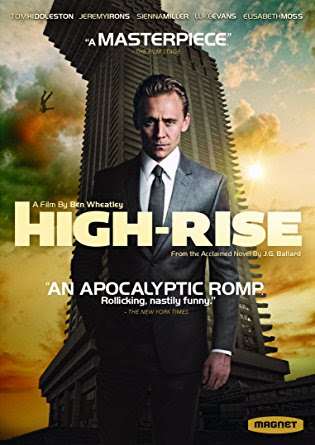
Movie Review: High-Rise (2015)

High-Rise (2015) directed by Ben Wheatley


Dr. Robert Laing (Tom Hiddleston) moves into a new and futuristic high-rise on the outskirts of London in 1975. His apartment is on the twenty-fifth of forty floors. The very top is occupied by Mr. Royal (Jeremy Irons), the architect and owner of the building. He's also constructing four others in the vicinity with a lake planned in the middle. The building has an indoor pool and a grocery store that is used by everybody. The one quirk of the building is that all the poorer, lower-class people live on the lower floors while richer, higher-class people live higher up. Royal's intention is to create a catalyst for interaction and change. While he intends improvement, things actually start to fall apart. Living in the lower floors is Mr. Wilder. He is upset at various injustices and slights he sees--power outages that take longer to resolve down below or the pool being reserved for rich people while children (most all of whom live in the lower half of the building) can't use it. He stirs up trouble. Naturally, Laing is caught in the middle, literally and figuratively.

The movie is based on a novel by J. G. Ballard published in the 1970s as a satire of the coming economic disparity he assumed would happen under Margaret Thatcher. Laing is a bachelor and a doctor of physiology. He keeps himself in great shape and is interested in participating in all the parties both above and below him, as well as the occasional sexual encounter (it is the 1970s, after all). He's a new-comer so he gives the viewer a chance to discover things about the building. The rich people make fun of him though Royal takes a liking to Laing and shares his intentions and desires with Laing. Royal is a figurehead for the rich just as Wilder is for the poor.

Wilder is a social climber who can't get anywhere and resents it. He's a TV documentarian who has been out of work. His very pregnant wife is befriended by Laing (who winds up just taking advantage of her). Meanwhile, the building descends into chaos as the grocery store is cleaned out and the pool becomes a place for the poor people to wash clothes. Power is intermittent throughout the building; water comes and goes as well. The clash between the rich and the poor gets violent several times and conditions get so bad people wind up eating pet food from the store, and eventually the pets themselves.

As satires go, this is very unsatisfying. In spite of the claims that rich and poor are different, they both are cruel and thoughtless to each other and even to themselves. The movie tries to be realistic about the social interactions but the situation becomes so absurd that the realism is at odds with the satire. Why don't people just leave? Why aren't other authorities brought in? If the point of the film is to show how a small but isolated and stratified society will implode why are these questions brought up within the film? The film makers don't understand the role of exaggeration in satire. The satire looks really weak in comparison to movies like Brazil or A Clockwork Orange (which is clearly an inspiration and source for the movie makers). Or even Idiocracy. The ridiculous elements of the story are taken too seriously, leaving the film empty and unconvincing.

I didn't find this movie enjoyable and wouldn't recommend it.