Showing posts with label space craft. Show all posts

Monday, October 28, 2019

NASA Goddard Visitor Center and Agents of Discovery

We made another trip to NASA's Goddard Space Flight Center. The visitor center is one of the locations for Agents of Discovery, a mobile-device based activity that we have done before. So we enjoyed the exhibits, the gift shop, and discovering some new facts.

Entrance to the visitor center

My children liked getting on the concrete barriers at the front of the building. The lady at the front desk told us not to climb on them, so I guess this is the last picture of that activity.

It says "No Parking," not "No Sitting"

Inside, we saw a sign that had different messages when looking through different colored filters.

Unfiltered message

Red-filtered message

Different types of soil are found on the lunar surface. Dust, volcanic soil, and meteor remains are all found on the moon.

Lunar soil exhibit

Also on the moon are footprints. We tried out the replica on display. None of us measured up to the Apollo 14 astronauts.

Big shoe to fill

Another display has models showing how the Hubble Telescope was repaired back in the day. I miss our old shuttle system.

Doing repairs

One display explains satellite mapping by having visitors bounce a pinball off a surface. The way the ball returns mimics the way satellite signals are reflected by the Earth's surface.

Satellite pinball

The Lunar Reconnaissance Orbiter has a copy on display. The many instruments it uses to observe the moon are described, along with interactive panels. My kids weren't so interested in this.

LRO

My children really enjoyed the infrared camera display. The pictures include a regular camera and the infrared.

Posing for the infrared camera

What the regular camera saw

What the infrared camera saw

We started the Agents of Discovery challenge, only to find that the QR reader on the app wasn't working. So the indoor discoveries went undiscovered.

I did find the QR code, Mr. Squirrel

Outside, the app worked better. At the Delta-B rocket, we read how it was used to deliver over 200 payloads into orbit. The app asked us what nickname was given to this rocket. We found the answer easily on the sign describing it.

A hard working rocket

From the rocket plaza we could see the flight center in the not-to-far distance.

Where the work gets done

Another outdoor challenge was to use the directional sign by the gift shop to see which NASA center was farthest away.

Various NASA bases

One interesting form of scientific detection is the Ozone Bio-Indicator Garden. The display tells how plants are effected by lower ozone layers. The plants are grown right next to the sign, enabling us to make our own observations.

Information

These plants are out of season or completely sensitive to ozone variances

Tobacco still grows strong

We took one last set of photos before buying some astronaut ice cream (the dehydrated kind) at the gift shop.

Sticking her neck out

Our man in space

A two-headed monster?

Yes indeed

Saturday, June 8, 2019

Book Review: Big Ideas: Rocket to the Moon! by Don Brown

Big Ideas That Changed the World: Rocket to the Moon! by Don Brown


After an extremely brief history of rocketry (starting with the discovery of gunpowder in China and getting to twentieth century in four pages), the book takes a quick look at the Cold War space race that inspired John F. Kennedy's interest in getting a man on the moon. Kennedy, at the beginning of the 1960s, challenged NASA and the country to get a man safely to the moon and back by the end of the decade. The book explains the various Apollo missions before Apollo XI, which landed Neil Armstrong and Buzz Aldrin on the surface of the moon.

The book is faithful to the history while adding a comic narrator who has little to do with the story other than providing occasional jokes. The format is a pale imitation of the Nathan Hale's Hazardous Tales books--the humor is weak and he doesn't provide any interesting insights into the situation. The book describes the other missions. I was amazed at how much of the moon got explored. The book does have a bibliography for further reading.

Slightly recommended.


Friday, May 17, 2019

Movie Review: First Man (2018)

First Man (2018) directed by Damien Chazelle


First Man tells the story of the first lunar landing in 1969 from Neil Armstrong's perspective. It starts with Armstrong (Ryan Gosling) as a test pilot for a private company. He is distracted by his three or four year old daughter's illness. She dies. Armstrong (according to the film) is detached and distant from the family. He's also accepted by the Gemini Program, the precursor to the Apollo missions that will land on the moon. He has difficulties with the training (but not too many) and difficulties with his family (but not too many). After the harrowing deaths of the Apollo I astronauts, a lot of people, including Armstrong's wife (Claire Foy) doubt the value of putting a man on the moon. Are the costs financially and in human life too high? The program goes on nonetheless.

The movie is clearly in awe of the accomplishment of landing a man on the moon in 1969 (as well it should be). The depiction of space travel and the lunar landing is impressive and visceral. Using Armstrong's perspective often becomes literal as the audience watches from inside his space suit. We also see things from inside his head, which is both good and bad.

The movie presents Armstrong as a flawed man who is more dedicated to the task than to his family. He is detached and not very talkative. Even with his fellow astronauts or with the press, he doesn't have a lot to say. His wife forces him to talk to his two sons about the risks before he leaves on Apollo XI. Gosling tries to make up for his lack of dialogue with his visual performance, but doesn't have quite enough presence or emotion to make Armstrong as relatable as I wanted him to be. His obsession with his daughter's death is both low-key and omnipresent. And yet it isn't subtle or the whole of Armstrong's life. The movie winds up following two tracks--Armstrong (mostly not) dealing with his daughter's death and Armstrong dealing with his career. Using her death as a central theme creates a narrative shortcut to connect the two but also makes the movie ultimately unsatisfying. We only see a tiny bit of Armstrong as a person and he isn't so likable or relatable. Turning the moon landing from a euphoric triumphant accomplishment for mankind into a personal cathartic event for Armstrong is disappointing. Even a short bit of online research shows that the movie's interpretation of Armstrong's character is wrong, making the movie even more disappointing.

Not recommended.


Monday, July 20, 2015

Plutopalooza!

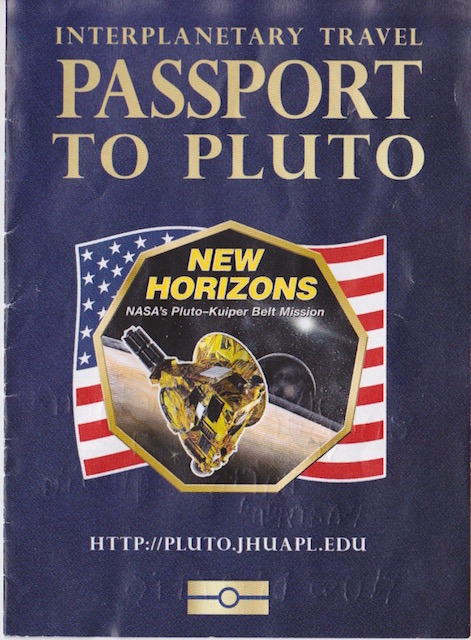
In celebration of New Horizon's successful fly-by of Pluto, the John Hopkins University Applied Physics Laboratory (a partner with NASA in sending the ship out) hosted a Plutopalooza. We visited in the morning and had a great time.

Ready to travel!

Celebratory sign with unfortunate flash flare

They had plenty of crafts and other fun activities for kids, including making a ultraviolet light-detecting bracelet and a spectrometer.

L sad to show her passport rather than her bracelet

Working on spectrometers

Almost done!

The hall was brimming with activity. We managed to get a postcard-perfect shot at the photo op spot.

Part of the hall

J ready to be a tourist

L not so much

We found one of several models of the New Horizons spacecraft and admired its shiny goldenness.

New Horizon at 1:25 ratio

In another the kids had their faces painted. Choosing the design and colors was part of the fun. J and L both picked out the space craft but different views (and color schemes).

Face Painting!

J gets drawn on

Side view of the craft

L's turn

Top view of craft

To show even more love for Pluto, J colored in a necklace to imitate the heart-shaped features on the new, more accurate photo of Pluto.

J works from a picture of the planet

A ball area represented the various sizes of various objects in the Kuiper Belt, the area of our solar system beyond Uranus and Neptune full of rocky and icy objects, much like the asteroid belt.

Objects in the belt

Objects in motion

We went to an hour-long presentation by some of the scientists who worked on New Horizon, including a graduate student who designed the dust collector. J was interested but L was not. The biggest surprise for me was the appearance of Brian May. He's a guitarist for the rock band Queen and an astrophysicist! He wrote that We Will Rock You song which has a whole new meaning considering he studies non-terrestrial stones.

Presentation

Rocker who is into space rocks

My other surprise from the presentations was the insistence that Pluto is a planet and not a dwarf planet. They asked how many planets are in the solar system, and their correct answer was "hundreds." So the issue is still controversial!

L was worn out after the presentation, so we went off to lunch at Chick-fil-A, a happy end to a fun and informative morning.

Wednesday, March 11, 2015

National Air and Space Museum Udvar-Hazy Center, Space Wing

One wing of the gigantic Udvar-Hazy Center is dedicated to outer space travel. The highlight is the space shuttle Discovery, around which all the other spacecraft and satellites are placed.

Space wing of Udvar-Hazy

Reading about Discovery

Space shuttle Discovery was the longest-serving shuttle, from 1984 to 2011. It spent a total of 365 days in space spread out over 39 missions. It docked twice with the Russian Mir space station and thirteen times with the International Space Station. It deployed several satellites and performed service missions on the Hubble Space Telescope. It was the first shuttle back in space after the Challenger and Columbia tragedies. Discovery was the first spaceship to have a female pilot, Eileen Collins in 1995, and had the first African American commander, Frederick Gregory in 1989. It came to the museum in 2012.

J by the nose

Other side of the nose

Tail section

Tail rockets

A fun display is the Apollo landing capsule that still has its floatation bags on it. When they landed in the sea, the capsules would have sunk like a rock if not for these safety measures.

Apollo capsule with flotation bags

Many models of Delta and Titan rockets are on display.

Delta and Titan rocket models

Behind them is a Sirius FM-4 Broadcasting Satellite. It's the "satellite" in satellite radio!

Sirius FM satellite

A much older communication satellite is Echo 1, launched in 1960 for the simple purpose of catching a radio transmission aimed at it and then re-broadcasting that signal in a different direction. The deployed satellite is a reflective sphere 100 feet in diameter, so it was launched folded flat and would inflate in space into its balloon shape. This backup satellite is still packed in its canister. It was never launched!

Echo 1

Another unlaunched gem is the Freedom 7 II, a Mercury capsule that was supposed to take Alan Shepherd (the first American in space) back on another mission in late 1963. After the success of the prior Mercury mission, NASA switched its attention to the Gemini project and cancelled Shepherd's solo launch. The name is a tribute to Shepherd's first capsule, the Freedom 7, which he took to space in 1961.

Freedom 7 II

Hanging out over the shuttle is a sample of a space suit designed for extra-vehicular activity.

EVA suit

The exhibit also has some classic items from science fiction, including a model of the mother ship from the end of Close Encounters of the Third Kind.

Mother ship from Close Encounters