Monday, March 23, 2020

American Revolution Museum at Yorktown, Part I

The American Revolution Museum at Yorktown is a privately-run museum about the American Revolution in general and the Battle of Yorktown in particular. The parking lot features flags from the original colonies as well as the belligerents in the Battle of Yorktown (the Americans, the British, and the French).

Colonial Flags

National flags

Museum entrance

The museum has a copy of Winged Victory, a famous Greek statue from the Hellenistic period depicting Nike, the goddess of victory. The original is on display at the Louvre in Paris.

Winged Victory

When we visited, the special exhibition gallery had a display on The Forgotten Soldier. The exhibit looks at the lives of Africans or descendants of Africans during the Revolutionary War period.

One display shows an engraving of the Boston Massacre made by Paul Revere. One of the three colonists who died was Crispus Attucks, a former slave then working as a sailor.

Crispus Attucks display

Closeup of the wounded man

Another display shows items found by archeologists excavating a slave quarters. Included are a shoe buckle, a plate, a bone comb, and half of a Spanish silver coin. They are all objects owned by both slaves and free people.

Items on display

Many groups of enslaved residents petitioned the Massachusetts government to free them, since slavery is incompatible with the freedom that was being fought for. The below petition was signed by Prince Hall in 1777. Slavery was not abolished in Massachusetts until 1783.

Petition for freedom

Another exhibit has a statue of Patrick Henry made by Lawrence Sully in 1795. Henry was famous for his "give me Liberty or give me death" speech at St. John's Church in Richmond, Virginia, on March 23, 1775.

Patrick Henry

The colonies traded with Europe, developing many industries and selling their products abroad.

Colony-crafted commodities

Many iron forges (including the ones at Valley Forge) provided raw materials for construction and local industries, as well as shipping back to the Old World.

Working in iron

One of the colonial protests was over stamps that had to be affixed to documents, effectively taxing the written word. My daughter tried out stamping a document. It's not as easy as it looks.

Stamping a book

Half a stamp meant half a tax?

King George III was not happy with the behavior of the colonies. The British had just financed the French and Indian War and expected the colonies to pay their due for their protection. The colonists did not feel the same way.

The king looking at the colonists

A life-sized diorama shows entrenched American and French forces repelling a British charge!

Defenders under cover

Redcoats not faring well

One hall is dedicated to the Declaration of Independence. Inside, Thomas Jefferson looks on his iconic work. The statue was made for the opening of the Jefferson Hotel in Richmond, Virginia, in 1895 by Edward Virginius Valentine.

Thomas Jefferson, looking stately

The exhibit also includes several weapons from the war.

Replicas of British uniforms and weapons

Cavalry equipment

In the back of the gallery, displays of different homes and outfits are found.

A middle-class home

An upper-class home

Clothing for women, children, and dolls

A fun interactive exhibit lets visitors answer questions to discover what sort of person they would be during the War for Independence.

Who was I?

The USS Raleigh was one of the thirteen original ships commissioned by the colonial government. It served the colonies well until it was grounded in 1778; the captain and crew abandoned the ship. The British were able to free the ship and relaunch it as HMS Raleigh. It was part of the fleet that captured Charleston, South Carolina.

USS/HMS Raleigh

The museum has a replica of a French siege gun used at Yorktown. The French army had 16- and 24-pound siege guns that blasted the British defenses at Yorktown. The gun was difficult to move because of its size and weight.

French siege gun

A highlight of the museum is a film about the Siege at Yorktown. The movie has an extra wide screen and simulates wind and smoke with blowing fans and mist machines. The enhancements give a heightened experience of what it was like for the Americans and French to capture two of the defensive redoubts in hand-to-hand combat on the night of October 14.

Not coming to a theater near you

The next part of the exhibit is a display on the Treaty of Paris which officially ended the war between the American colonies and the United Kingdom.

Treaty of Paris results

A nearby interactive table lets visitors refight various battles by changing formations of troops and tactics of the commanders. The idea is interesting but the execution is a little clunky. I am not sure what they were trying to convey, other than having another bit of fun technology in the museum.

Fighting the Battle of Cowpens

We then headed outside to the outdoor exhibits, the topic of our next post!


Saturday, March 21, 2020

Book Review: Death Wins a Goldfish by Brian Rea

Death Wins a Goldfish: Reflections From a Grim Reaper's Yearlong Sabbatical written and illustrated by Brian Rea


One of the Grim Reapers at Death, Inc., hasn't taken any time off. Human Resources sends him a note that he has to take his accumulated leave which means Death has a whole year off (though his other co-workers will take up the slack). At first, he's puzzled about what to do. He makes a list of things to try out. He goes through the typical cycle of activities (going to the county fair and winning a gold fish; trying out dating via an app; etc.). He also tries to find some meaning through living a leisurely life. When he gets back to work, he has some new perspectives on living that he didn't have before.

The book is half-comedic and half-winsome. It reads very quickly and can be taken as light entertainment. Death comes to the totally trite insight that spending quality time with others is important. Maybe you are one of the people that hasn't discovered this but I'd like to think that most people already know. Not spending more time at work is never a regret for anyone.

The comedy works well enough and the book is short enough to make it a fun, lightweight experience. The art is unimpressive--simple line drawings and coloring that look more like doodles then deliberate drawing. The style is probably meant to give a lighter tone. The only image I spent any time looking at was the long list of things Death might do on his time off.

Slightly recommended.


Friday, March 20, 2020

Movie Review: Invasion of the Body Snatchers (1955)

Invasion of the Body Snatchers (1955) directed by Don Siegel


Doctor Miles Bennell (Kevin McCarthy) is called home from a conference to the small California town of Santa Mira. His nurse is overwhelmed with patients needing help. The most intriguing cases are the people who claim their relatives are not really their relatives--they've been replaced by emotionless copies. Bennell sees one or two and refers them to his psychiatrist friend. He's a bit uneasy about the situation since the problem is wide-spread in Santa Mira. His unease turns to paranoia when an author friend discovers a body in his closet that appears generic but is slowly looking more and more like the author. Later, Bennell discovers giant seed pods in his greenhouse. The pods spawn bodies of the doctor and his girlfriend (Dana Wynter). To avoid being turned into soulless and emotionless copies of themselves, the two go on the run from the townfolk.

The movie is a science fiction classic. Pod People has become an idiom for emotionless or soulless individuals. The penultimate scene of Bennell running through a highway trying to warn all the drivers that they are about to be assimilated ("You're next! You're next!'), even shouted into the camera, is famous as well. The movie was based on a novel and had three remakes (1978, 1993, and 2007). The story plays as a great parable against conformity and indifference. It's also a harrowing adventure for the main character.

Weirdly enough, the film has been interpreted as condemning the dehumanizing effects of McCarthyism and the dehumanizing effects of communism. The film makers did not intend a political interpretation. Perhaps it is best to look at it with some perspective and acknowledge that it condemns dehumanization in contemporary society regardless of political persuasion. The "better life" offered by the pod people is one without love or joy or pain or sorrow. Such a life may be less chaotic but it is also less rewarding and less adventurous. The pod people offer an unreal world that everyone should reject.

Highly recommended.


Thursday, March 19, 2020

TV Review: Doctor Who: The Greatest Show in the Galaxy (1988)

Doctor Who: The Greatest Show in the Galaxy (1988) written by Stephen Wyatt and directed by Alan Wareing


The Seventh Doctor (Sylvester McCoy) and companion Ace (Sophie Aldred) go to the planet Segonax for the Psychic Circus, the titular Greatest Show in the Galaxy. Ace hates clowns so she is reluctant. More reluctant is two of the circus regulars who flee the big top only to be hunted down by the Chief Clown (Ian Reddington). The regulars split up, resulting in the capture of one and the death of the other when she stumbles upon an abandoned hippie bus with an evil android ticket-taker. The Doctor and Ace stop at a roadside fruit and snack stand run by a local who is down on the circus and anyone who wants to go. They have to leg it to the tent. On the way, they discover famous explorer Captain Cook and his companion. The captain is trying to unearth a giant robot. Or at least his companion is, while Cook blathers on about his exploits. The Doctor and Ace eventually move on, making it to the circus. They find a very small audience (a family of three). The Doctor is immediately recruited to be a performer, though it's the sort of command performance that involves a jail cell.

The plot is all over the place at the beginning in a surreal and disjointed way. The first (of four) episodes introduces a lot of characters and I was nervous that they wouldn't get pulled together. The story became a lot more coherent in short order. McCoy's goofy comic sense shines and he gets to do a bit of very credible-looking stage magic (nowadays they'd just use CGI or quick cuts). Like Patrick Troughton and David Tenant, McCoy has the knack for seamlessly switching between comedic and  dramatic performing as the Doctor. Reddington is good as the Chief Clown with a performance that is sinister and just under over-the-top (a very hard mark to hit). The rest of the cast is good, too. The circus setting is fun and sets up an interesting and creative shift at the end.

Recommended--the patience you need to get through the set-up is highly rewarded.


Wednesday, March 18, 2020

Yorktown Battlefield, Virginia--Part II

A continuation of yesterpost...

We went outside and did a driving tour of the Yorktown battlefield. Our first stop was the British Inner Defense Line, just outside the parking area for the visitor center.

Earthenworks created by the British to defend Yorktown

Further out is the Grand French Battery, part of the initial lines surrounding Yorktown.

French part of the battlefield

A bridge into the French area

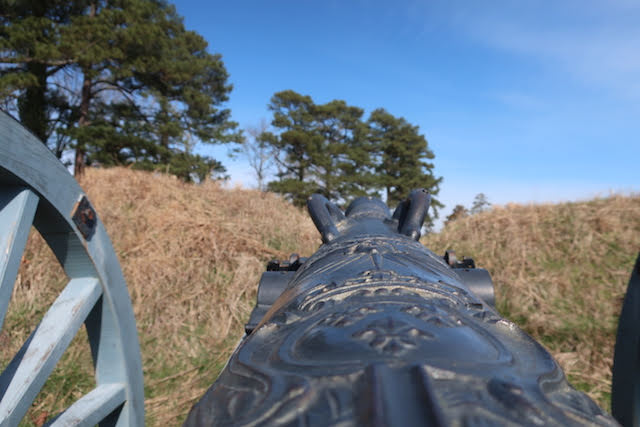
Some of the guns are still outdoors. Field guns had a lower trajectory and were used to smash through enemy earthworks. During a battle, they could be loaded with grapeshot and fired at troops. Mortars shot explosive shells at high angles. The intent was to drop the bomb behind enemy fortifications for maximal damage. Howitzers fired lower velocity bombs at medium or high angles. The bombs would often bounce on the ground and go just over the earthworks to hit the troops just behind the defenses.

Mortar, howitzer, and field gun

Looking down the barrel!

View to Yorktown (not very visible, even in good weather)

Map of the battlefield

Next, we drove to where Redoubts #9 and #10 were located. The spots still have fortifications, though the #10 is so close to the river that it is fenced off. It does have a nice plaque commemorating the daring night attack on the redoubt by Alexander Hamilton and the Americans, armed with unloaded muskets and fixed bayonets.

By the English defenses

Americans storm Redoubt #10!

Redoubt #10

Plaque in the sidewalk

Closeup of the redoubt

Nearby is the Moore House, where representatives from both sides met to work out the surrender agreement. They negotiated terms of surrender which Washington altered slightly. The British wanted war honors, where they could march out with their battalion's flags unfurled and playing American songs in honor of the enemy's victory. Such honors were not accorded to the Americans at the siege of Charlestown, South Carolina. Washington wrote, "The same honors will be granted to the surrendering army as granted to the garrison of Charlestown." What goes around, comes around.

The farm was owned by Augustine Moore, who probably fled to Richmond with his family during the siege. The house changed hands a few times. During the American Civil War, the house (with its nice view of the York River) sustained considerable damage from shell fire and from soldiers in need of some wood for fires. The house was restored in 1881 for the centennial anniversary of the Yorktown battle.

Moore House with outer buildings

The Well

The front of the house

The privy and icehouse?

Back of the house

We didn't go to the surrender field or on the encampment tour (both driving). The kids were getting a little bored and (more importantly) hungry. Maybe next time!

Tuesday, March 17, 2020

Yorktown Battlefield, Virginia--Part I

The Yorktown Battlefield is part of the Colonial National Historical Park in Virginia. The Battle of Yorktown was a colonists' victory in 1781 over the English forces under the command of Lord Cornwallis, though that victory would have been impossible without French support. Though the war would continue for several years, this battle was the final major engagement and convinced the British to stop trying to subdue the colonies.  The battlefield has a visitor center just outside of town.

Visitor Center

View of where the British Inner Defense lines were (just outside the center)

Inside the center is a recreation of the surrender march made by Lord Cornwallis's troops. The small diorama is made from broken items from the store, a good way to recycle.

Surrender march

Our children had the chance to become park rangers. My daughter was the only one to take on that duty at Yorktown.

Dark glasses means a tough ranger

We remembered to bring our National Parks Passport and my daughter dutifully got a stamp for the battlefield.

Stamping the passport

The Lafayette Cannon is actually a British cannon that was dented by an allied cannonball. It's said that Lafayette came back to America in 1824 and identified the cannon as one used during the battle. He became all emotional and hugged the cannon! That's how a British cannon was named after a French general.

Lafayette Cannon

The museum has a model of the battlefield that has lights and a voiceover describing the main events of the battle. The Americans and French set up an outer siege line and bombarded the town. The French fleet cut off the river entrance so the British were not resupplied. The allies moved their lines forward after capturing two redoubts on the British left flank. The second line was so close that the cannons were practically firing at point blank range. British commander Lord Cornwallis wanted to evacuate his army across the river. On the night they would flee, a storm came up and prevented the escape. He eventually surrendered to General Washington. He sent his second in command with his sword to surrender officially. Washington was annoyed by this and made the British second in command turn over the sword to his second in command!

Battlefield in miniature

In tribute to the importance of the French fleet blockading the Chesapeake Bay (and thereby the York River), the museum has a recreated boat inside the museum!

A ship far from shore ,in a bad way

The lower deck of the ship simulates the layout and conditions of a naval ship from the 1700s.

Wooden bunk and table

Mirrors made the place look bigger

Canvas hammock over a cannon!

Upstairs (or "on deck" if you like) are exhibits about the battle. The story of the siege is told with dioramas and displays. First we saw a display of French and American uniforms.

The allies wore blue

The first shot by the Americans was lit by General George Washington on October 9, 1781. The eighteen-pounder smashed into a dinner party where one British officer was killed and two others wounded.

Washington takes the first shot

One diorama shows the Americans attacking Redoubt #10. Lieutenant Colonel Alexander Hamilton (of musical fame) led a band of Americans with unloaded muskets and fixed bayonets in the assault of the redoubt on the night of October 14, 1781. At the same time, Comte Guillaume de Deux-Ponts led a French assault on Redoubt #9. Both attacks were successful and hastened the end of the siege.

Americans storm Redoubt #10

An interactive display explained what the different drum beats or "calls" meant. Soldiers heard a distinctive rhythm and knew whether to advance or retreat or follow some other order.

Don't ask for whom the drum calls, it calls for thee!

Another diorama shows the British surrender on October 19. The British marched out of town and surrendered in a field not far away. They gave up their flags, weapons, and musical instruments!

British marching not to victory

Another display shows items found in and around Redoubt #10.

Archeological finds!

Outside the boat are a few other exhibits. One shows a field table that Cornwallis used. The table comes apart easily and can be used in large tents as a desk or a dining table.

Cornwallis table

A large tent recreates George Washington's mobile headquarters. In addition to work desks and supplies, the tent included a dining set for meals.

Inside mobile HQ

Food service

The Chamber Tent was a smaller tent used by Washington as his private quarters. It was set up inside a larger sleeping marquee. One of Washington's descendants cut pieces from the walls of the tent to give away as souvenirs.

Chamber Tent

Next, we went out to the actual battlefield, the subject of our next post!