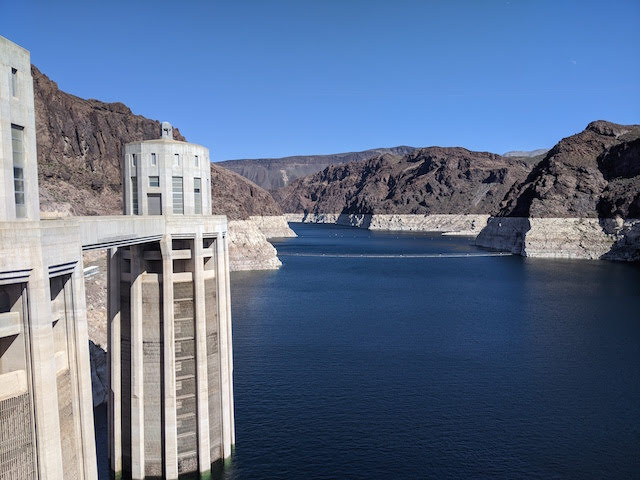
Saturday, April 25, 2020

Book Review: Saint Francis and Brother Duck by Jay Stoeckl, SFO

Saint Francis and Brother Duck written and illustrated by Jay Stoeckl, SFO


This kid-friendly biography of Saint Francis of Assissi is both charming and informative. It covers the basics of his life--his attempt to be a soldier, his misinterpreting the dream about rebuilding the church, his founding of the order, his visit to the Holy Land to stop the war, his love for the poor, and his love for animals. The one obvious literary license is Brother Duck, a talking duck that accompanies Francis during his adventurous life. The duck mainly cracks jokes and provides a way for Francis to monologue without monologuing, especially in scenes where he'd otherwise be alone.

It's an honest, simple, humble, and joyous book that well reflects the life and spirituality of Saint Francis.

Highly recommended.


Friday, April 24, 2020

Movie Review: The Eagle (2011)

The Eagle (2011) directed by Kevin Macdonald


Marcus Flavius Aquila (Channing Tatum) is an up-and-coming Roman soldier who takes his first command...in Britain. It's the second century A.D. and the Ninth Legion disappeared twenty years ago north of Hadrian's Wall. Marcus's father led the Ninth and the family's honor was lost along with the golden eagle that was the emblem not only of the Ninth, but of Rome itself. Marcus is assigned to a small fort which he valiantly defends, enduring a horrible injury during the battle. His company is awarded a great honor and he is given an honorable discharge. Marcus isn't interested in leaving Britain or the army. As he recuperates at his uncle's villa in southern Britain, he hears a legend of where the eagle is. With his new slave Esca (Jaime Bell), he sets off alone on a mission that the army can't do--search for and return the eagle to the empire. Esca has a bit of a chip on his shoulder but Marcus saved his life in a circus battle with a gladiator. Esca has sworn loyalty, but can a Briton be trusted? Esca naturally feels the same way about Romans. Their uneasy alliance become more difficult as they head north of the border and into the Scottish highlands.

The movie moves a bit slow though it does have nice attention to detail. The Roman fort looks realistic to the ruins I've seen in Britain. The Roman wealth isn't quite so extravagant in Britain as it is in Rome and the movie shows that lesser status (the circus is wooden and small, the opposite of the Colosseum). The movie takes the obvious themes of loyalty, friendship, and manhood and puts them through their paces as the plot moves along. The stark countryside looks great. There's no big surprises but also no big flubs either. It's an enjoyable B-movie all around.

Mildly recommended.

Thursday, April 23, 2020

Book Review: Upon This Rock by Stephen K. Ray

Upon This Rock: St. Peter and the Primacy of Rome in Scripture and the Early Church by Stephen K. Ray


A major challenge for people converting to the Roman Catholic faith is the papacy. The role of the pope as head of the Church of Christ doesn't fit in with current democratic ideals. The church was founded two thousand years ago, so investigating the early writings on Peter and the papacy has immense value. Understanding the culture of that time and the organic growth of the church provides a new perspective. This book gives an in-depth look at early writings on Peter and the primacy of the bishop of Rome.

The book is divided into three parts. The first looks at Saint Peter himself as he is described in the New Testament and in ancient secular texts. He clearly had a special role in the nascent church, a role given to him by Jesus Himself. He took on a leadership role among the apostles and Paul came to meet with Peter specifically when he converted to Christianity and wanted to become an apostle. Peter traveled to Rome and died during the persecutions of Nero. Ray discusses various objections to Peter's primacy and provides convincing counterarguments.

The second part looks at the first five hundred years of church history, specifically at the role of the bishop of Rome in the growing Christian church. Ray looks at dozens of texts from the early church fathers (theologians and bishops). This part of the book turns into a bit of a slog. He gives the quotations in the text and provides commentary in footnotes (which are on the same page, so readily consultable). I found this part a little repetitive and less interesting than the first part. Again, Ray looks at various objections and questions raised by Protestant scholars and gives able explanations of the Catholic understanding.

The final part of the book looks at more modern writings, specifically the Council of Trent (1566), Vatican I (1870), Vatican II (1965), and the Catechism of the Catholic Church (1994). This section is short and clarifies current understandings of the role of the Pope.

The first appendix lists all the popes from Peter to John Paul II (the book was published in 1999, so no Benedict XVI or Francis--I've written them in to my book!) along with a list of anti-popes, the men who illegitimately claimed to be pope. The second appendix is an interesting essay looking at the Old Testament basis for Peter's primacy, mostly looking at Joseph as the Pharoah's prime minister and at Isaiah's text on the change from Shebna to Eliakim as royal steward in Israel. Other issues are discussed, such as how God changes people's names (Abram to Abraham, Simon to Peter).

For me, the best parts of the book were the first section, discussing Peter directly, and the second appendix, comparing Old Testament examples to Peter's selection and role. The rest of the book has good information but is more scholarly. The book is a great resource for information on the founding of the papacy.

Recommended.


Wednesday, April 22, 2020

TV Review: Attenborough and the Sea Dragon (2019)

Attenborough and the Sea Dragon (2019) produced and directed by Sally Thomson


David Attenborough hosts this Nature documentary (sponsored by PBS and BBC) where a fossil is discovered on Britain's Jurassic coast (on the English Channel). A fossil hunter found the remains of an ichthyosaur of incredible size. "Ichthyosaur" translates literally as "fish-lizard," a short step to the titular term "sea dragon." The immense size of the skeleton is more fascinating because a large section of the ribs and spine have been smashed, presumably by an even bigger predator. So in addition to documenting the painstaking process of removing the fossil from the cliffside and slowly revealing the remains, Attenborough goes on a quest to find out about the predators of the ancient seas.

The whole package makes for nice storytelling and fascinating science. The documentary is less than an hour long and goes by quickly. Some photo-realistic animations of what they think the "sea dragon" looked like are added in. No actual dragons were harmed in the making of this documentary.

Recommended.


Tuesday, April 21, 2020

Hoover Dam Part II

A continuation of yesterpost...

My tour of Hoover Dam started with a short film about the building of the dam. Then I went down an elevator into the dam. The first part of the tour starts in the tunnels dug to divert the Colorado River around the dam site.

Transition from cliff rock to dam concrete

More of the tunnel

Another view

A picture shows the only time that the dam was flooded, with water going over the top of the dam in the 1980s. Even with so much extra water, the dam held.
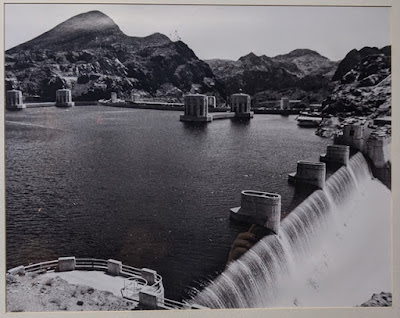
The dam disappearing

Diagram of the dam and the flow of water

The tour took us to the line of generators on the Nevada side of the dam. The small generator in the lower right below provides electricity for the dam's facilities.

The Nevada generators

The dam's power is produced with a smaller generator--self-sufficiency!

Many of the halls were built with marble and decorations inspired by the project and imitating the Native American art from local tribes. The below symbol shows the strength of the waters. Art Deco was still popular in the 1930s, so the builders had that influence as well.

In the floor

Some of the halls are much more plain and meant only for workers to see.

Maintenance hall

Even those halls have occasional decorations. The drainage grates were eventually filled in since women's high-heeled shoes would get caught in the holes.

Drain that doesn't drain

One of the best parts of the tour is getting to go down a side hall and see one of the "windows" in the face of the dam. The openings provide ventilation for the dam's interior hallways. The tour guide said that in the summer, that ventilation is less than desirable with 100 degree Fahrenheit air coming in.

A small, circular hall

The "window"

View from the window

The circular hall has an access tunnel that goes straight down. I was a little reluctant to step on the grating even though it was clearly secure and safe.

Access going down

The work halls let the employees inspect the dam for cracks or other faults. Most of the cracks that happened were in the first few years as the concrete cured and the dam settled.

Inspection hall

An old-style phone

A system was developed to mark what part of the hall a worker found cracks or other items that needed attention.

40 feet from 0

A crack found in 1934 that didn't get bigger

The dam has earthquake sensors just in case a catastrophic event were to happen. The dam is supposed to withstand mild earthquakes. We were forbidden from touching the sensors.

Earthquake detectors

Just in case the elevators don't work, a set of stairs was installed. They are very steep and have some platforms at certain levels for those who get weary from climbing. The bottom of the stairs is sometimes in water!

The stairs going down

The stairs going up

The concrete blocks were given letters to designate where they changed (and so people wouldn't think a large crack had formed!).

Meeting of Q and P blocks

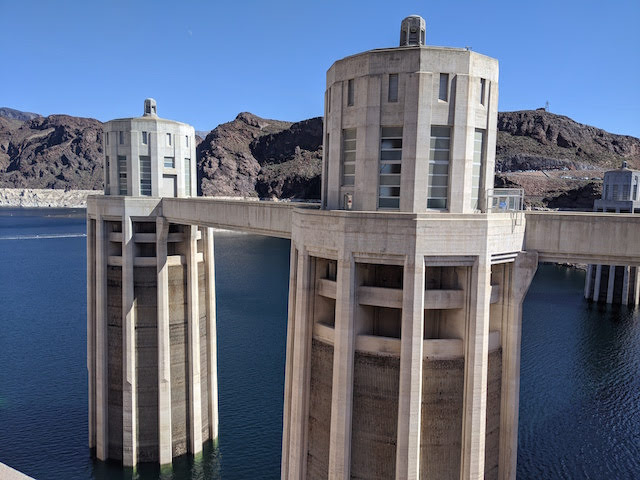
The tour ends at the top of the dam with a view of the the intake towers.

One of the intake towers

The top of the dam looks down on the river and power generators far below. It gave me the willies!

The river below

View of the river and bridge

The view back to the parking lot is less stressful.

The Nevada side of the dam

The dam creates Lake Mead. When I visited, the water was about sixty feet below where they wanted it. Even so, there is still plenty of water and no worry for power or irrigation.

Lake Mead

The dam has a small building on top of the elevator into the dam.

Near the middle of the bridge

The river is the border between Nevada and Arizona. It's also the line between the Pacific and Mountain Time Zones. A plaque shows the spot so visitors can be in two states and two time zones at the same time.

Plaque commemorating the project

Blogger on both sides of the line

The lake at a lower state

The intake towers provide the water that goes to the turbines on the other side of the dam. Tourists don't get to visit the towers.

Intake towers

The back of the dam

A plaque commemorates Doctor Elwood Mead for whom the lake is named. He was a water and irrigation engineer who worked on the dam project. He died in 1936 so Hoover Dam was his last great project.

Dr. Mead

Another display commemorates those who died during the construction of the dam. The tour guide said that no one is buried in the dam, contrary to popular belief.

Memorial to those who died on the project

Nearby is a commemoration of completion of the project. Two angels overlook a display showing where the stars and planets were in the sky when they dedicated the project in 1935. That way if future people or aliens (the outer space kind) visit they can calculate when the dam was built. It struck me as a bit egotistical.
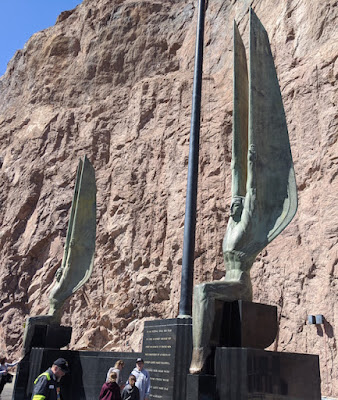
Angels overlooking the dam

Part of the star chart

The base of the memorial

The various states involved in the project are also part of the Colorado River system.

Arizona, Nevada...

...New Mexico, Wyoming, Colorado...

...California, and Utah

The Hoover Dam is an amazing achievement and a spectacular site to visit.

Monday, April 20, 2020

Hoover Dam Part I

On my last day in Las Vegas I drove out to Hoover Dam which is less than an hour away. The project began in the 1930s, during the Great Depression. The Colorado River often flooded, causing havoc for farmers and others. Southern California was badly in need of water. Creating a controllable source (like a reservoir behind a dam) was a viable solution. The dam would provide hydroelectric power to the region. The project also also provided jobs and a sense of accomplishment to a country suffering under economic ravages.

The Colorado River's Black Canyon was selected among several sites as easier than others. Even so, the project required a lot of infrastructure. Roads were built into the area and Boulder City was created to house the workers. The first part of the project was to divert the river around the site. Four large tunnels were dug through the cliff sides to channel the water downriver. With the water clear, the rocks and detritus on the riverbed were taken out. Concrete began pouring and continued constantly for two years. The project was planned down to the last detail and was completed two years ahead of schedule. President  Franklin Roosevelt dedicated it in 1935 as Boulder Dam. The project was authorized under Herbert Hoover's administration and eventually the name was changed to honor the thirty-first president.

The dam has been in continual use since opening. The builders also planned for tours of the dam by adding in marble and fancy decorations in certain sections. The tours have been ongoing since the dam opened in the 1930s. I took one of the tours and saw the museum and the insides of the dam.

The Welcome sign

Approach to the dam from the parking lot

After buying a ticket (I spent extra for the inside tour), I had a wait till the dam tour started, so I went through the museum. The museum tells the whole story of the dam from its construction to the science of hydroelectricity and the impact on the area.

One display showed the various reactions to the announcement of the project. Some were skeptical of the government spending so much money on the project (though it has more than paid for itself). Farmers and residents of the area wanted the water and the prosperity the project promised.

Various opinions on whether to build or not

Choosing the site was a long and laborious process. Black Canyon was chosen because it wasn't too far from resources like sand and gravel (for the concrete) and the point was more narrow and had better bedrock for the dam.

Where to make the dam

Construction began with blasting and digging out the tunnels to divert the river. Once the water was out of the way, the workers started pouring tons of concrete around the clock for two years.

Blasting powder and other tools of the trade

Recreation of the concrete bins used for the dam

Map of the river diversion and dam project

A model shows how the dam was built block by block. Each block had pipes inside of it so that water would cool the concrete and make it set faster. If they hadn't done that, the concrete would still be curing today!

Building up the dam

The displays show how the hydroelectric generators work. Each side of the dam has several generators, with seventeen in total.

Using magnets to make electricity

The museum has an observation area where I took my first picture with the dam.

The dam and I

Originally, the dam was used as a roadway across the Colorado River from Arizona to Nevada. Now, access to the dam is only on the Nevada side though people are allowed to drive across the top of the dam to the parking on the Arizona side. There's no exit on the Arizona side so I didn't bother diving my brother's car across the dam just to drive across the dam. A new bridge was built not far from the dam.

Cars on the dam

Colorado River under the dam

The power plants are just under the dam.

Power plants

Blogger with bridge in background

Another display shows how the energy flows from the dam to people's homes.

The path of power

Yet another display shows art inspired by the Native Americans of the area. Several large sculptures depict the industry and the resources used and produced by the dam.

A bit of art

The original museum for the dam is located on the Nevada side.

Original (and smaller) museum

Inside the old museum, a bust commemorates Herbert Hoover.

Hoover remembered

A display shows the various projects (i.e. other dams) created by the Bureau of Reclamation. Plenty of dams provide electricity for the western United States.

Dam map

The main display is a forty-foot diorama showing the Colorado River and the various dams built along it.

Diorama

Lake Mead (created by Hoover Dam)

A less complicated dam

Hoover Dam

The gift shop/cafeteria has a statue of the high scalers who removed the loose rocks from the canyon walls, thus making the site a safer place to work.

High scaler

In the next post, my tour of the dam starts!