Wednesday, September 7, 2022

Book Review: Jack Kirby: The Epic Life of the King of Comics by Tom Scioli

Jack Kirby: The Epic Life of the King of Comics by Tom Scioli

Jack Kirby, most famous as a comic book creator who teamed with Stan Lee, had an amazing life. He grew up in New York during the Depression. He started working in comics and animation in the 1930s and was drafted to fight in World War II. When he got back, the grim experience of being a soldier convinced him that the horror genre of comics was of no interest. He returned to comics writing in New York, working with Joe Simon (a pre-war collaborator) at various companies. He had a lot of creative output and was able to transition from superheroes to other comics (like romance or westerns) as the public's tastes changed through the years. He wound up working with Stan Lee and they revived superhero comics with the introduction of Marvel's classic heroes--Fantastic Four, Incredible Hulk, Iron Man, The X-Men, etc. Kirby had a lot of tension with Lee, who was more of a publicity guy, about credit for the creative work. With a family to support, Kirby often had to make hard choices about what work to accept and when to stay at a job that had less and less satisfaction for him. He led a full life and was appreciated by fans up to his death in 1994.

This biography tells Kirby's story from his point of view in this graphic non-fiction. Kirby was a creative genius but also had a lot of angst and a big chip on his shoulder. Very early on, Kirby gets peevish about other comic creators taking his creations or his ideas and running with them. Later, he feels ripped off by various publishers and collaborators but has a hard time fighting back because of family obligations. All the while he says that the work he is doing is the best and he is under-appreciated by his peers and the comic-reading public. The book shows this inferiority complex by drawing Kirby as smaller than other characters in many of the frames. And yet he has the face and hairstyle of The Fantastic Four's Reed Richards--the brilliant scientist who funds their amazing adventures with royalties from his many patents. By the end, the reader gets the sense that this book is the truth but not the whole truth of Kirby's life.

Recommended for fans of comics, it is probably of less interest to others.

Tuesday, September 6, 2022

Game Review: Friday by Friedemann Friese

Friday: A Solo Adventure design by Friedemann Friese and published by Rio Grande Games

Robinson Crusoe shipwrecks on your island and he's in bad shape. The player, as Friday, helps Crusoe deal with the island hazards, building up his abilities. Crusoe will need those skills, because pirate ships are coming. It will be the end for Crusoe in that either he will escape the island or will die fighting the pirates. If he doesn't die before even getting to that point! 

This game is a solo, card-driven challenge. The player starts with a deck of eighteen basic Crusoe ability cards. These cards are very basic, mostly the "weak" and "distracted" ones seen below. The number in the upper left is the fighting value (so 0s and -1s are bad).

Starting cards

Some cards have a special ability in the middle under Robinson's portrait. Above, the only special power is the +2 life on the "eating" card. The player starts with twenty life tokens (the game comes with two extra, so a maximum of twenty-two) and uses the tokens to pay for drawing extra cards or being defeated by a hazard.
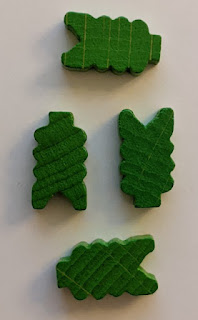
Life tokens (maybe there are supposed to be leaves?)

The player draws two hazard cards from the hazard deck and chooses one to fight (the other hazard goes in a hazard discard pile). Each hazard lets the player draw a number of free cards to fight the hazard. The number is in white on the middle left. 

Hazard card samples

On the middle right is the number of fighting points needed to defeat the card. The numbers are listed in three different colors to signify the round the player is in. The first round is green. Once the hazard deck runs out, the player shuffles the undefeated hazard cards into a new draw deck and has to use the yellow numbers. After running out again, the final round is red, a hard challenge before facing the pirates.

The player draws free cards hoping to get enough fighting points to beat the hazard. The player can pay a life point to draw an extra card, doing this as many times as wanted (the player can also stop drawing free cards early if so desired). If the points are equal to or greater than the hazard number, then the hazard card is turned upside down and added to the player's discard pile. As a new Robinson card, it has a better point number and maybe other powers, e.g. to add extra life tokens, to exchange a played card for the top card of the deck, to destroy a played card, or to copy the power of another card.

The good side of the hazard cards

The player may not get enough fighting points, in which case the player pays the difference between the fighting points and the hazard value in life tokens. In the top right of the Robinson cards there's a life token symbol. For every token paid for failing, the player can also eliminate played cards from their deck, i.e. they don't go in the discard pile. So losing can be a strategic choice--the 0s and -1s are usually removed in the first round when the player fails hazards. The undefeated hazard goes back in the hazard discard pile.

Once the Robinson deck runs out, the discard pile (defeated hazard cards and Robinson cards) are reshuffled. The player also has to add one of the aging cards, which introduce new negative effects to their draw deck.

Aging card samples

The aging cards are divided into normal (the brown hair on the lower half of the card) and difficult (the white hair). If the aging deck runs out before the game is done, Robinson dies of old age. Note also that the top right corner shows two life tokens, requiring two life tokens to remove the card from play.

If and when the player makes it through three rounds of the hazard deck, then two of the pirate ship cards attack. The player can choose which one to fight first, but both must be fought to escape the island.

Some of the possible pirate ships

The pirates have the same set up as the hazards, a number of free draws in white and a fight value in red. Some pirates have special abilities that change the the conditions. Hopefully the player has plenty of life tokens and cards that let them draw extra cards to make the big numbers.

The game is a little complicated at first play, though it speeds up quickly as the player gets more familiar with the cards. Balancing wins and losses with life points is a tricky decision. Sometimes paying to draw extra cards is worth it; sometimes paying the defeat cost is worth getting rid of bad cards. But then the player goes through their Robinson deck quicker, adding more aging cards.

At the end, the player can calculate their score by adding up fighting points, life tokens, and bonuses if the pirates are defeated. Values for aging cards and remaining hazards are subtracted. 

On my first game, I almost made it to the pirate round. The second time I made it to the pirate ships but was unable to defeat either ship (after losing to one ship, I tried the other one just for fun, if you can call losing 51 points to the pirates' 61 fun!). The third game I didn't make it to the boats. The fourth game I defeated the pirates with a final score of 61. Wohoo! The fifth game was another double pirate defeat with a final score of 50. The game offers different levels of difficulty, starting with the second level where the player draws a random aging card at the start. I might be ready to try it!

My first victory!

Each game takes less than half an hour, so playing multiple times in one night is easy (or squeezing a play in here or there). The game comes with boards for the hazard deck, the Robinson deck, and the aging deck, so it takes up more space than you would expect, but the game is still playable on a desk or small table. I found the learning curve not too hard. The decision-making around when to fail and when to succeed has the right level of difficulty. Sometimes the drawn cards make it easy to decide, sometimes you have to decide if you want to push your luck or hope to draw more cards that can be discarded. The difficulty ramps up as you get stronger cards in your deck, so the game comes to a nice crescendo with the pirate fights. I enjoy the game and it's nice to have a solo game that has some variety and plays quickly without a lot of set-up.

Recommended--this is a fun solo game with a small learning curve and a lot of replayability. 

Monday, September 5, 2022

Ice Cream Summer Part IX

Part of an on-going series as we make home-made ice cream all summer long!

Labor Day marks the unofficial end of summer in the United States, so this may be the last of the ice cream posts, but certainly not the end of the ice cream making!

We finally made cookies and cream ice cream. We thought about using Nutter Butters but the store had a big sale on Oreos, so they became the special ingredient in our usual vanilla ice cream. We did not measure the cookies properly, we just filled the mini-food processor two-thirds full and pulverized the cookies.

Oreos about to be made "ice cream friendly"

The process was very standard, just toss in the final ingredient in the last five minutes of mixing a standard vanilla batch. The flavor was very popular in the family even with the grayish color.

Putting the gray in great

Going back to chocolate, we made some chocolate and peanut butter ice cream. We used the usual chocolate ingredients and not the whole jar of peanut butter.

Mixed chocolate brands!

The process was the same old except for, you guessed it, the last five minutes. We did not measure out the peanut butter, unfortunately, we just kept adding knifefuls to the machine, hoping it would mix in with the chocolate. Those peanut butter ice creams with a ripple in the middle look great, but after previous experience not being able to easily spread marshmallow, we thought we'd let the machine do the mixing for us.

A gorgeous batch

The ice cream came out well, though the peanut butter did overwhelm the chocolate flavor. Maybe rippling is the way to go (and also measuring)? We will experiment in the future....

Going back to vanilla, we made Milk Dud ice cream, so hints of chocolate and caramel.

Two great tastes that taste great together!

After measuring out two-thirds of a cup of Milk Duds, I ground up the Duds in the small food processor to make them smaller. I wound up cutting some of the Duds that survived the chopper! Otherwise the process went smoothly. 

Enough for two containers

The flavor was good. Freezing made the caramel solid but crunchy. None of the chunks were big enough to cause problems while eating. The batch went quickly in our house.

We hope you've had a great summer filled with more ice cream than ours was!

Friday, September 2, 2022

Movie Review: The Woman in the Window (2021)

The Woman in the Window (2021) directed by Joe Wright

Anna Fox (Amy Adams) is a child psychologist who has been having a hard time for the past ten months. She's been separated from her husband (Anthony Mackie) and their daughter and has developed agoraphobia, fear of leaving her house. Her psychologist (Tracy Letts) is having a hard time with her since they can't get the medications right and she is uncooperative. Also, she drinks, which is a bad mixture with the drugs. She watches old movies and various neighbors' windows. A new family moves in across the street. The fifteen-year old son Ethan Russell (Fred Hechinger) comes over one night to drop off a gift from his mom. They have an awkward conversation and she suspects the family has difficulties. Later, a woman (Julianne Moore) comes over asking about the boy and the two women start off awkwardly but eventually bond as the woman explains her difficulties with Alastair (Gary Oldman), Ethan's hot-headed father. Once she leaves, Alastair Russell comes over asking about his wife and warning Anna to stay away from his family. After some more booze and pills, Anna hears shouting and sees an argument happening in the house across the street. She sees the woman get stabbed and frantically calls 911. Anna forces her self out of the house and tries to cross the street only to pass out as she reaches the pavement. She wakes up with Alastair over her and some police officers in her home. They are investigating the call and have a hard time putting things together. When she explains that the wife was stabbed, a woman (Jennifer Jason Leigh) steps forward and says she is Jane Russell. Anna has a hard time processing this (as does the viewer) and the movie continues on as she tries to unravel what's really going on. Is she hallucinating or did a murder really happen?

The movie starts off looking like a Rear Window clone (it's even one of the movies she watches) but veers off in a different direction since Anna has a lot more problems than Jimmy Stewart's character had. Amy Adams gives a solid, believable performance that has the viewer on her side even when she is obviously wrong. Some of the twists are hard to believe, including unfortunately the big reveal at the end of what's really going on. The movie is a weak B-level thriller. Don't expect Rear Window.

Slightly recommended.

Thursday, September 1, 2022

Book Review: Spy x Family Vols. 1 and 2 by Tatsuya Endo

Spy x Family Volume 1 by Tatsuya Endo

Superspy Twilight has a new assignment. He has to infiltrate a prestigious school and become close with a reclusive parent who works for a political party. For this assignment, Twilight needs two things he doesn't have: a child and a wife. He goes to a shady orphanage (which won't have good records on the kids, so easy to fake his fatherhood in the paperwork). The administrator lets him take the smartest kid they have, a six-year old girl named Anya. The girl is also the most troublesome orphan for an unusual and unknown (to the adults) reason: she's a telepath. As Twilight and Anya are shopping for fancier clothes, they run into Yor, a young lady who is getting a dress fixed because her office co-workers invited her to a party. She has a problem in that she said she'd bring a boyfriend but she has none for an unusual and unknown (to her co-workers) reason: she's an assassin. Yor almost asks Twilight to go until she sees his "daughter." She's worried about a vengeful wife, so Anya (who can read her concern) fakes that her mom is dead. Twilight agrees to go out with the co-workers as long as Yor helps with a family interview during the posh school admission process. Yor thinks having a family will be a good cover with her co-workers and for her assassin job so she agrees. They live in the same apartment with separate bedrooms. They also spend a little time together as a family to prep for the interview. When they finally get to the school, they have to run the toughest gauntlet ever--the watchful eyes and the intrusive questions of the stuffy, upper-crust faculty.

With such a ridiculous and over-the-top plot, the book is naturally a comedy. The story is light and fun with the occasional burst of violence (because of the spies and assassins). Nothing is too graphic. The tension from each character hiding their secret sets up a lot of fun situations. Their secret skills suit each other very well, even if they don't know it.

Recommended for some escapist fun.

Spy x Family Volume 2 by Tatsuya Endo

The pseudo-family's adventures continue as Anya squeaks her way into Eden Academy. The life of a student there is no paradise--Anya is bullied almost immediately by, of all people, the one boy that Twilight wants her to befriend, Damien the son of Donovan Desmond (leader of a political party). Anya has had some self-defense lessons from her pseudo-mom Yor, who has plenty of assassin skills to pass on to her new daughter. Trouble is brewing too, since Yor's brother finds out about the "marriage" and wants to come celebrate with the new family.

The book has some action but the focus is still on the humor. I like the twist of the "school drama" where it's six-year olds and not the usual high school crowd. The violence is a little more graphic here, so it's not suitable for six-year olds! Otherwise this is another entertaining issue.

Recommended.

Wednesday, August 31, 2022

TV Review: Avatar: The Last Airbender Season Three (2007)

Avatar: The Last Airbender Season Three (2007) created by Michael Dante DiMartino and Bryan Konietzko

For my review of season one, go here, and season two, go here.

Avatar Aang is recovering from a near-mortal wound. He and his friends are hiding out in the Fire Nation, getting ready to attack on the day of an upcoming eclipse, hoping to knock out Fire Lord Ozai. Firebenders gain strength from the sun, so the eclipse will weaken them substantially. If successful, Team Avatar won't have to worry about the return of Sozin's Comet, which promises to give the Firebenders a huge advantage. Ozai plans to finish his world-wide conquest when the comet returns, creating a hard deadline for Team Avatar if the eclipse plan does not work. 

Meanwhile, Zuko has returned to the Fire Nation and the favor of his father since he "killed the Avatar" at the end of last season. His victory feels hollow to him even before he finds out the Avatar is still alive. His betrayal of Team Avatar and especially of his uncle Iroh weighs heavily on his mind. Is his destiny really to become the next Fire Lord? Will his crazy sister Azula let it happen?

As in other seasons, the story moves at a good pace. It's not too fast, allowing the characters to develop and more of the world to be explored. It's not too slow, keeping up the sense of excitement and peril. The story weaves in a lot of the old, familiar characters for the big fights during the eclipse and during the return of the comet. The narrative comes to a climax in the last episodes that is very satisfying.

The show also maintains the quality of writing. The characters are rich and conflicted. Zuko has a crisis of vocation, realizing that maybe he is not meant to be on his father's side. He has to swallow a lot of pride and overcome a lot of mistrust from Aang and Katara. His character arc is my favorite part of the show. Aang also deals with a huge conflict. Everyone tells him he must kill Fire Lord Ozai but his Air Temple training teaches him that all life is sacred. As a twelve-year old (if you don't count the hundred years of suspended animation in the ice berg), he has a burden that even adults would struggle with. The show doesn't give quick, easy answers to these problems. Though set in a fictional world, the show has a lot of moral truth. The writing is great.

Highly recommended--this is easily the best kids' show I have seen, and in my top ten shows of all time.

Tuesday, August 30, 2022

Game Review: The Goonies: Escape with One-Eyed Willy's Rich Stuff by The OP

The Goonies: Escape with One-Eyed Willy's Rich Stuff--A Coded Chronicles Game designed by Jay Cormier and Sen Foong Lim and published by The OP

The Goonies is a kids' adventure film from the 1980s where a group of misfits go in search of treasure to save their homes from foreclosure by evil bankers who want to make a golf course/country club of their small town. This game puts the players in the roles of the kids as they follow an old map and various clues to find a pirate's hidden plunder. The narrative of the game mirrors the film's narrative, giving to players who have seen the movie only a small advantage but a larger portion of satisfaction as little callbacks and other bits from the movie show up. There's even the villains of the film, the Fratellis, chasing after the players. The game does a good job embodying the film's spirit of adventure.

The game plays like a narrative-driven escape room, with a lot of puzzles to solve as the players move forward. In the Coded Chronicles system, each character has an ability (like Explore, Pick Up, Use) that allows them to interact with items and locations on the slowly built-up map. A journal with various numbered entries describes what happens or what changes when the character do things. The character's number is added to the item or location, giving the right number to look up in the journals. More map tiles are revealed and more adventures happen, all the way to finding the treasure (it's a kids movie from the 1980s, so obviously it turns out all right in the end). The table I chose to play on was not quite big enough.

The game in progress

In the picture above, Data's gadgets (which get used periodically) are on the left with the main map in the center. Below the map are a bunch of items picked up during the game. At the top is the "treasure map" which is used in solving some of the puzzles. It's laminated so the dry-erase marker can both write on it and clear it off for the next puzzle that uses it. 

The game system works smoothly, though with eight characters, that means eight journals and some overlapping abilities. I played it solo and had to switch often between journals to look up stuff. Many wrong combinations lead to flavor text, which gets a little tedious for just one person. Occasionally the narrative ricochets around from journal to journal without any choices being made, which would be okay if I'd been playing with a group. The characters with Use and Explore did most of the action during the game. Mouth, whose ability was to Translate, has a noticeably slimmer journal, though he was given a side mission to decrypt images on the walls, so a player could be working on something on the side while the rest of game was progressing.

Like most escape games, the puzzle are a variety of deciphering visual clues and combining the right items to get the job done. Also like most escape games, some were obvious, some were fun challenges, and some were incomprehensible. Again, if I'd had a group that might have been easier with more eyes and more perspectives. I used the hint system and was able to reverse-engineer a couple of puzzles to see what they wanted me to do. That was sort-of satisfying. I've played enough escape-room games to be used to the occasional dip into the hints. The hint numbers are listed in the rule book and refer to paragraphs in the journals. I did accidentally read hints for problems I wasn't even working on while reading one of the journals!

Overall, I thought the game was just okay. The puzzles are engaging but a bit difficult and the story, which is broken into three acts, moves a little unevenly. The second act moved much faster than the first and third. The Fratellis are supposed to move forward if the players make an error which I ignored after a while since I wasn't so concerned about getting a score (and I already had plenty of characters to play). I am the type of escape room player where I ignore the timer (in this case, the Fratellis) and just enjoy solving the puzzles. The art is good and fits the theme and the components are high quality.

Mildly recommended.