Showing posts with label Japan. Show all posts

Friday, October 28, 2022

Movie Review: Dark Water (2002)

Dark Water (2002) co-written and directed by Hideo Nakata

Yoshimi (Hitomi Kuroki) is getting divorced and her husband is only contesting one thing--custody of their five year-old daughter Iku (Rio Kanno). Yoshimi is struggling to get on her feet, still looking for a place to live and for a job. Her real estate agent (Yu Tokui) takes her to a few places. She settles on a third floor apartment in a somewhat rundown building. She has a hard time juggling the responsibilities (home, job, and divorce) while also picking up her daughter from school. If that wasn't bad enough, the apartment ceiling has a leak and the upstairs neighbor is a bit noisy, running around. She asks the building manager to repair the ceiling but he just writes it down in his log. She goes to the apartment above her but no one answers the door. As she's on the elevator going back down, she sees a glimpse of a youngster in a yellow raincoat peek out the door. Meanwhile, her husband is bringing up all Yoshimi's bad history--she needed therapy after working too hard at a proofreading job where she was assigned all the grisly horror and thriller novels. As a child, she developed sleepwalking for a short time while her own parents divorced. He's trying to make her look unfit for custody. The weird stuff at the apartment only adds to her difficulty. There's a missing child poster for a girl in a yellow raincoat and the constantly reappearing kid's red purse that may be from the missing child. Iku likes the bag and wants to keep it but mom is unnerved by it.

This movie is definitely part of the "wet ghost girl" Japanese horror craze in the late 1990s and early 2000s. The movie does a great job leaving the viewer questioning whether there really is a ghost or the lady is just going crazy. The movie is anchored by Kuroki and Kanno's performances. The mother is both sympathetic and a bit neglectful, the viewer easily sees how the husband doesn't trust her to take care of their child. She overreacts to things. Kanno is also excellent as the child caught in the middle of the divorce and the conflict over a haunting she does not understand. The movie has almost no special effects, relying on sound design and the slow unfolding of the situation to provide the chills. The low-key menace must have been effective because at one point I thought about turning a light on. I had the visceral reaction that the filmmakers were going for. The ending provides some melancholic relief and ends the story nicely.

Recommended--I saw this on Kanopy.

Tuesday, August 4, 2020

Gen Con 2020 Online

Gen Con is the biggest board game convention in the United States. It happens every summer in Indianapolis...every summer except for the summer of 2020, of course. Corona virus shut down the physical convention. The organizers decided to shift to an online version, with many of the same presentations, demos, announcements, sales, and game play. The web site was fairly easy to navigate. I decided to attend the online con, getting virtual tickets for several events.

My first event was a lecture on Japanese Folklore and Mythology by Laura Baugh.

Cool interface--picture of woods because that's where lots of folk stories start

She described various stories, myths, and legends from Japan's past with a focus on how they show up in anime, manga, and other media these days. Also, she described how they are often misinterpreted, resulting in confusing and/or wrong impressions about what's going on (at least to Western eyes). Her presentation was very thorough and systematic. I learned a lot and added some stuff to my "to watch" list.

The lecture is available on her Twitch account, though you need to skip ahead about a minute because the sound wasn't working. Here's the link to Japanese Folklore and Mythology.

A great cover, too

I joined the Meeple Land Live Play and Giveaway, where people from Blue Orange played the game Meeple Land. They also gave away five copies of the game, asking some questions during the hour-long presentation. The theme of the game is building a theme park. Players have four round to buy attractions and amenities that they place on their large empty board. Attractions are large or medium tiles; amenities are small tiles. The tiles have various paths leading onto and off of them. Paths need to be matched up so that visitors can make it from one spot to the next. Placing the tiles can be tricky.

Meeple Land in action

Once players are done purchasing, they choose one of the buses full of meeples (it looked like anywhere from four to eight meeples of two colors on each bus) to come to populate their parks. Each attraction accommodates a few meeples of various colors, though some meeples might require that an amenity (like the burger stand or the gift shop) be nearby. The more meeples that make it into the park, the more money a player gets for the next round. If no matching attraction is available, the meeples wait at the park entrance for another round.

After the final round, points are given for how many different attractions are in the park and how many meeples are inside. Points are lost for any meeples that didn't have anywhere to go in the park and for any paths that are dead ends. No points are given for leftover money, so spending it wisely in the last turn is even more important than spending it wisely in other turns. The game looks like a lot of fun and is scheduled for release in September 2020. I did not win a free copy but may try to get it when it comes out.

Another helpful event I attended was a Twitch stream about Tabletopia, an online gaming platform. The site provides a 3D space with game pieces that players can manipulate on their own. The site provides PDFs of rules for games but the interaction is not limited by the rules. While playing chess, a player can move their king to any spot on the board. Tabletopia has a lot of games available and they have all been authorized by the games' publishers (except for obvious stuff like chess, checkers, poker, etc.). 80% of the games are free to play. Tabletopia has a monthly subscription model with two paid levels that grant more access. Users can play games solo, online with others, or in "hot seat" mode where other people in the same room take their individual turns at the same computer. The games have a chat box but the organizers recommend an audio or video third party service like Discord, Skype, or Zoom to get that "across the table" experience. The platform works on iOS and Android devices but is best through a browser.

Tabletopia main page

I joined the Dragomino Live Play and Giveaway hosted by Blue Orange. Dragomino is a kid's version of the popular Kingdomino game. In Dragomino, players put tiles together to get dragon eggs. Matching terrains get one egg drawn from a pile of eggs with the terrain's color. Flip the egg to see if it's an empty shell or a baby dragon. Baby dragons are worth one point at the end of the game; the empty shell means that player takes the mommy dragon token and will go first in the next round. At the end of the game, the mommy dragon token is worth one point. The game goes quickly and looks like fun for a younger crowd (5+ is the recommended age for playing).

Dragomino in action

The players

I watched a Learn Wingspan Live demonstration. The game is very popular in both the gaming community and the birding community because it is both a fun game and accurately depicts the birds and their activities. The game is not too complicated but does have a lot of moving parts. Players take their turns getting new birds, laying eggs, and getting food. All of this slowly builds an engine to get more eggs and more birds. The demonstration was on Tabletopia with the same guy from the previous Tabletopia presentation!

Wingspan on Tabletopia

A demo of Back To the Future: Dice Through Time was my final event. Players pilot DeLoreans from one of the four different timelines (1885, 1955, 1985, 2015), running between timelines to collect items scattered by Biff. Each item needs to go back to its original time and place. Every round starts with drawing event cards which can be good or bad. Some events go on the board, causing time paradoxes that need to be resolved. Other events help the players by giving them bonuses; still other events hamper the players by disabling some ability. After the cards are played, each player rolls four dice and then use the dice to move around the board and resolve the various situations. The dice have various faces, like the flux capacitor that lets the player switch timelines or the fist which knock the timeline's Biff to another location (he blocks players from dealing with problems). When players finish their moves, the Outatime track advances for the timeline with the most paradoxes on it. If players return an item to its proper time and space, they get to move the Outatime tracker back a space and get a bonus fetched by Einstein (Doc Brown's dog). The bonus is a token representing a die face. If players can get all the items back where they belong, the players win the game.

The video feed

A closer look at the board

The components for this game look great. The little DeLoreans have some nice detail and the custom die faces are fun. The graphic design is well done. The cards, DeLoreans, and dice all match whichever timeline they are from. The art is not photos from the movies but drawings that are instantly recognizable to fans of the films. The gameplay looks like fun. The couple hosting the video were funny and clearly knew Back to the Future very well, cracking jokes and using quotes from the movies. This looks like a great cooperative game for families.

While I did enjoy everything I did, I never played any games and I never had any of those fun surprises like running into cool cosplayers or finding a random game that is surprisingly enjoyable. I do have some new leads on good games and various ways to play online.

Friday, January 31, 2020

Movie Review: Gamera the Giant Monster (1965)

Gamera the Giant Monster (1965) directed by Noriaki Yuasa


Cold War tensions over the Arctic are high. A U.S. aircraft shoots down some unidentified planes invading U.S. airspace. Since every military airplane in the 1960s carried atomic weapons, the crashing ship causes a large explosion that cracks the ice and sends radiation below. The blast revives Gamera, a saber-toothed, sixty meter tall turtle that can walk on its hind legs, breath (and eat) fire, and fly through the air. Gamera attacks Japan, which uses its military might and its scientific prowess to stop the monster. Both fail, forcing them to establish an international committee of scientists who craft an ultimate plan to foil the unstoppable terrapin, the mysterious Plan Z.

If that wasn't enough plot, this b-movie has a b-story. A small boy is fascinated with turtles and is forced by his family to free a pet turtle he named "Pee Wee." He happens to release Pee Wee on the same beach where Gamera shows up, convincing him that Gamera is Pee Wee all grown up and that Gamera will cause no harm. Gamera does save the boy later, endearing the giant turtle all the more to the young boy, who improbably keeps showing up throughout the story. This side story is clearly meant to draw in little kids and show a sympathetic side of Gamera.

The overall story is very obvious and the symbolism is extremely heavy-handed. The movie is like a treasure trove of kaiju cliches. Gamera is futilely attacked by the Japanese army. He crushes cities and countrysides like they are cheaply made miniatures. Science is the only thing that can really stop such a bully. And atomic energy is bad. The only cliche missing is a fight with other similar (but more villainous) kaiju. The film makers saved that for the sequels, according to the special features.

Even with its flaws, I enjoyed the movie, though that is mostly due to happy memories of watching it as a child and cheering for the monster who saves little boys. For others, it will most likely be a less endearing experience.

Mildly recommended, if you have a soft spot for turtles, heroic monsters, or happy memories of The 4:30 Movie showing stuff like this.


Monday, November 26, 2018

Walters Art Museum Temporary Exhibits

On a school day off, we went into Baltimore and visited The Walters Art Museum (near the Basilica). The kids enjoyed it as much as they could. For some things and at some times they have more stamina. We can do a whole art museum if it is a small art museum. The Walters is fairly large. We saw some temporary exhibits that were a lot of fun, even for the kids.

The Walters Art Museum

The first exhibit was Japanese Woodblock Prints (on display till January 6, 2019).  Over 40 prints from the museum's collection are on display.

Entrance sign for the exhibit

The art is very stylized and distinctive. These prints are from Japan's Edo period (1615 to 1868) and represent the cultural exuberance of the capital city of Edo, now Tokyo.

Below is a print called "The Actors Ichikawa Kodanji IV as Kono Moronao and Nakamura Fukusuke I as Momoi Wakansanosuke" published by Uoya Eikichi in 1855. The artist was Utagawa Kunisada and the carver was Yokogawa Takejiro. Some of this information is on the print, which includes logos or inscriptions of the creators and publishers, partially to advertise the skills and partially as a form of copyright. Interestingly enough, there is no description of the roles they are playing. I guess viewers would just know from then-current pop culture what character they were playing and in what play.

The Actors... (1855)

From 1858 is "The Actor Iwai Kumesaburo III performing as the Girl Yae, later Seyama" published by Uoya Eikichi. Utagawa Kunisada was the artist and Yokogawa Takejiro was the carver.

The Actor Iwai Kumesaburo III... (1858)

Western artists in the late 1800s admired the woodblock works. Japan opened its ports to foreigners in 1859 so there was a natural outflow of products and art. French glass designer Eugene Rousseau adapted a woodblock image of a carp for the vase below.

Carp Vase (1878)

A popular way to collect prints was to make albums, such as "Lady Murasaki's Genji Cards" seen below. The illustrations are from the Tale of Genji written in the 1000s by Murasaki Shikibu. The story was rewritten and serialized during the 1830s by Ryutei Tanehiko. The Genji Cards were published by Tstaya Kichizo. The artist was Utagawa Kunisada II.

Lady Murasaki's Genji Cards (1857)

Closer look at one of the cards

Below is a triptych depicting 16th-century warriors putting their armor on. The pictures go from right to left. "A Group of Brave Warriors of the Takeda Clan" was published by Yamamotoya Heikichi in 1853 with art by Utagawa Sadahide.

A Group of Brave Warriors of the Takeda Clan (1853)

Nearby was a table for visitors to try their hand at creating art in the Japanese style. Small water brushes made strokes on special paper that would quickly dry out. It was hard to paint more than a few lines before the work vanished.

Showing how to do it

Working hard

The exhibit includes some "tools of the trade" used by artists to make the designs and the wood blocks. The first step was to draw the image on paper. The carver would use that image as a model when sculpting the block.

Artist's paper, brushes, and ink

More colorful inks

Carving tools

Another special exhibit until January 6, 2019, is The Return of the Buddha, which is not some action-packed sequel. It commemorates a statue that came back to the museum recently.

He's back!

The statue is a life-sized 6th-century lacquer Buddha. The statue was on loan to the Freer/Sackler gallery (the Asian art part of the Smithsonian) in Washington, D.C., where it was on display with other Buddhas.

The Walters's Buddha

Other Buddhas were available at the Freer/Sackler exhibit

The final temporary exhibit we saw was Chinese Snuff Bottles, on display through December 9, 2018 (so rush out quick if you want to see it!). The bottles are from the Qing Dynasty (1644-1911) and are quite charming. Almost 250 bottles are on display but by this point the kids were ready to move on. I saw one or two of the displays.

Snuff bottles were used for powdered tobacco by the Chinese and Mongolians. Smoking tobacco was illegal back then. Powdered tobacco was allowed because it supposedly had medicinal value. The bottles were popular and served the same purpose as snuff boxes in Europe.

Chinese Snuff Bottles

Another set

One close up

Two of a kind!

More from the permanent exhibits in a future post!


Monday, December 22, 2014

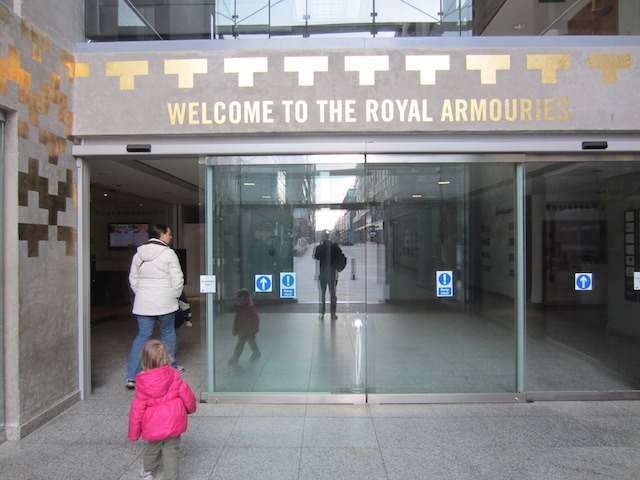
Royal Armouries, Leeds, England--Part the Blades and Armor

The Royal Armouries in Leeds, England, has an impressive display of weapons of all sorts from all over the world from most periods in time.  In this post, we'll concentrate on a sampling of the blades and armor in the museum. The next post will have the guns and cannons.

Entering the Royal Armouries in Leeds

The first thing we saw was a cutout of the famous portrait of Queen Elizabeth I.
 
L in the cutout

J in the cutout

We came upon a tower filled with suits of armor, swords, pikes, spears, and myriad other weapons. The tower went up three or four stories, making it quite impressive on its own.

Tower of weapons (click to enlarge)

A display that was a little disappointing to us parents but fascinating to the children was this set of arcade games.

Kids, there's more interesting stuff to see elsewhere!

On the first floor, we looked down at a mounted knight who himself was looking down on the cafe. Maybe we were on the second floor (or third floor, depending on how you are counting).

Knight from above

We enjoyed the exhibits on Japanese weapons, which shows various suits of armor for both rider and horse from the 18th century, as well as a sample warrior's home.

Japanese mounted warriors

Various swords and spears

18th century armor modeled on Japanese medieval armor

18th century armory in the 18th century style

A warrior's home

The exhibit has examples of Japanese firearms and helmets. As I said, there will be a separate post on firearms and cannons, but since this fits in with the other Japanese items, I post the picture here.

Japanese rifles and other firearms

1700s helmets

1700s armor

Another horse features less defensive gear for riding.

A more casual horse

Traditional Japanese swords are on display in a variety of sizes.

Japanese swords

On another floor we discovered dueling weapons, including swords and knives that look perfect for swashbuckling.

Dueling weapons

Nearby we found modern dueling equipment, including the padded armor used by fencers.

Fencer with foil

The European medieval section has a good variety of items. This German helmet from the 1500s is unusual in its detail with a nose and mustache on the visor. Even more impressive, the nose and mustache are one piece of metal with the visor, not later additions.

Helmet with mustache

Plenty of suits of armor are on display from different ages and different armies.

Various suits of armor

Mobile home for knights

Suits of armor are fairly nondescript, so knights who wanted to get credit for their feats in battle (or who didn't want to be killed accidentally by their own forces during battle) had shields, helmets, and surcoats with heraldic imagery identifying themselves. Coats-of-arms grew out of this tradition.
 
Heraldic shield of Charles Brandon, First Duke of Suffolk

Some of the armor is arranged whimsically, which we all appreciated.
 
Arguing armor?

In the gift shop, L tried out her dual-wielding feat with some axes.

L ready for battle

Another display shows the tools of 18th and 19th century whaling, including harpoons.

Whaling equipment

The display also has more modern equipment, like this harpoon gun.

J with a modern harpoon

The harpoon gun is a good lead in to the next post on guns and cannons at the armory.