Showing posts with label medieval times. Show all posts

Wednesday, April 22, 2026

Book Review: Predestination, God's Foreknowledge, and Future Contingents by William Ockham

Predestination, God's Foreknowledge, and Future Contingents by William Ockham, translated with introduction, notes and appendices by Marilyn McCord Adams and Norman Kretzmann

William of Ockham is most famous for his razor but he wrote a lot of other things about a lot of other topics. One interesting problem he dealt with is predestination, the idea that some people are already chosen to go to Heaven even before they have completed their earthly life. Certainty about predestination is fraught with peril and can be approached from more than one angle. 

Ockham comes at the issue from a logical perspective, discussing how future contingent situations, like the final state of one's soul, can be understood. He starts with a short discussion about whether predestination or reprobation (the opposite situation--the person will wind up in Hell) can be a real characteristic inhering in a person. A decisive answer is not forthcoming and the discussion shifts to whether a statement about a future contingent situation can be necessarily true or false. A lot of arguments can be made, for example: if Socrates was sitting yesterday, it is necessarily true that he was sitting yesterday, and thus a contingent situation (like "Socrates is sitting") can be necessarily true. Ockham works out a lot of different nuances from the argument before denying that statements about future situations have the same sort of necessity that can be attributed to statements about past or current contingent situations. 

Ockham also discusses the issue of whether God's knowledge can change. He takes it as given that God knows all truth. If a contingent truth, like "Peter is predestinate," changes to its opposite, like "Peter is reprobate," the amount of truth has not changed, just what is true and what is false. When "Peter is predestinate" becomes false, "Peter is reprobate" becomes true, so there is no more truth than before. To me, this is a lot of philosophical shell game shenanigans that are not satisfying or convincing.

The text is written in medieval style (since Ockham lived in the 1300s), with a proposed question, objections, answers to objections, and a main answer to the question. This format has the advantage of precision but it makes readability much harder for modern lay readers. Again, it was a common style 700 years ago, so he can't really be faulted for writing how everyone else did. Today's readers just need to shift their mindsets when coming to the text.

Mildly recommended--this is more of an academic text than something for a general reader.

Wednesday, September 10, 2025

The Spirit of Medieval Philosophy by Etienne Gilson

The Spirit of Mediaeval Philosophy by Etienne Gilson

Most historians of thought have a tendency to skip over what they refer to as "The Dark Ages," going straight from ancient Greece and Rome to the Renaissance and Enlightenment periods. Sure, there was some literature and art in this Christian-dominated period, but philosophy did not develop at all (so the historians claim) until people like Descartes arrived. Gilson examines if there was a mediaeval philosophy. Clearly, European thought was dominated by Christianity but it did not develop in a vacuum and plenty of authors in Jewish and Muslim traditions commented and expanded upon classical philosophers like Plato and Aristotle.

Gilson has a lot of issues to grapple with. Theological reflection was the primary interest in the middle ages, but that did not exclude the application and adaptation of philosophical ideas to their Biblical understanding of the world. "Faith Seeking Understanding" is the motivation and inspiration of thinkers from Saint Augustine to Saint Thomas Aquinas (held as the exemplar of Christian philosophy). Syncing up philosophical insights with theological insights creates a new system, built on the shoulders of what came before, but clearly going higher and in different directions from what came before.

After affirming the existence of mediaeval philosophy, Gilson runs through many other issues, showing the mediaeval Christian anthropology, including epistemological and moral concepts unknown or underdeveloped in the classical period. The meaning and purpose of human life has a tremendous shift with the revelation of a personal God who becomes man and shares in our life. The age did have a distinctive philosophy (often imbedded in the theology).

The book is a very technical and detailed discussion of these issues. Gilson is a persuasive writer but the text is dry and aimed at an audience that has a lot of familiarity with mediaeval Christianity and classical issues in philosophy. I found it tough going in spots, even with a lot of prior knowledge of the issues involved.

Mildly recommended--this requires some pre-requisites to appreciate fully.

Sample quote, the key shift that distinguished medieval thought:
"There is but one God and this God is Being, that is the corner-stone of all Christian philosophy, and it was not Plato, it was not even Aristotle, it was Moses who put it into position." p. 51

Wednesday, July 2, 2025

Book Review: The Name of the Rose by Umberto Eco

The Name of the Rose by Umberto Eco

Medieval monk Adso records an adventure he had as a young novice traveling with William of Baskerville, an older monk going to an isolated Italian monastery to participate in a theological dispute that will have far-reaching consequences. Some Franciscans want to reestablish the hard-core poverty originally practiced by Saint Francis but Pope John XXII opposes this. He is one of the Avignon Popes (during the period when the papacy moved from Rome to France) and has more than a bit of corruption. Since William was formerly an inquisitor, he has both the intelligence and the wiles to discern difficult situations. The situation at the monastery quickly becomes much more difficult. When William arrives, a monk is discovered dead, possibly by suicide. He might have been killed, since the circumstances don't add up, so the abbot asks William to investigate. Another more gruesomely killed body shows up the next day, making the situation very perilous for the dispute (and the other monks).

The novel focuses slightly more on the murder investigation than the debate. Many clues point to a solution in the monastery's library which is large and labyrinthine. It's also off-limits to nearly everyone--only the librarian, his assistant, and the abbot are allowed in the library. The other monks who copy books have to request the tomes from the librarian. The monastery is famous for its book collection and has attracted monks from all over Europe. The layout and details of the monastery are presented in a lot of detail by author Eco, often in excessive detail. The factions around the debate get a lot attention too, something only partially related to the murder investigation. While these parts of the book parallel the murder investigation's labyrinthine search for the truth, they also feel padded out with the author's own interests. Eco adds a lot of Latin and a sprinkling of other languages, often without translations, making it more challenging to follow conversations. The languages certainly make it more atmospheric but also more difficult to read.

While I am glad that I read this, I did think it needed some editing to make some parts shorter (e.g., how many different real and fantasy animals were carved on the church's entrance?) and would have benefits with some footnotes for people who don't have a reading knowledge of Latin, Italian, French, and German. I don't think I will read it a second time.

Mildly recommended.

Wednesday, May 15, 2024

Book Review: The Frugal Wizard's Handbook for Surviving Medieval England by Brandon Sanderson

The Frugal Wizard's Handbook for Surviving Medieval England by Brandon Sanderson

A man wakes up in a field surrounded by scorch marks wondering where he is. More distressing, he wonders who he is. He quickly discovers he's in Medieval England though a bunch of details are off. Days of the week have different names, writing is forbidden, and magic is real. He finds a lot of loose papers around him. The titular handbook is something he brought to help him but it exploded when he arrived. He's cobbled together a bunch of pages but key texts are missing, like the page where he wrote down his name and purpose for being there. The book is additionally unhelpful in that it's mostly advertising, though it does explain that he is in an alternate dimension that is very similar to his home dimension. He quickly discovers there are other people from (probably) his dimension that are looking for him and making trouble for the locals. He imagines himself a hero, so he sets off on a hero's quest. As his memories come back, he starts to doubt himself and what's going on.

Sanderson wrote this as one of his lockdown projects. He'd had the idea for the title and also the idea to write a "guy wakes up in an unfamiliar environment with amnesia" stories. Once the two ideas met, this novel was born. The book has the light-hearted whimsy Sanderson is so good at in the Alcatraz stories. I found the amnesia element a bit underwhelming. He always got key memories back just when it helped the plot along, which to me reads as forced rather than natural development. The illustrations are fun and the excerpts from the Handbook are entertaining. I enjoyed reading this once but probably won't re-read it.

Mildly recommended.

Monday, August 28, 2023

Barcelona Gothic Quarter and Cathedral

We made our own walking tour of the Gothic District in Barcelona, Spain. The streets are narrow and compact, occasionally leading on to plazas or courtyards with a place (or several) to eat and maybe even a nice fountain.

A spot for some tables

A nice fountain

A bit of tiling on the wall!

The area dates back past the Gothic times, with bits of the walls from the Romans. Back then Barcelona was known as Barcino, so not a big change like other places.

A bit of Roman walls

The star of the area is the Cathedral of Barcelona. Construction of this building started in 1298 but took about 150 years to complete.

Entrance to the Cathedral of Barcelona

Gothic towers overlooking the plaza

Row of saints overlooking the door

The inside is spacious but not highly decorated. the nave contains a choir, the main altar, and stairs down to the crypt.

Nave

Stair to the top of the choir

The choir stalls

Above the main altar

The main altar

Stairs to the crypt

Altar in the crypt

Many side altars are along both aisles of the church.

Altar for Our Lady of the Rosary

Saint Mark's Altar (I think)

Like many other European cathedrals, this one has a cloister and a chapter house. The cloister has a fountain and a large set of geese. The thirteen geese represent the age of Saint Eulalia when she was martyred in 303 during the reign of Roman Emperor Diocletian. She's a popular local saint!

Cloister

Fountain

The geese

All accounted for!

The chapter house has many historical objects, the most important of which is the Golden Throne of King Martin the Humane. He was the last Catalan king, having no offspring. He dedicated his throne to Jesus Christ, saying only He could occupy it after Martin's death. Our guidebook says that Hitler, in his mania to get religious and occult objects, wanted to seize this from Spain but it was safely stored in Paris (!). No pictures were allowed in the chapter house, sadly.

Visitors are allowed to go up on the roof and enjoy the views of Barcelona.

Flying Buttress and Bell Tower

The main tower

View to Montjuic, with the white Olympic Tower and MNAC

Sagrada Familia, still under construction

Montjuic with castle on top!

Nearby rooftops

View to the port

The city council and other government buildings sit in a plaza right near the Cathedral.

Flying the Catalan flag

A more "ecumenical" display of patriotism

Columns from the first century temple to Caesar Augustus were found walled up in a medieval building a hundred years ago. They are now on display.

Pillars of Augustus

On the edge of the quarter is a statue to Ramon Berenguer III, a local count from the 1100s. He fought to reunite the area under Christian rule and freed many Christian slaves in Muslim-controlled Tarragon.

Ramon Berenguer

Some random decoration my wife pointed out

Monday, February 8, 2021

Book Review: The Age of Illumination by Scott Rank

The Age of Illumination: Science, Technology, and Reason in the Middle Ages by Scott Rank


In The Age of Illumination, Scott Rank overturns some common misconceptions about the Middle Ages, the period of history circa 500 to 1500 AD. Many historians characterize this time as an age of superstition, ignorance, and disease. It's as if there was a cultural and intellectual black hole between the fall of the Roman Empire (end of the Classical Age) and the Renaissance (beginning of the Modern Age). The Renaissance was a return to classical ideas of the ancient Romans and Greeks as if no progress happened in between. Rank sets the record straight by looking at the history and culture of the Middle Ages.

Waves of barbarian attacks caused the collapse of the Western Roman Empire (centered in Rome) but not of the Eastern Roman Empire (centered in Constantinople). The empire had been divided earlier in an attempt to make it more manageable. The theological and cultural differences of the Latin West and the Greek East became a political divide. Even with the fall of ancient Rome, it wasn't long before others tried to reunite the European landscape under one rule, eventually becoming the Holy Roman Empire. A complicated relationship grew between the Catholic Church and the emperors. National identities began to emerge as England and France became rivals, Spain began a long fight to throw off Muslim control, and Eastern Europe faced the growing threat of the Ottoman Empire. 

The Crusades began and ended during this period. Initially, they were an attempt to secure the Holy Land in Israel for Christian pilgrims. As with any large-scale, multi-generational effort, the situation became very complicated and had lots of unintended results. When the Holy Land was secured, the Knights Templar were formed to keep the area safe for travelers. The Knights turned into an international corporation, with Knights in Europe taking deposits from pilgrims (so they didn't have to carry much wealth and thus were less of a target for brigands). The deposits would be paid back in Jerusalem. The Knights became very powerful and were somewhat secretive, leading to their disbanding by jealous and suspicious opponents. The Church, often with ecclesial approval, sold indulgences to finance some of the Crusades, a practice that was corrupt and in part led to the Protestant Reformation. The Reformation became a practical end to the Crusades as Christian infighting arose in Europe.

The culture of the Middle Ages was highly intellectual and creative. During this period, the university system began and all fields of knowledge were encouraged. The feudal system started with serfs who worked lands for vassals and lords who provided military service to the king. Though the life was difficult, it also included a lot more leisure time than we have today. Holy days were feast days in a literal sense--everyone feasted and celebrated, often for more than one day. The calendar was full of holidays (the very word is derived from Holy Days) and work for serfs was periodic, with intense periods planting and harvesting then long periods of little work. The creativity of the Middle Ages can be seen in the cathedrals built all over Europe. The new Gothic style allowed for more light and decoration than the classical Roman and Greek temples. Artisans developed new technologies for creating stained glass, cloth, and even producing food. Thousands of water mills dotted the English landscape and were used to ground grain into flour as well as create hardened armor plate. 

Women were able to have a greater role in society. They often ran castles and estates when the lord was called off to service by the king. They had freedom to move about, often independently like on the pilgrimage described in Chaucer's Canterbury Tales. Joan of Arc became the French hero of the Hundred Years War. Charges of witchcraft were few during this period since the ecclesiastical opinion was witches do not exist. Charges of conferring with the devil for power were more often leveled at men since such consort required more education. The age of witch burnings came after the Middle Ages, during the Enlightenment.

The book also describes the impact of the Black Death on European culture. The numerous, quick deaths wiped out a large portion of the population, having huge social effects. With a depleted labor force, lords had to pay more to serfs. Industries and towns went dormant, waiting for a recovery. People became more mobile, looking for work opportunities. 

Historians are wrong to characterize the Middle Ages as a time of superstition and ignorance. The period featured a lot of growth intellectually, culturally, and artistically. The foundation of nations and the restraint of government powers through legal means like the Magna Carta began in the Middle Ages.

Highly recommended.


Thursday, May 21, 2020

TV Review: Kingdom Season One (2019)

Kingdom Season One (2019) written by Kim Eun-hee and directed by Seong-hun Kim


Set during Korea's medieval period, Kingdom tells the story of the nation's king who has been afflicted with smallpox. At least that's the official story. The Crown Prince (Ji-hoon Ju) is suspicious since no one is allowed to see the king except for a small set of advisers...and the queen. The queen is not his mother. She is the second wife of the king. In fact, she is about the same age as the crown prince. She's also pregnant. Since the crown prince is actually the son of a concubine, the royal lineage will fall to the unborn child if he is born before the king dies.

The king did die but a royal physician was brought in with the "resurrection plant" to keep him alive. Unfortunately, the cure turned the king into a flesh-hungry, irrational monster, i.e. a zombie. Political intrigues ensue as the Crown Prince investigates and the Haewon Cho clan (the queen is a member) schemes to get rid of the Crown Prince. Zombie mayhem also ensues as the corpse of the physician's assistant inadvertently causes a zombie plague outbreak starting from the doctor's rural clinic.

The show is a good mixture of royal drama and zombie horror. The political fencing would make a good drama all on its own. The gore starts off fairly mild though that increases during the third episode. The actors are very good and the stunt work and special effects are very realistic-looking (hardly any noticeable CGI). I enjoyed the ongoing story and the action/horror elements.

The big finale had two problems. We expected this to be a self-contained series but found out at the cliffhanger ending that there's another season. So we would have been left waiting around. Luckily the second season has already released. The other problem is a surprise twist about the zombies that really does not make much sense though they may have a chance to explain it away as the characters reading the situation wrong. At least I hope that's what happens. We will watch on.

Recommended.

This is currently available on Netflix (as of May 2020).

Monday, June 24, 2019

Book Review: The Medieval Myths by Norma Lorre Goodrich

The Medieval Myths by Norma Lorre Goodrich


Medieval stories can often seem overwrought and exaggerated to the nth degree. Consider Saint Benedict jumping naked into a thornbush to quiet his fleshly desires. If we are honest, though, exaggeration is a common component of storytelling (how big was that fish you caught?). Larger than life deeds capture the imagination much better than mundane tasks; they make better stories. The medieval period in Europe saw the emergence of national identities, and with that national heroes. This book retells the stories of seven heroes, whose stories have gone on to inspire other stories or even greater versions of their own stories. Getting back to the roots with early texts, the author shows us how these powerful characters became lasting icons in Western culture. Here's the heroes from this book:

1. Beowulf (Scandinavia)--Beowulf the Geat comes to the Danish lands to help King Hrothgar. The king's hall is plagued every night by the seemingly undefeatable ogre Grendel. The Danes live in fear and horror of the ferocious beast. Beowulf promises to take care of the problem, which he does spectacularly. The trouble isn't over though, for Grendel's mother comes to take revenge. Fifty years later, Beowulf is king in Geat when one of his subjects steals a goblet from a dragon's horde, inciting the dragon to attack the countryside. Like a great action hero, Beowulf gears up one last time to defend his people. The stories are exciting and full of larger-than-life actions. Beowulf is a model of heroism and his tale is well told.

2. Peredur, Son of York (Wales)--Peredur is a famous figure whose story (and very self) transformed through the ages into Percival (England) and Parzival (German) both of whom quested for the Holy Grail. Peredur didn't have such ambition, though his story is also set in the time of King Arthur. He's more like Lancelot, a young man of purity and strength who goes on many adventures that test his physical and moral abilities. Peredur's story follows his exploits wooing women in a courtly manner and defeating knights honorably. The narrative is interesting but episodic. It doesn't come to a climax but just stops. Peredur is straightforward, honest, and brave--a worthy hero who was beloved back in the day.

3. Roland (France)--Roland is a popular hero in French medieval epics. This story focuses on a major fight with Muslims from Spain. Roland heroically holds off the swarming invaders and delays in calling for backup from Emperor Charlemagne. The battle descriptions reminded me of the Illiad, with the graphic depictions of injuries, including internal organs falling out. If you are squeamish, this may be too intense. Also, the story focuses a lot more on Charlemagne than Roland. Better Roland stories might be found elsewhere?

4. Berta of Hungary (France)--Princess Berta of Hungary is betrothed to Pepin, prince of France soon to be king. Berta travels to France with a small retinue, including a mother and daughter. The mother decides to switch her daughter in for Berta after the marriage ceremony and, amazingly enough, pulls off the scheme. Berta is sent into the woods to be killed while the false Berta takes over as a horrible queen. The true Berta is not killed, however, when the knights who are sent with her refuse to do the deed. They bring back a pig's heart to prove her death. The story continues on in typical fairy tale fashion, though it clearly pre-dates Snow White and other stories that borrow from this one. This story is really well written and plotted, possibly the most enjoyable in the book. The female characters have verisimilitude and are the center of the story. This story was written by a minstrel around 1270 and we are lucky that it was written down and not just performed.

5. Sifrit (Austria)--Sifrit is Siegfried from the stories that Richard Wagner turned into his famous operas. This story is a part of the Nibelungenlied, written around 1200. Here, Sifrit travels to Burgundy and meets Chriemhilde, the beautiful princess of the land. He wants her as his bride. To accomplish this, the king has Sifrit help him to win Brunehilde as the king's bride. They have to engage in a bit of subterfuge which eventually brings tragedy back on their heads. The story is unfamiliar to me. It takes place after Sifrit defeats the dragon and gets the Nibelung horde. He is an interesting character and the unfamiliarity made the story interesting.

6. Prince Igor (Russia)--Prince Igor rides east and fights valiantly but futilely with the Qumans. He's captured and faces the task of escaping back to the Russian capital Keiv. The story here is mostly focused on storytelling itself, often invoking Boyan, a legendary bard of the Russian people who was the best poet (if he ever really existed). The current author often wishes he was as good as Boyan or credits metaphors to Boyan. The focus is different but less interesting to me. The story also has a highly nationalistic slant.

7. The Cid (Spain)--Rodrigo Diaz of Vivar was known as El Cid, or "the Hero." Often he is called Mio Cid or "my Hero," typically by those who follow him. He lived in the 1000s when Spain was still divided into many different kingdoms and the Moorish invaders (as they were known then) were still a force to be reckoned with. This story starts with the Cid's conquest of Valencia but then turns a bit soap opera as his daughters are given in marriage to some ambitious cads who wind up treating the women horribly. Then comes the Cid's retribution. The story is riveting and quite unexpected. It ends medieval style in a tournament with jousting and swordplay.

The collection gives a slice of medieval life from many different perspectives within Europe. Berta and Sifrit were my favorites, with Beowulf a close third. The other stories are also good.

Highly recommended.


Thursday, November 9, 2017

Book Review: Medieval People by Michael Prestwich

Medieval People: Vivid Lives in a Distant Landscape by Michael Prestwich


The medieval period covers a long time and is populated with a great diversity of people. This book looks at some seventy people who lived from 800 to 1500 AD. He chronicles Christians, Muslims, Huns, and heretics from many levels of society. Some were religious or civil leaders (sometimes both), some were artists, some were everyday merchants, craftsmen, and farmers. 

The biographies are short, typically three or four pages with at least one page's worth of pictures or art depicting the person or items related to the person. In such limited space, condensing a person's life is hard. The writing is occasionally choppy, like a longer biography was edited for length without any adjustments to make the narative flow naturally.

That wouldn't be so bad if many of the things left in are inaccurate, like the caption of a picture from the motion picture El Cid about the 11th century Spanish warrior. The caption claims the character was "Charlton Heston in his most famous role." [p. 39] More famous than Ben-Hur or Moses in The Ten Commandments? Plenty of other dubious interpretations and factual errors spring up, ruining the author's credibility.

If that wasn't bad enough, his treatment of spirituality is appalling. He claims Thomas Aquinas did not have mystic visions at the end of his life, rather he had migraine headaches that stopped him from writing. Catherine of Siena receives nothing but scorn, contempt, and mockery from the author. Joan of Arc probably had anorexia, which would explain her "voices" and belief that she would save France but not her few military victories.

The best thing about the book is the illustrations and pictures. It is a coffee-table size book and unfortunately fits that cliche--a book better to look at than to read.

Not recommended.


Thursday, December 1, 2016

Book Review: Medieval Women Mystics by Elizabeth Ruth Obbard

Medieval Women Mystics: Gertrude the Great, Angela of Foligno, Birgitta of Sweden, Julian of Norwich introduced and edited by Elizabeth Ruth Obbard


This book gives a collection of writings by four medieval women who experienced mystical visions. Those visions were not just for their personal gratification but led them to live holier lives, instruct others, and give a concrete witness to the demands of Christ's love. They are not the only women mystics of the time. They have been selected to represent the variety of vocations available to women and to show a feminine response to grace. These texts are not dry, technical scholasticism. They do contain precision and show a concrete and personal response to the call to holiness.

Each section starts with a brief biography and overview of the woman followed by passages from primary texts. I am a fan of primary texts when studying someone so I like the format very much. Enough texts are provided for each woman to present various thoughts and experiences. Here is a quick overview of each lady:

Gertrude the Great (1256-1302) went as a five-year old orphan to the Benedictine abbey of Helfta. Nothing is known now of her parents; she clearly adopted the nuns as her family. She became a nun and had several visions of our Lord. Late in her life she was commanded to write down her visions. Some stories come from her own words; others are written down by others. She had a great closeness to Christ, granting her insights on His suffering and His relationship with His mother that are edifying.

Angela of Foligno (ca. 1248-1309) was highly influenced by the rise of the mendicant orders (Franciscans, Dominicans, Carmelites, etc.), especially by the character and spirituality of St. Francis of Assisi. She was a married woman of some wealth who was transformed by Francis's example. She became a spiritual mother to many and often gave others practical advice. Her words center around Christ in His poverty and humility, emphasizing that spiritual growth can only come through both the knowledge of Christ's life and the imitation of His example. Suffering is to be embraced as a means of unity with Jesus and a way to strengthen virtue.

Birgitta of Sweden (1303-1373) was also a married woman but she lived in high society. After having mystical visions of Jesus and His blessed mother, she spoke out against abuses and corruption among the courtly aristocrats, earning her the title "the Swedish Joan of Arc." She and her husband eventually left courtly life and went on various pilgrimages. Birgitta founded a mixed order (i.e. men and women in the same setting) and obtained papal approval. Her fame and influence all but disappeared during the Protestant Reformation and only recently has Birgitta's writings and contributions been recognized.

Julian of Norwich (1342-1420) had a near-death experience in her thirties during which she had sixteen visions of Jesus and Mary over a few days. Afterward, she became an anchorite, someone who dedicated their lives to prayer and counseling while never leaving very small quarters. Typically anchorites live in a room attached to or inside a church so they could receive the sacraments. She lived her life in Norwich at the Church of St. Julian (so most scholars don't even think "Julian" is her real name) and wrote a book about her visions and her reflections on them afterwards. Since she was not part of an order, her book was thought lost during the Protestant purges in England. She has only recently been rediscovered. She had an intense devotion to Jesus and Him crucified and is famous for writing "all shall be well and all manner of things shall be well." The quote is a response to reflections on the damage that sin causes. She is a bit controversial--she discusses the "motherhood" of Christ, which would surely garner all sorts of misinterpretations in modern media. She describes His providence and how He feeds His children from His own body, something that mothers do. So the idea isn't really as controversial as it seems.

The book is a wonderful overview and makes for a good jumping off point for further reading. I am interested especially in Julian and Birgitta and will be hunting around from more from them.

Wednesday, April 27, 2016

Book Review: Richard III by David Baldwin

Richard III by David Baldwin


King Richard III (1452-1485) is one of the most controversial kings of England. He was the last of the Plantagenet line and was replaced by Henry Tudor, who became King Henry VII. Richard came to the throne through a mixture of circumstances and deliberate acts. His decision to take the crown may not have been the act of unbridled ambition it is often portrayed as. He lived a hard and unstable life, seeing many relatives die and many reversals of fortune as the Lancastrian Plantagenets fought with the Yorkist Plantagenets over the throne(i.e. the War of the Roses). His nephews (who were legitimate candidates for the throne) were taken into the Tower of London (which was both the royal castle and a prison), never to be heard from again. People assume he killed them or had them killed though there is no direct evidence. His efficiency at governing was at times ruthless and at other times completely just. He put in motion many reforms and established a courier system that eventually developed into the Royal Mail. His life is a lot more complicated than either Shakespeare or Thomas More make it out (though their writings have colored popular opinion).

David Baldwin's biography of Richard makes the effort to be objective, looking at the historical records and evidence. Baldwin does not want to paint Richard as a villain or as a saint, but to see him for he was. The story is complicated not only by the lack of records and the Tudor propaganda but also by the many overlapping names (the book starts with a list of 23 people who have similar names, including three Georges, three Margarets, and four other Richards besides Richard III!). These various challenges are well met in this book, which is readable and convincing. An extra chapter was added where Baldwin describes the discovery of Richard's remains in the Leicester car park.

The even-handed approach and clear writing make this an excellent look at the life of Richard III. I see the author has also written Robin Hood: The English Outlaw Unmasked. Based on the excellence of this biography, I am going to hunt down his Robin Hood book.


Friday, February 5, 2016

Book Review: Art and Beauty in the Middle Ages by Umberto Eco

Art and Beauty in the Middle Ages by Umberto Eco


Quite often the middle ages are the forgotten link between the Classical period and the Renaissance. Moderns assume that Renaissance thinkers and artists rediscovered the works of ancient Greece and Rome and had this amazing and original break with medieval tradition. Umberto Eco (author of The Name of the Rose among other works) dispels this myth with this overview of aesthetic and artistic theory in the years from AD 500 to 1400.

Eco shows the classical roots of medieval theory and theology. Platonic thought was dominant early on, where his ideal world of forms was the standard by which beauty and artistic craft were measured. Aristotle was rediscovered during the middle ages; his systematic approach was assimilated and imitated by the Scholastics. The centrality of symmetry and proportionality for beauty began with Pythagoras's focus on numbers. That focus was re-enforced and enhanced by the biblical notions that creation is good (cf. Genesis's account of creation) and that the world was made according to number, weight, and measure (cf. Wisdom 11). The world is both good and knowable in a mathematical way. It conforms naturally to the transcendental notion of beauty--that which is seen as good gives delight.

The medievals had much more to say about beauty than art. Beauty is a property all things have, both things in the natural world and things made by man. Often, artistic objects were judged beautiful by their symmetry to the world of ideals or of nature. Innovations in artistic theory were rare but not unprecedented. The theoretical trend followed the cultural trend--the great artistic achievements of the age were the cathedrals. They were built by many and varied artists whose anonymity was assumed. The work was done for God, not personal glory. By the late middle ages, individual artists were becoming more prevalent and theories such as nominalism (like Duns Scotus's notion of haecceity or "thisness" as the core of being, making individuality more significant than conformity to an ideal) embodied this shift of emphasis.

Eco does a fine job pulling together various sources from almost a thousand years of thought. He is able to distill a great portion of the history of philosophy and artistic consideration in a mere 120 pages. The book is very academic but is also accessible and a good introduction to aesthetics in the middle ages.


Tuesday, March 31, 2015

TV Review: Black Adder Series 1 (1983)

Black Adder Series 1 (1983) created by Rowan Atkinson and Richard Curtis


I started watching Black Adder back in merry old England since it was available on instant streaming. The story is about a scheming English prince from the middle ages, Edmund the Duke of Edinburgh (Rowan Atkinson). History is a bit different here--Richard III's nephews didn't die in the tower (Edmund is one of them); both Richard III and Henry VII die at Bosworth Field, leaving Richard's brother the king. Edmund is the younger son but a prophecy by three witches claims he will be king one day. Edmund schemes to make the prophecy come true. He decides to be the worst villain ever so he calls himself "The Black Adder." With two henchmen he tries to cause mayhem and overthrow the crown. The King is played by Brian Blessed in a very broad comic performance. The king is barely aware of his son Edmund (he often refers to him with the wrong name) mostly because of the older son. All sorts of courtly shenanigans (in one episode the king wants to make an alliance and tries to marry Edmund off to a Spanish princess who is not at all attractive) and medieval tomfoolery (Edmund is accused of witchcraft in another episode) are the natural result.

The show is funny but not without flaws. Brian Blessed's king seems almost like a cartoon character, though many of the plots are over the top as well. The middle ages look very Monty Pythonesque. The end of the series is surprisingly downbeat and makes me wonder how they had further series. On the other hand, Atkinson is good at being conniving and incompetent at the same time, a fun combination. The writing is clever and inventive. The theme song is great fun. I don't think I'd watch it again but I would watch other series.

Here's the theme song (even though it says it's the series 1 ending, it doesn't spoil anything):


Monday, December 22, 2014

Royal Armouries, Leeds, England--Part the Blades and Armor

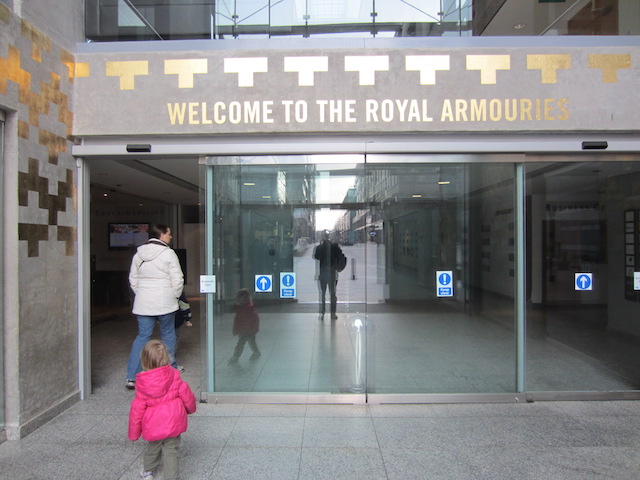
The Royal Armouries in Leeds, England, has an impressive display of weapons of all sorts from all over the world from most periods in time.  In this post, we'll concentrate on a sampling of the blades and armor in the museum. The next post will have the guns and cannons.

Entering the Royal Armouries in Leeds

The first thing we saw was a cutout of the famous portrait of Queen Elizabeth I.
 
L in the cutout

J in the cutout

We came upon a tower filled with suits of armor, swords, pikes, spears, and myriad other weapons. The tower went up three or four stories, making it quite impressive on its own.

Tower of weapons (click to enlarge)

A display that was a little disappointing to us parents but fascinating to the children was this set of arcade games.

Kids, there's more interesting stuff to see elsewhere!

On the first floor, we looked down at a mounted knight who himself was looking down on the cafe. Maybe we were on the second floor (or third floor, depending on how you are counting).

Knight from above

We enjoyed the exhibits on Japanese weapons, which shows various suits of armor for both rider and horse from the 18th century, as well as a sample warrior's home.

Japanese mounted warriors

Various swords and spears

18th century armor modeled on Japanese medieval armor

18th century armory in the 18th century style

A warrior's home

The exhibit has examples of Japanese firearms and helmets. As I said, there will be a separate post on firearms and cannons, but since this fits in with the other Japanese items, I post the picture here.

Japanese rifles and other firearms

1700s helmets

1700s armor

Another horse features less defensive gear for riding.

A more casual horse

Traditional Japanese swords are on display in a variety of sizes.

Japanese swords

On another floor we discovered dueling weapons, including swords and knives that look perfect for swashbuckling.

Dueling weapons

Nearby we found modern dueling equipment, including the padded armor used by fencers.

Fencer with foil

The European medieval section has a good variety of items. This German helmet from the 1500s is unusual in its detail with a nose and mustache on the visor. Even more impressive, the nose and mustache are one piece of metal with the visor, not later additions.

Helmet with mustache

Plenty of suits of armor are on display from different ages and different armies.

Various suits of armor

Mobile home for knights

Suits of armor are fairly nondescript, so knights who wanted to get credit for their feats in battle (or who didn't want to be killed accidentally by their own forces during battle) had shields, helmets, and surcoats with heraldic imagery identifying themselves. Coats-of-arms grew out of this tradition.
 
Heraldic shield of Charles Brandon, First Duke of Suffolk

Some of the armor is arranged whimsically, which we all appreciated.
 
Arguing armor?

In the gift shop, L tried out her dual-wielding feat with some axes.

L ready for battle

Another display shows the tools of 18th and 19th century whaling, including harpoons.

Whaling equipment

The display also has more modern equipment, like this harpoon gun.

J with a modern harpoon

The harpoon gun is a good lead in to the next post on guns and cannons at the armory.