Showing posts with label Kilkenny. Show all posts

Sunday, December 1, 2013

St. Canice Church, Kilkenny, Ireland

St. Canice is so popular in Kilkenny that the Roman Catholics of the area built a church to him after the cathedral dedicated to him was taken over by the Protestant Church of Ireland. In 1747 a chapel was built. It fell into disrepair in the early 1800s, so a new project was mounted to build a larger church. The records are spotty, but it seems that the church was in use in 1824 though the construction did not finish until the late 1830s.

St. Canice Catholic Church, Kilkenny

The exterior features a nice statue of the saint and some holy water fonts outside the doors of the church which J used joyfully.

St. Canice

J blesses himself

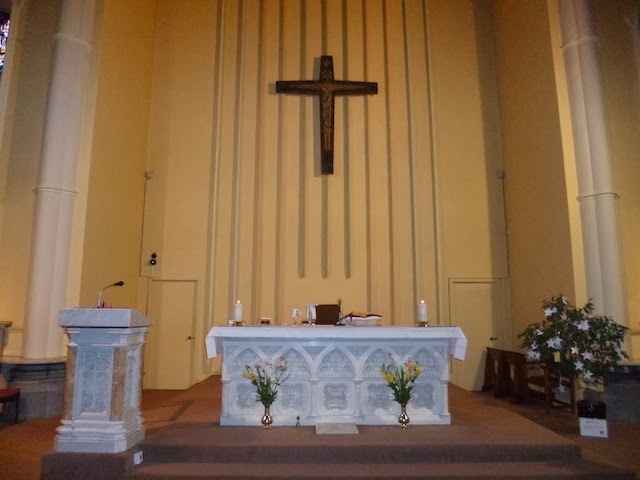
Inside is a simple church with a fairly unremarkable nave and altar.

Nave

Altar

The Stations of the Cross are quite nice, carved in relief and painted to make them more evocative.

Station #7

The real standouts here are the stained glass windows. By the front just before the altar is one with the four evangelists, Matthew, Mark, Luke, and John.

Four evangelists

Just in front of it, and inside the sanctuary where I couldn't go to get a picture, was another window with the same layout. Sts. Peter and Paul are the top saints. Just under them are Sts. Patrick and Brigid, certainly worthy of being closer to the Lord than mere evangelists!

Across the altar is a lovely window of the Annunciation with a Madonna and Child statue just below it.

Marian section

Who was St. Canice?
Canice lived from approximately 525 to 599 A.D. He began life as a shepherd but was soon called to be a fisher of men. In the 540s he studied for the priesthood under St. Finian. In the 560s, he went to Scotland (where he was known as Kenneth) and founded several monasteries. Tradition states he founded a monastery in Kilkenny on the grounds of the Cathedral dedicated to him (which is nearby the Catholic Church). He was a learned scholar and wrote a commentary on the gospels called Glas-Chainnigh. His name is variously spelled as Cainneach, Canisius (Roman spelling), Kenny, and Kenneth. His feast day is October 11.

Sunday, October 27, 2013

St. Canice Cathedral, Kilkenny, Ireland

St. Canice Cathedral is located on the grounds of a sixth century monastery. St. Canice was a great monastery founder and built one at this location. The town sprung up around it and the town's name reflects that--Kil Cainneach is "Church of Canice" in Gaelic. All that remains of the old monastery is the 102-foot round tower built by King O'Carroll in 847.

St. Canice Cathedral, Kilkenny

The current church was built in the 13th century out of local stone. Many members of the local ruling family, the Butlers, are buried inside the cathedral.

Possibly the tomb of Dame E. Butler, wearing an Irish cloak

Husband, wife, and dog

A pleasant-looking dog, possibly denoting a pleasant master

A vicious-looking dog with not such a nice owner

Some 12th century effigies?

At the back of the church is the West Door, which is only opened for the bishop and for brides (at least according to our tour guide). The church is the second largest medieval church in Ireland (behind St. Patrick's in Dublin), so brides have a long walk to the main altar.

Nave

Main altar

In addition to the east window (dating from the 1200s), many other fine examples of stained glass from various periods can be found throughout the cathedral.

Lives of Saints (click to enlarge)

Two different styles right next to each other!

A side altar with smaller windows

Other fine works of art in the cathedral include a beautiful lectern, a statue weeping near the tombs, and the vaulted ceiling.

Standard eagle lectern

Mournful statue?

Vaulted ceiling

In the north transept, dating from the 1200s is St. Ciaran's Chair in black marble. A stone under the seat dates back to the 400s and is thought to be from a bishop's throne. The chair is now the seat of the bishop for the cathedral.

St. Ciaran's Chair

Of course, the children's favorite part of the church is the model of Kilkenny as it was in Elizabethan times.

The old town

Since it was a rainy day we did not go up the tower, though the views over Kilkenny are supposed to be spectacular.

Saturday, October 26, 2013

Kilkenny Bits and Bobs

Here are some items that didn't merit their own posts and are gathered up here!

Walking down Abbey Lane in Kilkenny, parts of the old medieval wall are still visible, as is a still used medieval gate.

L and J look like tough Viking invaders

Glad I'm not driving!

The old Courthouse building is still standing but not in use anymore. A sign said it used to be the jail as well.

Kilkenny Courthouse and Jail

Near the castle is a bank building that has been turned into a restaurant and bar called Left Bank which I thought was rather clever.

Left Bank on the right side of the photo

Market Cross is the local market though it is overrun with modern stores. Some gems are still hidden amongst the larger grocers and clothing/shoe stores. The kids enjoyed the flat escalator to the first floor.
 
Market Cross courtyard

Nearby Market Cross is the town hall called Tholsel. It was built in 1761 with a beautiful exterior that features the town crest and the town clock that chimes on the hour. The building had a major fire in 1985 but has been rebuilt and is used as the archives.

Tholsel

That's a crest!

The tourist information office was formerly the Shee House. Sir Richard Shee had the building built in 1582 as a hospital for the poor. It didn't close until 1895.

Tourist information

Across from the castle is the Kilkenny Design Centre and National Craft Gallery where artisans display their wares for sale. We were afraid to go inside. What if the kids knocked something over and we had to pay for it?!?

Pretty building, though

Kilkenny features a few alleyways off the main road that are picturesque.

Tattos are not allowed on the main road?

Other passages were less welcoming, as in they were guarded by dragons! This is Ireland, after all. St. Patrick got rid of the snakes but not the lizards!

I don't remember bearded dragons in D&D

Thursday, October 24, 2013

Rothe House, Kilkenny, Ireland

On the Medieval Mile in Kilkenny, one house has been converted to a museum that chronicles the life of the wealthy merchants who lived there. Rothe House is the 17th century home of the Rothe family, who connected three houses (from 1594 to 1610) in addition to having two gardens in the back of the property, making a fine example of Tudor construction.

Rothe House, Kilkenny

Our tour began in the gift shop, which struck me as unusual. Typically that's where tours end. We paid our admission and began our self-guided tour. We went out to the courtyard between the first two buildings where the children tried to pose but weren't quite tall enough to make the grade.

Two children hidden by the balcony railing

Inside the first hall, we saw the main entertaining and dining room, which includes a massive fireplace with an Irish deer's head. The particular species is extinct and would probably have been quite tall judging from the skull (and the description on the sign).

The first hall

Antlers as wide as fireplaces!

Upstairs from this room is a loft where the family and servants slept together, an unusual arrangement.

The loft

Other end of the loft

A display cabinet shows a Viking sword. The Vikings had raided the area several times. Since the property is owned by the Kilkenny Archeological Society, artifacts from around Kilkenny have been brought here.

Viking-era sword

From an even earlier period is an Ogham Stone, an example of various early Celtic stones with writing on them. Most are memorials dating from the 300s to the 700s A.D. The Ogham alphabet was used by locals up to the 1600s. Most of the surviving stones come from southern Ireland.

Ogham Stone

More fascinating to J was the windy staircase leading to a higher level in the second house.

Spacious stairs by medieval standards

The second house holds more historical artifacts, including a prop and gear from 1857, when the inventor Godwin Meade Swifte claimed to have flown a powered airplane some 50 years before the Wright Brothers in America. Swifte built the flyer in his home and had to have doors enlarged to take it outside. He couldn't find a motor both light enough and powerful enough to power the plane, so he used a pedaling system. He took the contraption to Foulksrath Castle where a small summit provided a good launching point. Not fully confident in his flying machine, he had one of his butlers try out the "Aerial Chariot." The chariot fell to the ground, resulting in a broken leg. For the servant, not the inventor. The project was abandoned.

Remains of the Aerial Chariot

Outside in the second courtyard, a nice display on heraldry adorns the wall.

Second Courtyard

Heraldry!

The courtyard also has the house's well which is fed with rainwater by the drains of the neighboring buildings.

Covered well!

Up above this area is the garden area which has been restored to its original 17th century model. The first garden has herbs and vegetables. The second is a small orchard with mostly apple trees. Some ducks also live here.

Herb garden

Orchard

Our path wound back through the various houses and courtyards and we exited, as we entered, through the gift shop.