Showing posts with label St. Canice. Show all posts

Sunday, December 1, 2013

St. Canice Church, Kilkenny, Ireland

St. Canice is so popular in Kilkenny that the Roman Catholics of the area built a church to him after the cathedral dedicated to him was taken over by the Protestant Church of Ireland. In 1747 a chapel was built. It fell into disrepair in the early 1800s, so a new project was mounted to build a larger church. The records are spotty, but it seems that the church was in use in 1824 though the construction did not finish until the late 1830s.

St. Canice Catholic Church, Kilkenny

The exterior features a nice statue of the saint and some holy water fonts outside the doors of the church which J used joyfully.

St. Canice

J blesses himself

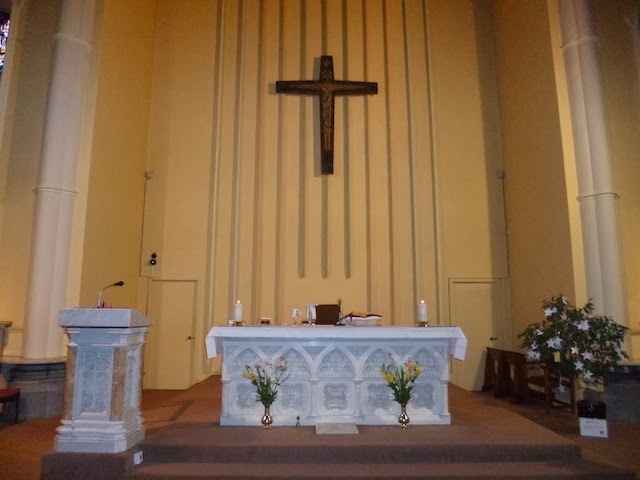
Inside is a simple church with a fairly unremarkable nave and altar.

Nave

Altar

The Stations of the Cross are quite nice, carved in relief and painted to make them more evocative.

Station #7

The real standouts here are the stained glass windows. By the front just before the altar is one with the four evangelists, Matthew, Mark, Luke, and John.

Four evangelists

Just in front of it, and inside the sanctuary where I couldn't go to get a picture, was another window with the same layout. Sts. Peter and Paul are the top saints. Just under them are Sts. Patrick and Brigid, certainly worthy of being closer to the Lord than mere evangelists!

Across the altar is a lovely window of the Annunciation with a Madonna and Child statue just below it.

Marian section

Who was St. Canice?
Canice lived from approximately 525 to 599 A.D. He began life as a shepherd but was soon called to be a fisher of men. In the 540s he studied for the priesthood under St. Finian. In the 560s, he went to Scotland (where he was known as Kenneth) and founded several monasteries. Tradition states he founded a monastery in Kilkenny on the grounds of the Cathedral dedicated to him (which is nearby the Catholic Church). He was a learned scholar and wrote a commentary on the gospels called Glas-Chainnigh. His name is variously spelled as Cainneach, Canisius (Roman spelling), Kenny, and Kenneth. His feast day is October 11.

Sunday, October 27, 2013

St. Canice Cathedral, Kilkenny, Ireland

St. Canice Cathedral is located on the grounds of a sixth century monastery. St. Canice was a great monastery founder and built one at this location. The town sprung up around it and the town's name reflects that--Kil Cainneach is "Church of Canice" in Gaelic. All that remains of the old monastery is the 102-foot round tower built by King O'Carroll in 847.

St. Canice Cathedral, Kilkenny

The current church was built in the 13th century out of local stone. Many members of the local ruling family, the Butlers, are buried inside the cathedral.

Possibly the tomb of Dame E. Butler, wearing an Irish cloak

Husband, wife, and dog

A pleasant-looking dog, possibly denoting a pleasant master

A vicious-looking dog with not such a nice owner

Some 12th century effigies?

At the back of the church is the West Door, which is only opened for the bishop and for brides (at least according to our tour guide). The church is the second largest medieval church in Ireland (behind St. Patrick's in Dublin), so brides have a long walk to the main altar.

Nave

Main altar

In addition to the east window (dating from the 1200s), many other fine examples of stained glass from various periods can be found throughout the cathedral.

Lives of Saints (click to enlarge)

Two different styles right next to each other!

A side altar with smaller windows

Other fine works of art in the cathedral include a beautiful lectern, a statue weeping near the tombs, and the vaulted ceiling.

Standard eagle lectern

Mournful statue?

Vaulted ceiling

In the north transept, dating from the 1200s is St. Ciaran's Chair in black marble. A stone under the seat dates back to the 400s and is thought to be from a bishop's throne. The chair is now the seat of the bishop for the cathedral.

St. Ciaran's Chair

Of course, the children's favorite part of the church is the model of Kilkenny as it was in Elizabethan times.

The old town

Since it was a rainy day we did not go up the tower, though the views over Kilkenny are supposed to be spectacular.