Tuesday, January 7, 2014

Sherwood Forest, Nottinghamshire, England

Sherwood Forest is one of those iconic places that may be richer in mythology than in reality, like Camelot or Xanadu or Stone Henge. Still, it's an irresistible draw...we had to check it out eventually. One Saturday in November we finally did.

The Forest is run by the Nottinghamshire County Council and the only admission charge is a slight parking fee. The entrance has some nice restaurants, shops, and a small museum.

Museum and gift shop entrances

The first sign in the museum

The museum presents the history of what is known about Robin Hood and the folklore that surrounds him. They were just getting ready for the Christmas season, so the statue of Robin Hood was decorated appropriately. Sadly, the picture of the Sheriff of Nottingham holding a present did not come out. It was pretty funny.

Robin Hood in his Christmas TV special, "Bows of  Holly"

Another fun sign

Many of the exhibits had little buttons to push to hear about the Merry Men or the customs and laws of Robin Hood's time. J and L enjoyed listening again and again. Or maybe just pushing the buttons again and again.

J joins the Merry Men for a pot of stew

In the stocks for the crime of balding!

Outside the visitor center are several statues of famous scenes, like Robin's fight with Little John on a bridge.

Famous quarterstaff conflict

Robin takes aim

L makes a face

The forest itself has several walking (and trotting) trails. We chose the short loop out to the Major Oak since it dates back to Robin's time.

L still trying to be a statue on the trail

The horse path!

Random bit of the forest

The Major Oak

The Major Oak is estimated to be between 800 and 1150 years old with a trunk 33 feet in diameter. The canopy is 92 feet across and the tree is still growing. In the interest of keeping it going, some supports have been added to the more massive branches.

The Major Oak from the other side

The Major Supports

The legends tell that Robin and his Merry Men would meet at this oak before going on adventures but little is known for certain. Stories of Robin Hood date back to 1261, very close to his presumed existence in the late 1100s and early 1200s.

The forest has plenty of other interesting trees, some spooky, some creepy crawly, some carved fantastically.

One spooky sample

Another spooky spot

Home to creepy crawlies...

...so says the sign!

A fun carving!

J and L did find a little shelter that immediately became their headquarters for action. Until they realized how spooky it was and they ran away!

The lair?

The forest is quite evocative though not as densely packed with trees as it looks in movies and TV shows. It made for pleasant fall walking.

Can't see the forest for the trees

A bench!

We visited plenty of other spots in the area which we'll see in upcoming posts!

Monday, January 6, 2014

Book Review: Unholy Night by Seth Grahame-Smith

Unholy Night by Seth Grahame-Smith

Happy Epiphany to all!

Unholy Night has a premise that makes a lot of people nervous, if not outright offended. The story of the three wise men visiting the baby Jesus is changed into an action/adventure yarn about a trio of thieves who pass themselves off as wise men to escape execution. They wind up in Bethlehem just as the Christ child is born. They take umbrage with Herod's orders to kill all the children in Bethlehem and start slaughtering all Herod's men. Then the wise men/thieves take the Holy Family under their wing and help them as they flee to Egypt. The story is not exactly what the gospels tell us.

On the other hand, the story is clearly intended as fiction (just look at where it's shelved in book stores and libraries) and the author hasn't tried to boost sales by pretending there is some historical truth to what he's written, a la Dan Brown. I can't fault Unholy Night on those grounds, even though it follows the Dan-Brown method of making fantastic flights of fancy off the story of Jesus. Unholy night isn't revisionism or mockery; it's more of an alternate-reality story where one little twist makes for interesting developments.

The story is also (and this is another example of non-Dan-Brownity) populated with a lot of interesting and well-developed characters. The story focuses on Balthazar, a thief from childhood who has a vendetta against Rome. He's spent his life wandering and thieving and killing with an expertise that's earned him the nickname "The Antioch Ghost." He's a well thought out character and a very interesting person. He's skeptical and brutal and is initially drawn to defend Jesus and his parents mostly for spite of Herod (who tried to execute him) and Rome. But there's also something else motivating him. As his history is revealed, his motivations become clear. The other characters, including Joseph and Mary, are also well-rounded and hew closely to their biblical selves (which is probably the main reason the book is religiously inoffensive--Jesus, Mary, and Joseph aren't the characters with the interesting twist).

At times the realism is a little too real. The violence in the book is extreme. There are lots of fights and wounds are described in detail. Herod is as physically sick as he is mentally and morally. A plague of locusts is particularly unpleasant, though it spares the fugitives, causing Balthazar to question his skepticism and his life's ambition.

The story comes to a satisfying conclusion for all the characters, good, evil, and the inbetween. I'm glad I read it and would recommend it for those who have the stomach for brutal violence and tough redemption. The nearest comparison that springs to mind is the film In Bruges. If you liked that, you'll enjoy this.

Thanks to A Good Story is Hard to Find podcast that inspired me to read this book!


Sunday, January 5, 2014

St. Mary and St. Martin Church, Blyth, England

On a trip to Nottinghamshire we stopped in Blyth to see St. Mary and St. Martin church. We have a guide book to the 1000 best churches in England and this church was recommended for a huge mural of the Last Judgement that dates back to the medieval period. The church itself was built in 1100 by local Benedictines as part of their priory. Additions were made through the centuries including a portion of the church built for the local parish. At the dissolution of the monasteries in the 1530s the monastic part of the priory was destroyed, leaving a Gothic-looking parochial church.

St. Mary and St. Martin

View from the east end of the church

The exterior has a substantial entryway (sometimes called a Galilee porch).

Entryway

The walls are decorated with some nice gargoyles. Even L noticed them and wondered what they were.

Some of the gargoyles

Gargoyle close up

Another close up

We didn't have an answer for L other than the usual storm-drain spouts and scaring away the bad folk, both human and spiritual.

We were unable to get inside, a common problem from November to March in England. Churches are often left open for visiting in warmer, brighter months. We came in mid-November on a Saturday. Perhaps next time!

Saturday, January 4, 2014

Sleeping Beauty--Our 2013 Panto Experience

After having so much fun at last year's Panto, we decided to go again this year. My brother and his girlfriend were in town, so they came along for the fun.

In case you've never heard of Panto, here's my brief overview from last year:
Pantomime (often abbreviated 'panto' because there are no mimes!) is an English tradition around Christmas and New Year's that dates back to the 1700s. The show is a musical comedy based on a fairy tale. Songs, dances, and jokes are non-stop. Songs can be original but often are adaptations of pop songs or other familiar tunes. Often jokes are made about local and national celebrities and nearby towns or shops. The shows are family-friendly and audience participation is encouraged. The villain taunts the audience and asks to be booed, for example. Some of the characters are played by actors of the opposite gender. The Dame, usually the mother of some character, is played by a man in outlandish costumes. The Hero is played by a woman, usually in some tight breeches so you know she's a girl. Two actors play an animal, usually a horse or a cow. The good fairy enters from stage right (the audience's left) and the villain from stage left (the audience's right), mimicking the ancient theatrical tradition that the right side is Heaven and the left is Hell. A chorus of extras provide back up dancers, singers, villagers, minions of the villain or whatever is needed for the story. Usually there's some slapstick scene involving baking or decorating and at least one sing-along for the audience.
Poster!
 Last year's show was Jack and the Beanstalk. This year's is Sleeping Beauty. The panto is more or less exactly the same as the fairy tale. Two changes were made. First, a boy named Tom was born the same day as Aurora (a.k.a. Sleeping Beauty) in the castle and they are a couple even though he is the cook's son. The cook is the Dame and Tom is the Hero who eventually saves Sleeping Beauty. The chorus does service as minions to the villain, but at one point a big yellow minion from Despicable Me comes on stage. He comes back later, so maybe he filled the horse/cow role for this production.

The second change was the location. The castle is Knaresborough Castle, about four miles from the theater. This relocation allowed plenty of North Yorkshire gags. Also, they put Mother Shipton in (though not as the bad fairy) and her cave is one of the spooky places Tom and company visit. She was a famous sooth-sayer back in the 1400s who made all sorts of vague predictions. She fit in well.

The stage before the show

Overall the production was amazing, though not as good as last year's. Maybe it isn't as fresh and new like the first time seeing a Panto. We had a great time none-the-less and highly recommend it.

One of the after-effects of the show is new theater experiences at home. J and L both have put on performances. L is usually the star/author/director with J in a supporting role or narrator.  He always carefully reminds us in the audience to "Turn off your cellphones and give a big round of applause!" In one production, L was a princess (actually, she is a princess in all the productions) and J was an alien. L wound up killing the alien and then said, "Who am I going to marry now that the alien is dead?" I guess that's a problem with a two-actor show!

Friday, January 3, 2014

Our Christmas Tree 2013

We put off shopping for a Christmas tree for a bit too long. On December 15, we finally sorted out the living room so we'd have space. We even got the decorations from the attic and the tree stand from the garage. All we needed was an actual tree.

Making room at the inn, I mean, living room

We went to a nursery that afternoon only to discover they were sold out! This made us a little nervous about our options.

No tree at the nursery!

We drove past Harlow Carr Garden on the way and remembered a sign for trees there. Initially I was reluctant to go because they might have overpriced trees. But it was far too convenient so we went anyway. In their outdoor plant shop they had seven trees left, four of which were the wrong size for us (one too tall, three shorter than J or L). We picked the best one of the remaining three. We didn't bring any rope or bungee cords and the shop attendant didn't think they had any. Luckily, the tree was the right height to fit inside the car when we put the middle seat of the second row down. The tree extended from the trunk to the steering wheel comfortably (sort of). The ride home felt a lot less perilous than the usual top-of-the-car trip. No worries for it falling off!

At home, we had the usual challenges with balancing a real tree in a real stand. At first, we needed a weight to keep the tree from toppling over backwards.

Bare tree with ballast

In case you can't tell, that is a bag of rice. Some unused hand weights were lying around, so they became tree weights. After decorating the tree, we were able to cloak the "little helper" we were using.

Decorated, waiting for presents

We even decided to put presents under the tree early. Thankfully, the children did not rip into presents early. Christmas morning was a lot of fun. We opened about three quarters of the packages before going off to Christmas morning Mass, which was very nice. We came back home, had a snack, and finished the gifts.

The tree hasn't fallen over, the kids haven't knocked it over, pine needles haven't dropped everywhere (yet). It's been a great tree.

Thursday, January 2, 2014

Grassington Dickensian Festival 2013, England

We visited the Grassington Dickensian Festival again in 2013. We went in 2011 and thought it was one of the best Christmas festivals in Yorkshire. This time we went a little later in the day and experienced some new parts of the festival.

Grassington Dickensian Festival 2013

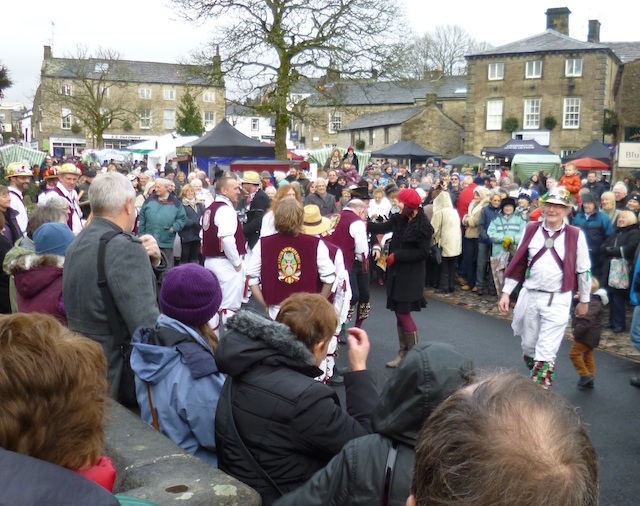
On our first arrival, we saw a group of Morris Dancers from Leeds. Their performance was very entertaining.

Morris Dancers in action

Morris Dancers ready for another go


After watching the dancers, we ducked into one of the church cafes for some hot chocolate and mince pies. We used the loo and then headed up the street to see more wonders of the festival.

More of the streets

Meat pie stall

We saw one of our favorites from the last visit--Hardcastle's Amazing Human Vegetable Machine. It's a sort of slot machine where patrons put in £1 in the hopes of winning £5. Three people in the machine start laughing (though it is more like cackling if you ask me) and eventually produce a random piece of veg. If all three pieces match, the patron wins! We didn't see anyone win. Not that I am saying it's rigged, but as soon as a contrary piece of veg showed up, the human who showed it said, "bah humbug!"

Human Vegetable Machine

Here's the machine in action!


Further up the street we saw a fun hat shop where L fell in love with a frog hat. We bought it for her, so you may see it in future blog posts.

L's new hat

At the top of the hill we discovered the trail to Santa's Grotto. We followed the signs carefully until we arrived at the right building.

Part of the signs

A well-disguised grotto

Inside, we had to wait in a short line before seeing Santa. L wanted to touch everything. Somehow we kept her from cutting in line to touch the white tree in the front. Eventually she was satisfied.

L's fondest wish

We were ushered into Santa's little room where he asked the kids some questions. L was too shy to answer but J filled the gaps. When Santa asked J what he wanted for Christmas, J said, "A hexbug," which is a robotic insect. Santa said, "You want a Xbox? I may have to get my American elves to work on that!" J didn't correct Santa (such a polite boy!) so hopefully we don't get the wrong item down the chimney!

J grilled by Santa

L not too shy for a picture

We saw more booths when we walked down a different street. One stall had candle dipping. Customers could change regular white tapered candles into colorful creations. L really wanted to do it and J joined in.

Customers with their plain white candles

L has her go

J has his go

We are using the candles at dinner time which is very pleasant. Further down the street we stopped in at the Grassington Folk Museum, which has a variety of exhibits on local farming life, World War II, and other sundries.

An 1800s doll house

Vintage games

1920s items

We walked out of the museum and saw the evening torch-lit procession. Various torch bearers guide Joseph and Mary (on a donkey) up the hill to the church where carols are sung. J and L both wanted torches but we said that was for grown-ups.

Lucky fire-bearers

We headed down the hill rather than up, so we could catch the bus back to our car. It was a fun visit and definitely one of the things to do if you're in Yorkshire during the Christmas season.

Wednesday, January 1, 2014

Brompton Oratory, London

The Brompton Oratory was founded by John Henry Newman (later Cardinal Newman, now Blessed Newman). He was a leading figure in the 19th century English Catholic revival and established a community of priests at the Oratory. The church first opened its doors in 1884 but the dome and facade were not completed until the 1890s.

Brompton Oratory, London

Like many famous churches in London, photography is not allowed inside (see the on-line church tour here). Of course, we got something so much better since we attended Sunday Mass there. In addition to the excellent music from a boys' choir and an intelligent (though very brief) sermon, we received Jesus in the Eucharist.

The interior is extremely ornate, including 12 larger-than-life statues of the Apostles that came from Siena Cathedral. Many other decorations were donated by churches on the continent or modeled after Roman decorations. The final external work was the Newman Memorial which went up in 1896, six years after Newman's death.

Newman Memorial

Who was John Henry Cardinal Newman?
Born in London in 1801, John Henry Newman grew up in the Church of England. In his teens, he decided to dedicate his life to holiness. In the 1820s he went to Oxford and became an Anglican priest. He became a leading figure in the Oxford Movement which sought to restore more Catholicity to the Anglican Church. In 1843 he left his Oxford post and, with a small group of followers, lived a life of prayer and reflection in a converted stable block just outside of Oxford. An Italian Catholic priest came in 1845 and received Newman into the Roman Catholic Church. Newman went to Rome to study for the priesthood and was ordained in 1847. He returned to England and established the first English Oratory in Birmingham. He sent a fellow convert to establish Brompton Oratory in May 1849. Newman continued to write and was made a cardinal in 1879 by Pope Leo XIII. He lived for the rest of his life at the Brompton Oratory. His funeral procession drew a crowd of 15-20,000 people. He is currently in the process of being declared a saint.