Friday, June 23, 2023

Movie Review: It Came From Outer Space (1953)

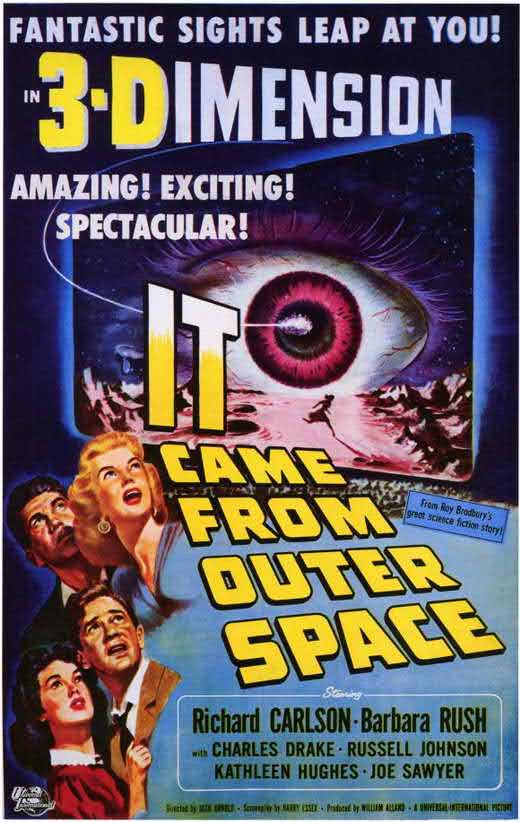
It Came From Outer Space (1953) directed by Jack Arnold from a story by Ray Bradbury

Astronomer John Putnam (Richard Carlson) is having a night of dinner and star gazing with his girlfriend Ellen Fields (Barbara Rush) when a fiery object streaks through the sky and crashes not too far away. They go to investigate. He climbs down into the crater and discovers a space ship. The crater collapses on the ship as he scrambles away. The sheriff shows up along with other townsfolk from their small Arizona town. Putnam can't convince them of what he saw. The next day, there's a mocking article in the newspaper about Martians. If that wasn't bad enough, some people start acting weird, like they were robots or possessed...something is definitely off and needs investigating.

The movie is an early "invasion from space" thriller that was shown in 3D. While there are a couple of creative visuals and special effects (including a "monster's eye view"), the overall film has nothing particularly outstanding. The actors are just okay. The alien plans, once discovered, are a bit underwhelming. The big speeches about dealing with people from another world and what the future holds for humanity are perfunctory. A lot of other films cover this ground in much more interesting and striking ways. I can see why this movie has faded into obscurity.

Not recommended, unless you are a die-hard sci-fi fan.

Thursday, June 22, 2023

Book Review: Persuasion by Jane Austen

Persuasion by Jane Austen

Anne Elliott is the only sensible member of her family. Her father, Baronet Walter Elliot, is vain both about his appearance and his station in life. He's more concerned about those than his estate's finances which has led him into too many debts. Her younger sister Elizabeth shares her dad's vanity. Her other sister Mary has married and moved out, though she can't manage her kids because she's too self-involved. Aunt Anne can keep them in line when she visits. Distant cousin William Elliott is the heir apparent to Walter's estate (since he only has daughters) though William is estranged from the family. Anne's mother died when she was young, though her mom's best friend, Lady Russell, has been a surrogate mother to Anne. The only difficulty with Lady Russell happened seven years before the start of the book. Back then, Anne fell in love with Frederick Wentworth, a junior naval officer who proposed marriage. Anne accepted. The family did not like the situation. Even Lady Russell objected based on his lack of accomplishments, his unsure future, and his lack of social standing (he is not from a prominent family). Anne reluctantly agreed to break off the engagement, leading to heartbreak for both parties.

As the story opens, the financial difficulties have come to enough prominence that Anne and Lady Russell (along with the family accountant) convince the father to move to more modest accommodations in Bath and rent out the house to a respectable person. They find Admiral Croft, who is highly suitable--Navy men are well-organized and scrupulous. Anne's main concern is that Mrs. Croft is Wentworth's sister, so it seems like the exes could run into each other. She spends some time with Mary's family, a less trying experience than the anticipated meeting with the now Captain Wentworth. He's worked his way up the ranks and is now quite well to do, even if he does not have a family social standing. A lot of minor female characters are fascinated by him since he is handsome too. Most of the young people decide to visit the coastal town of Lyme where some friends of Captain Wentworth are living. A tragedy ensues, forcing many different romantic and social entanglements for the characters.

While Pride and Prejudice is a comedy of manners, this is more a drama of manners. Austen's wry writing style is well suited to describing the situations and the character's attitudes toward each other. Anne is a fascinating and sympathetic character. She does the best she can but she is very reserved and shy, not asserting herself like she should (which is probably an attempt not to be like the slightly overbearing and pompous father). She steps up to the situation when needed (like during the tragedy) and her goodness provides avenues for success even against her neglectful relatives. The tale is delightful and full of good insights about human nature and human society.

Highly recommended.

For more and better commentary, check out A Good Story is Hard to Find podcast #309.

Wednesday, June 21, 2023

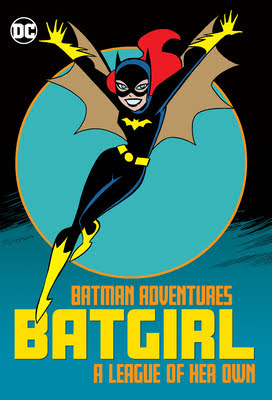
Book Review: Batman Adventures: Batgirl: A League of Her Own by B. Timm et al.

Batman Adventures: Batgirl: A League of Her Own by Bruce Timm with Richard and Tanya Horie

Based on the characters as seen in Batman: The Animated Series, this set of tales is taken from the Batman Adventures comic book series from the early 1990s. Barbara Gordon is Batgirl. Here, she has some solo adventures, a team-up with Batman, and a team-up with Robin. She's her plucky and adventurous self, as willing to talk her way out of a situation as fight her way. She also does research and other detective work when necessary to solve a mystery and bring a case to closure. She's a great role model in this book. I liked the stories quite a bit.

Recommended, even if you aren't a Bat-fan.

Tuesday, June 20, 2023

TV Review: Black Knight (2023)

Black Knight (2023) created by Cho Ui-Seok based on webcomic "Taekbaegisa” by Lee Yoon-Kyun

After an apocalyptic event, the Korean peninsula is left a desert with atmosphere that's barely breathable. People live in a social stratified society where everyone has QR codes on the back of their hands. It's a form of identity and a way to manage money and goods. Except, not everyone has it. The lowest level of society,the refugees, live in squalor on the outskirts of civilization. Most everyone else lives in domed living areas managed by the government and Cheonmyeong, a corporation that manufactures goods and bottles oxygen for public consumption. Naturally, the corporation wields a lot of power. They use Deliverymen to get products to the various citizens. The most famous deliveryman is 5-8 (Kim Woo-Bin), who is able to fight off bandits better than anyone else. All the refugees admire him, including Sa-Wol (Kang You-Seok). He wants to be a deliveryman since it is a way for refugees to climb away from their bottom-rung status. So he practices fighting with his friends. He's gotten good, but is he good enough to earn a place among the Deliverymen?

Meanwhile, Cheonmyeong is building a new, larger dome that will accommodate most citizens. The plan is ambitious. Ryu Seok (Song Seung-Heon) is the son of the CEO and is ready to take over the company. He leads the project and has side schemes to make sure things turn out well. He's not so interested in the refugees benefiting from all their work, though the corporation has been kidnapping children and performing mysterious experiments on them. So his evil knows no bounds. Seol-Ah (Esom), a military investigator for the Defense Intelligence Command (DIC), investigates various murders and incidents which all happen to relate to Cheonmyeong's activities. Also, she had taken in Sa-Wol as a refugee child, so she has an interest in the welfare of the refugees beyond the usual desire to promote justice in her society.

The world of Black Knight is a typical apocalyptic/environmental disaster story. People wear masks to breathe when they are outside. The very first scenes have a Mad Max vibe, though quickly a lot more civilization is seen. Certainly they have a lot more technology than the Australian desert apocalypse. Overall, the show looks good, not great. The plot has a tension between the violent action (which can get graphic) and the social and political intrigue. Some plot points seem out of place or unnecessary but things are resolved by the end of the six-episode arc. The plot is fairly standard with few if any surprises. It needed something more or something less, I am not sure which. Either more character development for the characters or a tighter story arc (so, fewer characters) would have made the show more enjoyable. The actors do a good job but the characters don't have quite enough growth, action, or motivation.

While there could be a second series, the story ends with this one. I am not sure what a sequel would do. I enjoyed what is in the show but was not wowed by it. Black Knight is a mid-level entry in the post-apocalyptic sci-fi drama category.

Mildly recommended.

Monday, June 19, 2023

Hammond-Harwood House, Annapolis

The Hammond-Harwood House in Annapolis, Maryland dates back to the late 1700s. Matthias Hammond was a tobacco farmer, though perhaps it is better to say that he managed a couple of plantations. To show off his wealth and to have a place to stay when he was elected to the Maryland General Assembly, he had the house constructed in 1774 in the middle of Annapolis. The architect, William Buckland, started the house but died in late 1774. His apprentice finished the building. Hammond never actually moved in, but did rent out some of the space to Jeremiah Townley Chase. Chase bought the house in 1811 for his daughter and son-in-law Frances and Richard Loockerman. Their daughter Hester married William Harwood and their family lived in it for generations. When the family died off in 1925, the house and contents were sold at auction. Nearby St. Johns College bought the property, hoping to turn it into an art school. Unfortunately, money dried up during the Great Depression and nothing happened. In 1940, the Hammond-Harwood House Association was formed, which bought the property and turned it into a museum and historic site. They still have tours most every day. We took a tour on Memorial Day weekend in 2023.

Hammond-Harwood House, Annapolis

The architect followed the Anglo-Palladian style, with a main building connected to two wings by covered hallways called "hyphens." Symmetry was the central theme in these mansions as can be seen from the exterior.

Front door

Museum entrance into the north hyphen

The back of the house is quite similar to the front, though the door is less ornate. Also, the bottom and top parts of the door are separate, allowing residents to open one or the other depending on how much air flow they wanted. In hot summers, family and guests would stay downstairs with the front and back doors open to allow airflow.

The back door

The top of the back is just like the top of the front

The garden originally extended down to the waterfront. As times got harder, the family sold off some lots. A small garden still exists.

Back garden

One of the Loockerman boys loved to carve everywhere, including adding his initials to one of the exterior bricks!

"IL 1829"

The south wing served as the kitchen, laundry, and slave quarters. The kitchen had all the latest gadgets from the late 1700s and early 1800s.

Fireplace and lots of cooking implements

Table of kitchen gadgets and some info on who lived here

The sort of meal the servants had

One "high tech" device was this movable candle stand. The light could be moved up or down depending on the needs of the kitchen staff.

Only moves up and down

The spice cabinet had a lock on it since spices were so valuable back in the day. The lady of the house held the key.

The spice must flow!

The living area of the house has many portraits of various family members. They date back to revolutionary period and many were done by the Peale family.

One matriarch

Proof of wealth--a pet in the portrait!

The front door has seven locks in it, though there is only one keyhole on the outside. Our docent had a fun time quizzing our eight year-old about many things in the house, including identifying all the locks.

Why we didn't come in this door

Right next to the door is a clock. The style in the 1800s was to show off the mechanism, so the clock did not have sides.

Displaying their wares

To the right of the front door is a small room that the master of the house used as an office. There is even a door in the back of the room in case he heard a guest come in and decided not to greet that particular person!

Front office (Washington in picture)

Another desk

The back room on the main floor is the dining room. The family entertained guests here.

Dining room

Fireplace in the dining room

Just off the dining room is a drawing room where the ladies would come after dinner when the men were having their port and cigars.

Tea service set-up

On the left of the front door is a Lady's Waiting Room, where the lady of the house would entertain guests when they arrived.

Front drawing room

The staircase includes a small closet under the stairs, just like in Harry Potter!

Going up

Right above the dining room is a ball room where the family did more entertaining, including playing music and dancing.

Ball room

Across the hall is a game room for more relaxing.

Card table

Some chess men

Smoking table

The clay pipes on the table above were made extra long for sharing purposes. Once one gentleman was done, he broke off a bit of the end and let the next fellow have smoke.

Two bedrooms, a master and a guest, are also on the second floor.

Guest bedroom

Master bedroom

No closets up here, just drawers

The portrait in the corner depicts one of the children with her doll. In the chair under the portrait is the same doll!

I can't decide if this is creepy or not

The master bedroom includes some "model furniture" which are not toys for the kids, but things a craftsman used to show what he could make. The smaller version gave the potential buyer an idea of what the finished product would look like.

People weren't that much shorter back then

Our tour took us back out to the garden and the main office. We saw some of the flowers that bloom in the spring.

A rose by any other name?

We enjoyed our visit to the Hammond-Harwood House and recommend it.
Friday, June 16, 2023

Movie Review: Black Sunday/The Mask of Satan (1960)

Black Sunday/The Mask of Satan (1960) directed by Mario Bava

Princess Asa Vajda (Barbara Steele) was accused of witchcraft along with her consort Javutich (Arturo Dominici). The townsfolk tried to burn them both after they nailed masks of Satan on their faces. A rain storm came (or was summoned by the Devil?) and prevented the burning. Asa laid a curse on the town and the royal family that she would be revenged for generations to come. Asa was buried in the family crypt with a cross over her sarcophagus. Two hundred years later, two doctors are traveling to a medical conference and stop off in the town. Before they reach the inn, they travel along the road supposedly haunted by the witch. Their carriage has a minor accident, forcing the coachman to make some hasty repairs. The doctors explore the area, going into the decaying chapel and discovering the crypt. Asa's tomb has a window that shows her masked face with the cross looming over her. The younger doctor Andrej (John Richardson) is called away by the coachman. Older doctor Kruvajan (Andrea Checchi) is attacked by a large bat, forcing him to swing wildly at it. His swings eventually fell the bat but also destroy the cross and the window. He cuts himself on the glass when he removes the mask from the corpse, revealing a desiccated face without eyes. He leaves as drops of his blood drip onto the face.

Meanwhile, brother and sister Constantine (Enrico Oliveri) and Katia (also Barbara Steele) try to comfort their father (Ivo Garrini) who worries about the 200th anniversary of the curse. They live in the Vajda castle which has lots of creepy passages (including some hidden ones) and portraits of Asa and Javutich. It isn't long before the revenge plan begins in earnest as Asa is slowly restored to life and summons Javutich from his grave to help.

The movie makes the most of its low budget and black and white photography. Characters hide in shadows or melt into the scenery, creating an ongoing expectation and tension for the viewers. Some of the special effects are amazing even now. Steele gives a good dual performance as the evil Asa and the innocent Katia. Naturally a romance springs up between the young doctor and Katia, giving the movie some conventional grounding (and on-the-nose musical scoring). Bava's direction is assured and impressive. He went on to make a lot of horror films, which I may try some more of (I've already reviewed Black Sabbath, which is three short films strung together, not some remake or refashioning of Black Sunday).

Recommended, especially for horror fans.

Thursday, June 15, 2023

Book Review: B.P.R.D. Omnibus Vol. 2 by M. Mignola et al.

B.P.R.D. Omnibus Volume 2 stories by Mike Mignola and John Arcudi; art by Mike Mignola, Guy Davis, and others; letters by Clem Robins

Another series of stories featuring the Bureau for Paranormal Research and Defense, the place where Hellboy grew up and worked for years (though he is no longer with them in these stories). These naturally come after Volume 1.

The Dead--The B.P.R.D. headquarters moves from Connecticut to Colorado, partly as a cost-saving measure, partly because the plague of supernatural frogs is moving west across the United States. Director Manning hires a new guy named Benjamin Daimo to run the team while Kate Corrigan and Abe Sapien are on a different assignment. The Colorado facility is an old scientific research center built just after World War II. Unfortunately there's a lot of stuff that goes bump in the night in the several sub-basements. Meanwhile, Kate and Abe research Everett Caul, who is the person Abe was before something happened to change him into a fish man. Abe has no memories of that time. After consulting with a Connecticut librarian, they go to a seaside house that Caul built. Caul moved there and married, though his widow committed suicide soon after Caul's disappearance. Abe visits the abandoned house on a dark and stormy night. He meets the wife's spirit and has to struggle with what to do.

The parallel stories are both interesting since they delve into different histories and different personal dynamics. Liz Sherman and the others have a hard time accepting Daimo, who is a former soldier and very much a shoot-first-ask-question-later guy, along with his dismissive attitude toward Roger the Homunculus. I enjoyed both stories very much. Guy Davis's art is distinct from Mignola's style and became the standard for the B.P.R.D. stories. It's less dark and spooky but still creepy.

War on Frogs--Five separate stories of fighting with the frog monsters highlight different situations and different characters. Roger is getting overly influenced by Daimo, turning into a soldier of fortune. Abe has decided to forego field work which spooks out the regular B.P.R.D. agents. Johann has his own problems dealing with the ghosts of frogs who were killed just after being changed from humans. 

The stories provide no real forward movement for the main storyline, just a bunch of creepy character moments for everyone involved.

The Black Flame--Zinco Corporation's head Mr. Pope is a fan of Nazi Germany, but only the occult extremism. He has a secret office with memorabilia and records from World War II. His research references various occult allies like the Crimson Lotus. Pope is interesting in becoming the new Black Flame, a Nazi occult warrior. Zinco's R&D department has captured some frogs for experiments, like making them speak in English. Meanwhile, the B.P.R.D. has its hands full assaulting various nests of frogmen across the U.S. Roger is gung-ho at fighting while Abe sticks to paperwork at headquarters. Liz is slowly turning into a living weapon, only interested in roasting the frogs. When the Black Flame tries to claim the frogs as his own followers, they merge into an even greater and more horrible monster. 

Here's the forward motion missing earlier. Things move at a relatively quick pace. A lot of people's lives are changed and the big finale leaves a lot of damage on the Earth and in the B.P.R.D. roster. It's an exciting finale...at least I hope it's the end for the war on frogs.

Epilogue--A story told from the perspective of a B.P.R.D. recruit who tries to befriend Liz. Ashley Strode is her name. She has a hard time dealing with Liz's off-putting attitude after the events of the Black Flame storyline. It's interesting and melancholic.

The book ends with some sketches and commentary from the artists. The stories are fascinating and the character arcs are interesting. I enjoy the B.P.R.D. characters a lot and they get their due here.

Recommended.