Showing posts with label Anglesey Abbey. Show all posts

Friday, August 10, 2012

Lode Mill at Anglesey Abbey

A watermill has been located at Lode Mill for at least a thousand years. It's listed in the Domesday Book. The current mill dates from around the 1700s, when it was advertised for sale with a house and some outbuildings around it. It ground corn into flour until about 1900, when it was converted to cement grinding. Bottisham Lode Cement and Brick Company did not stay in business too long, shutting down by 1920 and letting the mill go unused. When Huttleston Broughton (later Lord Fairhaven) bought Anglesey Abbey in 1926, he also acquired the mill in 1934 and restored it to its corn-grinding state. It eventually went into disuse again and was restored in 1982 by the Cambridgeshire Wind and Watermill Society. It still grinds corn today.

The outside of the mill is rather unimpressive.

One door and two windows...not much to see or even see through

Inside are the usual assortment of gears and grinding equipment.

Gears to transfer the energy from the water wheel to the rest of the mill

Gears and grind stones

Grain pouring into a pair of grinding stones

Belts from the motors installed in the cement grinding days

They do have a sack hoist to take the grain and any flour that needs extra grinding back up to the top of the mill. This contraption always impresses me. They thought of a way to make the wheel do the literal heavy lifting required for a gravity-fed mill.

Sack hoist

The upper floor also has an exhibit on how the mill runs as well as milling throughout time. One panel explains how grain was husked and the chaff cleared by different methods in different times.

Separating the grains and the husks in history

At the top of the mill was another small window that looks over the Quarry Pool (the name given in the cement days), which is fed by the Bottisham Lode, the small river next to the mill.

Quarry Pool with many lily pads

Warning found inside the mill--remember to get permission first!

The display for hand-grinding fascinated Lucy, who may have been thinking of making her own bread.

Grinding up the good stuff

Outside, we were able to see a bit of the wheel itself. The metal water wheel is nine feet wide and sixteen feet in diameter. It is fairly well protected, though I am not sure what natural elements would damage it if all that water doesn't hurt it.

The wheel is carefully fenced off and inside the walls

Thursday, August 9, 2012

The Gardens of Anglesey Abbey

Anglesey Abbey has extensive gardens, over 114 acres! Designed by Lord Fairhaven in imitation of the great landscape gardens of the 1700s, many paths wander through the different sections. We only saw a few of them.

The entrance is flanked by small statues. The gardens are full of statues. Lord Fairhaven collected them from houses across the countryside. Mostly they depict mythological or biblical subjects.

Walking into the gardens

King in the green

Another statue (don't know who, they aren't labeled!)

Tragedy?

Old age?

Winding our way towards the house itself, we saw a tree that had been struck by lightning twice. At least, that's what the sign says.

Lightning does strike twice in the same spot!

In case you don't believe me

Near the house, we found a lovely tree for climbing.

Jacob starts his ascent

Lucy joins in the fun

Jacob enjoys the view

According to the web site, there's a tree house somewhere but we didn't find it. We did go down Lime Avenue along the Quarry Pool to visit the Lode Mill.

Quarry Pool with Lode Mill in the distance

The clear highlight, at least in the summer, is the Herbaceous Garden, which has a circular lawn surrounded by various flowering plants and herbs, which are in turn surrounded by a hedge border.

The Herbaceous Garden

People admiring the flowers

Bees admiring the flowers

On our way back to the car, we took the Holm Oak Avenue which was lovely and shady from the hot sun.

Lucy comes through the gate by the mill

Jacob and I on the avenue of oaks

I can't remember why we hugged, but we don't really need a reason, do we?

This path led into the Winter Garden path, which was not as shady but a nice stroll back to the visitor center and car park.

Paths diverge

The Winter Garden is probably not best in July

We enjoyed our visit and would probably come back to explore more in another season.

Wednesday, August 8, 2012

Anglesey Abbey

Anglesey Abbey is not a religious house (though it was an Augustinian Priory back in the 1100s), rather it is the 20th century recreation of an 18th century luxury country house. Bought at auction by Huttleston Broughton (the first Lord Fairhaven) in 1926, he and his brother restored the house and made extensive improvements to the gardens. He died in 1966 and left the property to the National Trust to preserve it as an example of an earlier lifestyle.

The house is quite impressive, with a large collection of antiques, fine art, and modern conveniences. Let's take a look.

Anglesey Abbey

Entrance

The art collection is quite extensive, even including two large rooms strictly devoted to works of art. But items are found all over the house, in bedrooms and studies, bathrooms and libraries.

Neptune near the front door

Painting with antiques

Helmet and swords in the front hall

Fireplace with fancy ceiling above

Even the wall lights are works of art!

Gallery of paintings

Other objects d'art

The house is not just a museum. Clearly many people lived there and many more could be accomodated.

One of several bedrooms

The small library

Another bedroom

Gothic arch vanity!

A discreet toilet

Master bath (with tub book holder!)

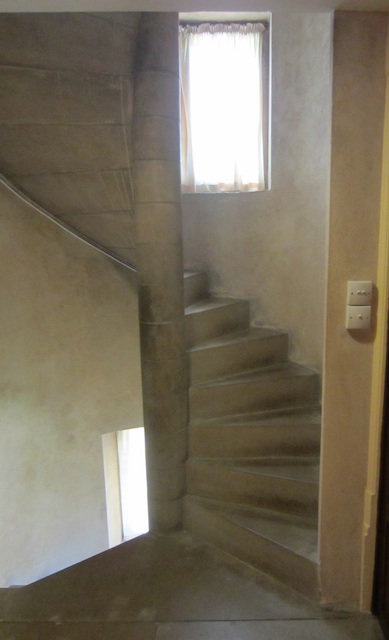
Jacob loved all the windy stairs in the house.

Jacob can't be bothered to turn around

A smaller winding staircase

I loved the massive library, which includes a small wheel-barrow used for carting books to your bedroom if you want to check an atlas or an encyclopedia at night. That's my kind of luxury.

The trick to having infinite bookshelves

The book-barrow

Many clocks adorn the house (apparently Lord Fairhaven loved punctuality). Another neat gizmo was this ceiling light with its clever use of mirrors.

Fancy clock

Light reflected out of the lamp

The dining room is the last stop of the house tour. It is the oldest room in the house and definitely reminds the visitor of the monastic origin of Anglesey Abbey.

Medieval dining area

After visiting the house, we went on to explore the gardens and the Lode Mill, but those are items for another post.