The
Oude Kerk or Old Church in Delft began as a simple stone church in 1050. Around 1240, a local official, Bartholomeus van der Made, began rebuilding and expanding the church, naming it
St. Bartholomew after his patron. By the late 1300s the church was completed and rededicated to
St. Hippolytus, patron of Delft. After the Reformation, it became known as the old church (in contrast to the new church on the Markt).
 |
| The eastern end of the church |
The church tower (built in the early to mid 1300s) has been a worry for centuries. Due to subsidence, it has leaned in different directions and demanded constant care.
The interior is quite bright and cheerful (a big contrast to the new church), with plenty of windows and white walls filling the church with light.
 |
| Nave |
 |
| Pews |
The main pulpit has some nice relief work of John the Baptist and the four evangelists. It dates from 1548 and somehow survived the
Iconoclastic Fury of the Protestants in the 1560s. It was moved to the center of the church, presumably to give preachers a better vantage on the congregation.
 |
| Main pulpit |
 |
| Evangelist John being inspired |
Strangely, another pulpit is in the north transept which dates from the 17th century and also has the four evangelists' theme.
 |
| Spare pulpit |
Two organs also are located in the church. At the back wall is the main organ, dating from 1857, with 2,832 pipes. In the north transept is a smaller organ from 1873 built by the same organ maker, Christian G. F. Witte.
 |
| Main organ |
 |
| Spare organ |
The area of the main altar now has the tomb of
Piet Hein, the Dutch naval commander during the
Eighty Years' War against the Spanish (1568-1648).
 |
| Main altar area |
 |
| Tomb of Piet Hein |
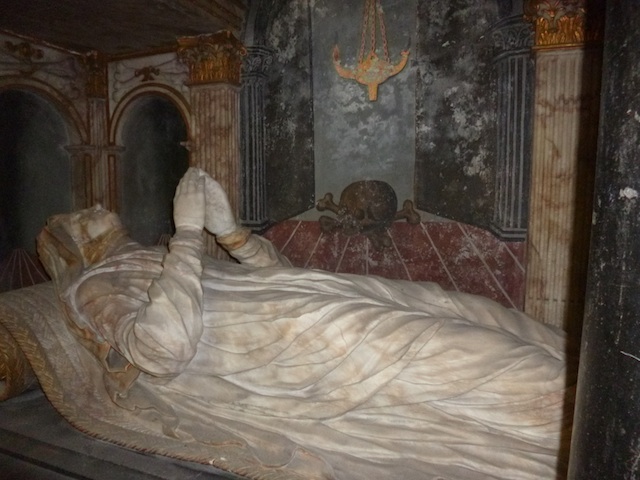
Johannes Vermeer is also buried here, though he died a pauper and was buried in his in-law's grave. He has just a small stone. A much larger tomb is Elisabeth Morgan's, who is the daughter of Philips van Marnix. He is thought to have written the Dutch national anthem.
 |
| Elisabeth Morgan tomb |
 |
| View inside the gate |
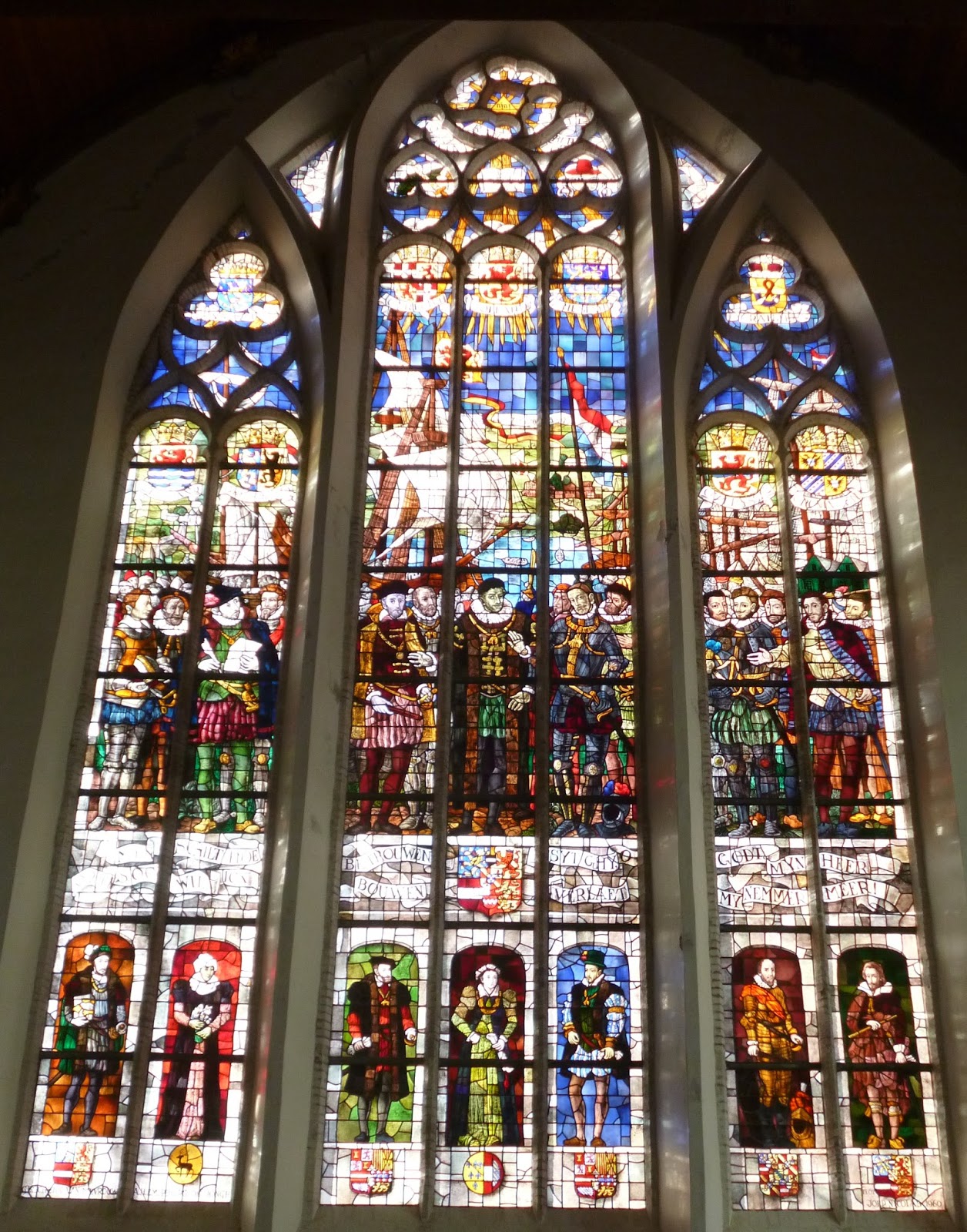
Stained glass windows have been in the church since the early 1400s. The fire of 1536 destroyed many of the windows and the
Delft Thunderclap (a 1654 explosion of the overstocked gunpowder depot) finished the job. The windows weren't replaced until the twentieth century. A wide variety has been installed, including both biblical and patriotic themes.
 |
| Patriotic stained glass |
 |
| Liberation window? |
 |
| Detail from a window |
 |
| The angel burning Isaiah's tongue from Isaiah 6? |
Who was Geertruyt van Oosten?
Geertruyt was buried in the church tower in 1358. She had been a member of the
beguinage opposite the church. The beguinage was a community of unmarried women who lived together for mutual support. She led a holy and pious and charitable life. Legend has it she received the stigmata, though when people flocked to Delft to see her, she begged in prayer for it to be removed. Her wish was granted as far as the blood flow, but the marks remained. She is venerated locally for her holiness.






 Posts
Posts

