Showing posts with label Granada. Show all posts

Monday, February 11, 2013

Alhambra V--The Rest of the Place

After seeing all the big sights at the Alhambra (except for the Generalife, which was the leisure palace with gardens further up the hill), let's look at some more bits and pieces of the complex. Though surrounded by a fortifying wall, the Alhambra is more of a self-contained city, including the fort, the royal palaces, places of worship, some residential and some commercial areas. We could have easily spent a day wandering through all the nooks and crannies.

J on the path into the Alhambra

At the visitors' gate is a large touristy cut-out the likes of which my children love. So they posed for a photo.

Cheesy photo op

A long, tree-lined path leads visitors to the gate into the Alhambra.

Walking the path

Main visitor gate (part of the long curtain wall around the complex)

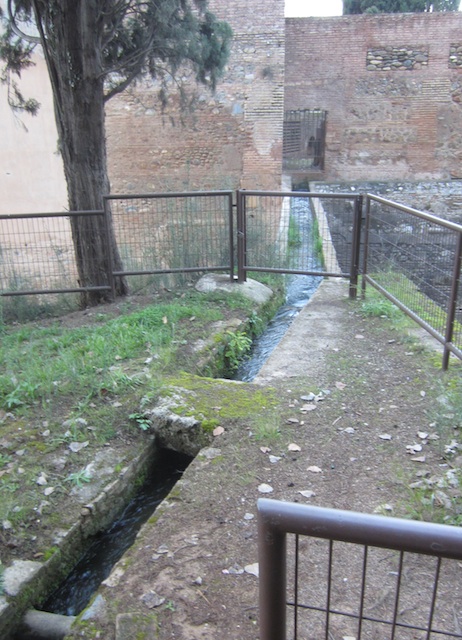
Just inside the gate is the Royal Water Channel, which brings water in from above and provides the fountains with fresh running water.

Running water, it's almost like a fountain

Water feeding into the Alhambra

Further along, we saw a large tower/gate that used to provide access. It's called the Puerta de Siete Suelos or Seven-Storeyed Gate, presumably because it has seven floors inside. We did not go in. The gate was built in the 15th century on the site of an old gate, but Napoleon's army blew the new gate up in 1812 when they retreated from Granada. The gate was rebuilt in the 1970s from paintings and descriptions.

Seven-Storeyed Gate (not so tall from inside the Alhambra)

View over the nearby wall

Just down from there is the Palacio Abencerrajes, helpfully translated on the visitors' map at "Palace of the Abencerrages." The legend goes that the Abencerrages were a family invited to a banquet in the 16th century at the Alhambra and were slaughtered at that banquet. No wonder their palace is now an archeological dig.

Their palace got slaughtered too...by Napoleon's dynamite (haha!)

Right next to the Church of St. Mary is the Mosque Baths. The baths were used to purify before prayer (remember that the mosque was demolished to build the church). But they were also used just to get clean and to socialize. The baths date back to the early 1300s.

Baths entrance

The ceiling had star-shaped holes to let light in

Inside the baths

Outside the baths

Across from the Palace of Charles V is the Gate of Justice or Puerta de la Justicia. Built in 1348, it is the largest gate and has memorials to Charles V and Washington Irving. Inside the gate is a sloping floor that twists and turns through the gate, making it impossible for military forces to charge through speedily in attacking or defending the Alhambra.

Inside entrance to the Gate of Justice

Outside entrance to the gate

Washington Irving memorial fountain

The gate also has some nice bits by it.

J loved the waterfall

Cats of the Alhambra

The Gate of Wine or Puerta del Vino is a smaller gate since it separated the Alcazaba from the artisan and royal area. Troops were originally stationed there; now it has a couple of gift shops.

Gate of Wine does not sell wine, alas

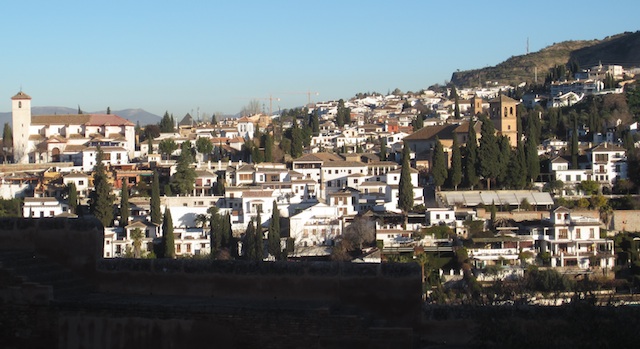
View of Granada from the Wine Gate vicinity

We noticed on our way out that the street were designed with a small channel to run off extra water. The children loved walking along both sides of the channel.

J crosses the channel

L couldn't decide which side to be on!

We could have stayed even longer if we had the ambition, or seen the Generalife which is more of the same spectacular architecture and gardens. Do visit if you go to Granada!

Sunday, February 10, 2013

Alhambra IV--Church of St. Mary

The Iglesia de Santa Maria de la Encarnacion is known in English as the Church of Saint Mary of the Alhambra, which is a rather rubbish translation, if you ask me. The church was built on the site of the Alhambra's Great Mosque, following the Renaissance style of a cruciform church. Inside are several Baroque altars, including the main altar. Construction began in 1581 and concluded in 1618. Ambrosio de Vico was the architect, following (and simplifying) a previous design.

Iglesia de Santa Maria de la Alhambra is another name

The church still has regularly scheduled Masses and is part of the Granada archdiocese. The interior is not too big but is very impressive.

Nave

Main Altar

Altar detail

The statue in the middle of the altar is called The Virgin of the Anguish by Torcuato Ruiz del Peral in the 1750s. It is taken out at Easter and used in procession at the Alhambra. The statue is put in a model of the arches from the Court of Lions made in silver, also on display in the church.

Processional throne

Other side altars include an Ecce Homo (named after the moment when Pilate presented the scourged Jesus to the crowd), St. Joseph and Jesus, and one to an unidentified bishop.

Ecce Homo altar

St. Joseph with the Christ Child

Some bishop?

The pulpit is another fine, ornate work in the church, with which L poses:

Pulpit

Visiting the church was a nice, quiet moment to relax during our visit to the Alhambra.

Saturday, February 9, 2013

Alhambra III--The Nasrid Palaces

The highlight of visiting the Alhambra is seeing the Palacios Nazaries, or the Nasrid Palaces. Three palaces were built by Muslim caliphs during the 14th century. The Comares Palace was built by Yusuf I (who ruled from 1333-1354). The Mexuar Palace was built by Ismail I in the 1360s. The Palace of the Lions was built in the late 1300s by Muhammad V. The buildings were constructed from rather modest materials (plaster, timber, and tiles), but the craftsmanship is simply amazing. They wanted to build a bit of paradise on earth, to show off their wealth, and to deny their waning power. When the Christians took over in 1492, they made some modifications but hardly any.

The Palaces are so popular that visitors need to buy timed tickets to enter. But first they stand in a long line a half hour before the ticket time. We dutifully did that, though J and L wandered in and out of line a few times. We finally got close enough to see the entrance, which leads into the Mexuar Palace.

Almost to the front of the line!
Court of Machuca next to the entrance

Door into the Mexuar Palace

The name "Mexuar" is derived from the Arabic Maswar, the hall where the council of ministers met and the sultan would dispense justice to the people. This was our first taste of the ornate beauty we were about to feast on.

Later Christian addition

One glorious ceiling

A glorious wall (click to enlarge)

The ceiling of the Golden Room

Patio del Mexuar

The Patio del Mexuar was finished in 1365 and was the meeting room for the sultan to consult his council or to listen to the petitions of his people.

Next to the Mexuar Palace is the Comares Palace. The Room of the Ship has some more amazing detail work. It is called thus for its ceiling which is like a ship's hull inverted.

Decorative ceiling in Room of the Ship

Wall details

Another ceiling, from the Salon de Embajadores I think

The Room of the Ship leads into the Salon de Embajadores, the largest and most important room in the Alhambra. It served as the throne room and as the meeting area for ambassadors. The ceilings there represent the seven heavens of the Muslim cosmos.

Wall and one ceiling in the Hall of the Ambassadors

A quiet corner

The scale of the work is amazing

The Salon leads out onto the Patio de Arrayanes or the Court of the Myrtles. It is so called for the myrtle plants around the central pool. The pool not only serves as a graceful and calming visual, but also reflects the light into the various windows around the courtyard.

Done ambassadoring, J and I are ready for more

Patio de Arrayanes

Various beneficiaries of the pool's light

J and the fountain

The final famous palace is the Court of Lions or Patio de los Leones. The lion-based fountain is the most emblematic part of the Alhambra and is an extremely popular spot to take photos.

Lion fountain and delicate columns holding up the arcades

Plenty of visitors here

J and the fountain II

We moved on from here to the Hall of Kings or Sala de los Reyos. Important art was kept there though removed long ago.

The hall is the art now

Many splendid arches

Just beyond the Hall of the Kings is the apartment where Washington Irving, famous author of The Legend of Sleepy Hollow and Rip Van Winkle (though at the time he was famous for a biography of Christopher Columbus), lived for a few months and was inspired to write his book of Tales of the Alhambra.

Washington Irving slept here

We ran into yet more gardens and fountains on the tail end of the Nasrid Palaces tour.

Another sweet garden

Another courtyard with a fountain

View from one of the towers along the wall

The Alhambra is not impervious to the occasional cheesy tourist photo op, which L gladly took advantage of.

Raising money for archeology, I think

The last bit was the archeological dig area of the Palace of Yusuf III, which also has some nice workmanship and a small, green pool.

The doors lead up to the top of this small tower

View from the top of the tower

We enjoyed the visit though the children's energies were drained by the beauty and the walking. We decided to find another snack before wandering off to see more of the Alhambra.