Louis XV had a serious illness in 1744. When he recovered, he decided to build a splendid church in honor of
St. Genevieve, the patron of Paris. French architect Jacques-Germain Soufflot designed the church in a Neo-Classical style. He wanted to make a rival to St. Peter's in Rome. Construction began in 1764 and was not complete till 1790. Soufflot had died ten years earlier and his assistant Rondelet finished the work.
 |
| Back of the Pantheon |
The next year, the Revolution's leaders turned the building into a national
Pantheon, a temple to house the remains of France's great men.
Mirabeau was the first to have his ashes put there, though
Voltaire,
Jean-Jacques Rousseau, and
Marat were soon to follow. Mirabeau and Marat were later removed when the political climate of the Revolution changed.
 |
| Rousseau's Tomb |
 |
| Voltaire's Tomb |
In the 1800s, the building was used for Christian worship during two separate periods. The building was finally given over to secular use in 1885 when
Victor Hugo was buried in the crypt. Various other illustrious French citizens have been buried here throughout the years, including
Marie Curie and her husband.
Alexandre Dumas' remains were moved here in 2002.
 |
| Victor Hugo (left), Alexandre Dumas (center) |
 |
| Marie (top) and Pierre Curie |
They are all in the extensive crypt downstairs. Up above is main body of the Pantheon, with a large open area. Originally the design had many windows to allow natural light to flood into the building. With the Revolution's repurposing of the building, they bricked up most of the windows to create a more tomb-like atmosphere. They also removed the main altar and put in a statue honoring the National Convention, part of the Revolutionary government in 1792.
 |
| Main altar area |
 |
| Mosaic above the altar, caption: Christ teaches the country's fate to France's guardian angel |
In spite of the many attempts to secularize the use and decor of the building, much of the religious art from the periods when it was used as a church still survive. Several massive paintings follow the life and major events of St. Genevieve.
 |
| St. Genevieve comforts Parisians when Attila the Hun was coming |
Other big events in French Catholic history are also recorded, including the martyrdom of the first bishop of Paris, St. Denis, and the crowning of Charlemagne by Pope Leo III.
 |
| St. Denis picks up his head after he is martyred! |
 |
| Coronation of Charlemagne |
A variety of sculptures from the early twentieth century are found throughout the main floor of the Pantheon.
 |
| Sculpture called "The Avenger" |
 |
| Hoche, general of the French army |
 |
| Tomb |
Off in a side room is a scale model of the Pantheon, including a cut-out section showing the interior.
 |
| Model of the building |
 |
| Model of the interior |
Under the dome of the building is
Foucault's Pendulum. That is, the French physicist Leon Foucault installed it himself in 1851. It was taken down when Napoleon III returned the building to religious use and then put back up in the early 1900s.
 |
| THE Foucault's Pendulum |
 |
| THE dome |
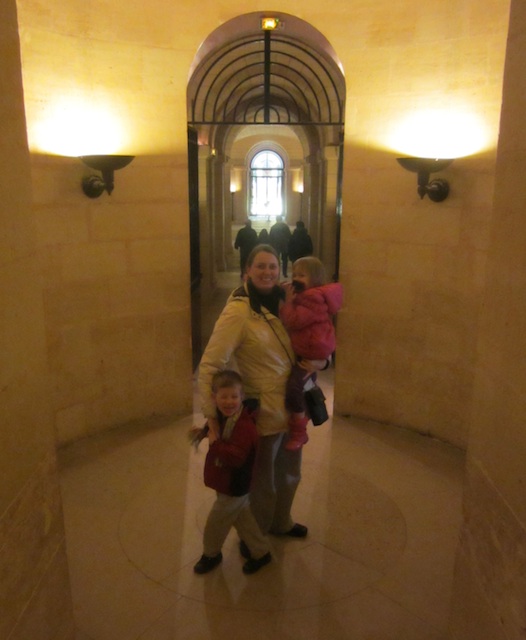
The children enjoyed running around the large emptiness of the upstairs. Down in the crypt they were more sedate, as was fitting.
 |
| Running around a nice open area |
 |
| Posing in the crypt |
When we came out, we caught another glimpse of the Eiffel Tower in the distance.
 |
| View down Rue Soufflot |




 Posts
Posts

