Showing posts with label Ripon. Show all posts

Monday, May 26, 2014

Bits of Ripon, England

Here's some parts of Ripon that never made it into their own posts!

Ripon is a charming market town in the heart of Yorkshire. Ripon has a Wakeman who keeps watch over the city. Every night at 9 p.m. he comes to the market square and blows his horn. The tradition has continued for over 900 years and is still done. The Wakeman also blows the horn on Thursday mornings to announce the opening of market day.

Ripon Market Square

The town hall

The Wakeman's House, now a pub

The Cenotaph in the market square is 300 years old and commemorates war heroes from many different conflicts.

The cenotaph

Just outside the square is the Spa Baths. Constructed in 1904, it serves as an indoor swimming pool to locals.

Ripon Spa Baths

Across the street is the Spa Park Maze, a 2001 recreation of an ancient turf maze destroyed in 1827. The maze (according to records) was known as the "Maiden's Bower" and probably had something to do with fertility rites.

Spa Park Maze

Beyond the maze is a playground. The kids weren't with me when I visited so there are no cute pictures of them in action.

Playground without children!

Holy Trinity Church is located on the other side of the park. It is the less famous Church of England building in Ripon (the other being the Cathedral).

Trinity Church

On the other side of town is the Victorian Clock Tower. Two sisters had this built to commemorate Queen Victoria's Diamond Jubilee in 1897.

Victorian Clock Tower

The other side of the tower

Sunday, May 25, 2014

St. Mary Magdalen/The Leper Chapel, Ripon, England

The Church of St. Mary Magdalen sits on the edge of Ripon. The church was founded as part of the Hospital of St. Mary Magdalene by York Archbishop Thurstan circa AD 1115. This Norman chapel is all that remains of that original site. The hospital took care of lepers in the area (Crusaders could have brought back the disease from their travels). The sisters provided food, clothing, and shelter for the lepers. As well, they maintained a priest for the chapel. By the 14th century leprosy had mostly died out and the hospital began serving the sick and destitute of Ripon. After the Dissolution of the Monasteries under King Henry VIII, the abbot of nearby Fountains Abbey became the chaplain for the hospital. The mastership of the hospital was given to the deans at Ripon Cathedral in 1688 and they have supplied clergy for the church since then.

Chapel of St. Mary Magdalen, Ripon

3/4 view

Visitors are welcome but have to get the key to the door. Some almshouses were built across the street and two of the residents have keys. The original doorway is true to the ancient Norman style.

The key to the church

The Norman door

Inside is the original Norman baptismal font, which was found in a local field. It was used as a cattle trough but was restored to the church in 1951. A new base was added.

Baptismal font

Another entrance is on the other side of the font.

Not in use

The nave of the church is separated from the choir by a fifteenth-century oak screen.

Nave

Just on the other side of the screen in the left (or northern) wall is a low window called the Leper Window. Lepers could attend Mass from outside and were able to receive communion through the window.

The Leper Window on the left

The sanctuary shows signs that statues and relics were kept there before the Reformation. One niche is clearly filled in.

A corner of the sanctuary

The stone altar is the original Norman altar, unharmed by Cromwell's Puritans except for a crack in the middle. The piscina on the south wall is also early and apparently still in use.

The Norman Altar (crack not visible)

Piscina

A small mosaic in the floor is assumed to have come from a Roman villa in Ripon that is no longer extant.

A nice mosaic

In the mid-1800s, a larger church was built across the street to serve the congregation. It was not open for visitors.

Victorian Church of St. Mary Magdalen

Saturday, May 24, 2014

Ripon Spa Garden, England

The Ripon Spa Garden is a well-maintained park just outside the town square. It has something for just about every taste.

Entrance to Spa Gardens

The Ripon War Memorial is located here and has won Best War Memorial, "town class," in Yorkshire several times.

Ripon War Memorial

Close by is the statue of the Marquess of Ripon, George Frederick Robinson. He was born at 10 Downing Street in 1827 (yes, he was the son of a sitting Prime Minister). As an adult, he was known as Earl de Grey, and worked tirelessly for the good of the country. He served in Parliament and then in the War Office. He worked with Florence Nightingale to improve the lives of average soldiers and negotiated to avoid war with America over the Alabama Affair (the Alabama was a Confederate ship that received hospitality from British ports during the American Civil War; the US Government was naturally unhappy that Britain's promise of neutrality had been violated; Earl de Grey smoothed things over). He became a Roman Catholic in 1873 (a controversial move for a prominent British politician). He served as Viceroy to India in 1880. He died in 1909.

Marquess of Ripon statue

Close up

The garden has a large lawn with a Victorian Gazebo in the middle. Concerts are performed on Sunday afternoons in the summer with plenty of ground for picnicking.

The lawn

The gazebo

A mini-golf course and other fun activities are available as well as a small cafe for a cuppa and a snack.

Mini-golf with the cafe behind it

Another fun activity is the Green Man Trail. Many Green Man plaques are hidden among the trees and bushes. I only found the obvious one on a shed door. I must bring the kids next time to help in the hunt!

Green Man on the door!

Of course, the garden has plenty of well maintained flower beds and interesting trees.

Early spring crocuses

A tree in early spring before getting leaves

The most interesting tree is one that has been cut down. It was not entirely removed and Chainsaw Mick has carved several characters from Lewis Carroll's Alice in Wonderland on the remaining tree branches. Carroll's father was a canon at Ripon Cathedral, so young Lewis spent plenty of time in Ripon.

Alice in Wonderland carvings

Alice and the Mad Hatter

Another Green Man!

Spa Garden is worth a visit when coming to Ripon!

Tuesday, March 4, 2014

Ripon Pancake Race 2014

A fun British tradition is the Pancake Race on Shrove Tuesday, commonly known as Mardi Gras in America. I went to Ripon Cathedral which was hosting an event this year.

The cathedral getting ready

Pancake making before the race

According to the internet,
The event at Ripon has been a regular fixture since the 1990’s when an ancient tradition was revived. It marks Shrove Tuesday, the day of celebration and finishing off the eggs before Ash Wednesday, the beginning of Lent, a period of fasting and spiritual reflection in the church’s calendar, when traditionally Christians give up certain foods such as meat, eggs and fish.  Lent lasts for 40 days, the period that Jesus Christ fasted in the wilderness at the start of his ministry. 
The cathedral has a Pancake Bell which rings at 11 a.m. to signal the start of the festivities. The bell has tolled on Shrove Tuesday for some 600 years, though for most of the time it was a call to the locals to be "shriven" of their sins in confession (hence the "shrove" in Shrove Tuesday). In 2008 the race wasn't held because of a mountain of health and safety paperwork. The next year public demand was so strong that the obstacles were overcome.

This year, racers included some of the clergy and the local authorities. Children from local school came to participate as well. Some ladies (and a few gents) dressed up in old-fashioned clothes, including white aprons and bonnets, to race down the street. Toward the end, it seemed like individual groups and families came up for a go.

People getting ready to race

Here's a video of the racers in action!


Thursday, August 8, 2013

Markenfield Hall, UK--The Hall

After visiting the moat, let's go through the guardhouse and see the courtyard and the interior of Markenfield Hall!

The courtyard is remarkably like it was back in the middle ages. A report from Queen Elizabeth's surveyors (the property was confiscated since the owners were on the losing side of the Rising of the North) gives the same impression that modern visitors would--the main hall is in the back, flanked by various farm buildings and lodgings for farm workers and visitors. The only thing out of place now is the modern vehicles.

Stables, now the garage

The main hall across the courtyard

Visitor accommodations and work rooms (and anachronistic vehicle)

The entrance is slightly changed in that a stone staircase formerly lead above the current door into the great hall on the first floor (or second floor if you are American). Visitors can see the archway that has been filled in slowly being covered over in foliage.
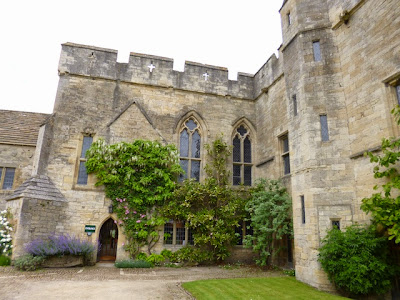
Main Hall

Inside, the first room is the Undercroft, which would have provided support to the great kitchen on the left. The kitchen is no longer there, it has been subdivided into several other rooms. After the Crown took over in the 1570s, the Undercroft also was subdivided. The entrance room became the kitchen for the tenant farmers who worked on the estate. The great hall's fireplace was dismantled and brought downstairs, making the centerpiece of the farm kitchen.

Entrance fireplace

Neighboring small kitchen

Medieval arches from the Undercroft

The rooms to the right lead to the interior stairwell, with the usual apparatus--coat hooks and a nice grandfather clock.

L can't wait to go upstairs

J is serious about being on time!

The Great Hall was originally built in 1280 and was a free standing building. When John de Markenfield was licensed to crenelate the house, he united the Great Hall to the surrounding buildings, making the impressive manor house that stands today. The hall was used for entertaining until the confiscation. Both it and the chapel were used for storage by the farmers. A modern replica of the 1340 fireplace has been installed, along with many furnishings and paintings to make a comfortable if busy room.

Great Hall from the stairs

The "new" fireplace

Books, busts, and breakables (luckily out of children's reach)

My dream--a bookcase with a ladder!

A fancy chest

Down a short hallway from the Great Hall is the Chapel. The hallway has a spooky arch and the windy staircase we guessed must be in the house when we were outside.

Spooky arch

Windy staircase

Exterior of windy staircase

The chapel is dedicated to St. Michael the Archangel and was part of the 1310 expansion of the house. Mass was said here daily for 250 years by a series of resident priests, who were probably associated with nearby Ripon Cathedral (only three miles away). After the Rising, it became a store house and was eventually restored as a chapel in the 1980s.

St. Michael Archangel

Altar

North wall, indicating where two levels were built for storage

One remarkable part of the chapel is the medieval double piscina. It was used by the priest to wash his hand on one side and to clean the chalice and paten on the other side. The carving is quite elaborate, including the Markenfield crest and several oak leaves and acorns.

Medieval piscina

Nearby is a 17th century statue of a pelican feeding her young. It was believed that pelicans would tear open their breasts and feed their own blood to their young, much like Christ offering His blood on the cross to save mankind. Beneath the baby pelicans is the crown of thorns.

Pelican in her piety

We saw several bedrooms but signs asked not to take photos since the bedrooms are in use by the family. The rooms look cozy but it is hard to imagine living in such a house day to day.

Markenfield Hall is only open a few times a year and we have been meaning to see it for quite some time. We were happy to have the opportunity and highly recommend a visit. Services are still held in the chapel, which we have thought about attending but haven't worked it out yet.