See previous Winterthur posts about the gardens, the children's garden, and the house at the links.
Having a massive estate with buildings to spare means there's plenty of room to have a museum at Winterthur, a sprawling du Pont estate in Delaware. On our visit, we saw some of the permanent exhibits and an intriguing temporary exhibit on art forgeries.
The museum has several rooms of items collected by the du Pont family. Henry Francis du Pont was an avid collector of American colonial antiques.
Our children enjoyed most the exhibits with some interactivity.
The du Ponts collected a lot of furniture, even outside the American colonial period.
The displays also have some more practical items, if fine china can be considered practical!
Works of iron are prominent in the collection as well.
Painting also make nice collectables, though our children were not very interested.
A whole room is dedicated to embroidery. Books on technique and patterns sit alongside various works.
Upstairs is the exhibit "Treasures on Trial: The Art and Science of Detecting Fakes."
The first display describes various terms used about faked art. Sometimes copies or replicas are made without an intention to deceive, just to have something to take home and remind one of a great work. Forgeries and counterfeits are made with the intent to deceive, leading to criminal fraud in some cases.
Fashion is a popular area where "knock-offs" are used either to look good or to make money through fraud.
Historical items are also popular to reproduce, such as the famous Stradivarius violins. Antonio Stradivari worked in the 17th and 18th centuries and his violins are so popular (and valuable) that fakes are a way to make a tidy profit on the gullibility of buyers.
Tiffany and Co. makes more than jewelry--their stained glass is also famous and used in decorative practical items like lamps.
Paintings are another area where copies and forgeries can turn up.
At the end of the exhibit is a vampire killing kit from the 1800s, providing an interesting case of deception. Did people really believe in it or did they go along because of the Dracula hype? Has someone more recently reproduced the kit, making it look older and possibly authentic?
The museum had a lot of items we didn't get to see (a whole other wing is devoted to decorative soup tureens--for some reason the children weren't interested). If we lived closer we'd consider becoming members so we could visit the grounds and the museum again.
Having a massive estate with buildings to spare means there's plenty of room to have a museum at Winterthur, a sprawling du Pont estate in Delaware. On our visit, we saw some of the permanent exhibits and an intriguing temporary exhibit on art forgeries.
The museum has several rooms of items collected by the du Pont family. Henry Francis du Pont was an avid collector of American colonial antiques.
 |
| Grandfather clocks |
 |
| Clockworks and other gizmos |
Our children enjoyed most the exhibits with some interactivity.
 |
| A fun touch screen |
The du Ponts collected a lot of furniture, even outside the American colonial period.
 |
| Old furniture |
 |
| A good variety of chairs |
 |
| Different styles of feet on chairs explained |
The displays also have some more practical items, if fine china can be considered practical!
 |
| Mishmash of fine china |
 |
| A massive loom |
Works of iron are prominent in the collection as well.
 |
| Iron gates and things |
 |
| Gold beater's trade sign from Boston |
 |
| Decorative and functional parlor stove |
 |
| Rifles |
Painting also make nice collectables, though our children were not very interested.
 |
| Paintings and Prints gallery |
A whole room is dedicated to embroidery. Books on technique and patterns sit alongside various works.
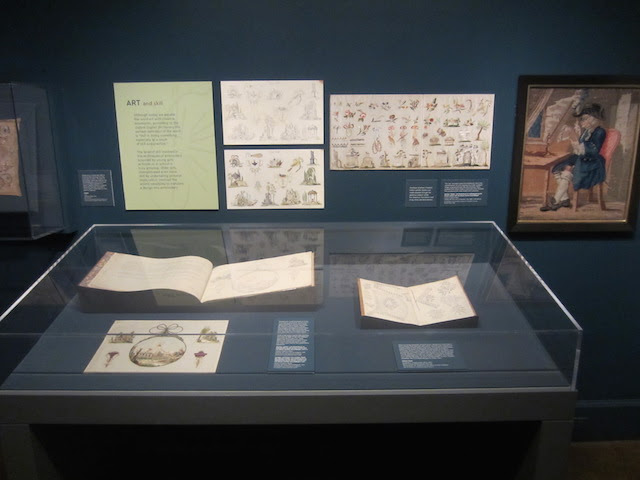 |
| A little "how to" display |
 |
| "The Politician (after William Hogarth)" attributed to Alice De Fuller (1870-80) |
 |
| An amazing basket |
Upstairs is the exhibit "Treasures on Trial: The Art and Science of Detecting Fakes."
 |
| Fancy stairs |
 |
| The entrance |
The first display describes various terms used about faked art. Sometimes copies or replicas are made without an intention to deceive, just to have something to take home and remind one of a great work. Forgeries and counterfeits are made with the intent to deceive, leading to criminal fraud in some cases.
 |
| The good, the bad, and the illegal |
Fashion is a popular area where "knock-offs" are used either to look good or to make money through fraud.
 |
| Dresses, handbags, and sunglasses--I certainly can't tell fakes from reals |
Historical items are also popular to reproduce, such as the famous Stradivarius violins. Antonio Stradivari worked in the 17th and 18th centuries and his violins are so popular (and valuable) that fakes are a way to make a tidy profit on the gullibility of buyers.
 |
| Explaining violin making techniques/details |
 |
| A fake Stradivarius |
Tiffany and Co. makes more than jewelry--their stained glass is also famous and used in decorative practical items like lamps.
 |
| A Tiffany lamp and a fake |
Paintings are another area where copies and forgeries can turn up.
 |
| "The Procuress" by Dirck van Baburen and a fake |
 |
| Van Gogh's "Oleanders" with a copy by John Myatt |
At the end of the exhibit is a vampire killing kit from the 1800s, providing an interesting case of deception. Did people really believe in it or did they go along because of the Dracula hype? Has someone more recently reproduced the kit, making it look older and possibly authentic?
 |
| Vampire killing kit info |
 |
| Real or fake? |
The museum had a lot of items we didn't get to see (a whole other wing is devoted to decorative soup tureens--for some reason the children weren't interested). If we lived closer we'd consider becoming members so we could visit the grounds and the museum again.




 Posts

