Showing posts with label pope. Show all posts

Friday, April 21, 2017

Book Review: Jesus of Nazareth: Holy Week by Benedict XVI

Jesus of Nazareth Part II: Holy Week: From the Entrance into Jerusalem to the Resurrection by Benedict XVI


Benedict continues his deep analysis of the Gospel texts to understand who Jesus is and what faith in Him brings about for believers. This book follows Jesus from His Palm Sunday entrance into the holy city of Jerusalem through the resurrection with an epilogue about His ascension. Naturally, other relevant texts from the Old Testament and the New Testament are referenced and explained in light of Jesus's passion, death, and resurrection. The songs of the Suffering Servant from Isaiah and a surprising number of the Psalms have fuller and deeper meaning. The book is steeped in Holy Scripture.

The book is also very aware of recent scholarship about Jesus. Benedict frequently references the work of the historical-critical method without going into depth about the method. Rather, he uses their work to investigate who Jesus is and what faith in Him brings about for believers (i.e., Benedict sticks to his purpose!). Benedict has an awareness of academics and often references their work, not to engage in controversies, but to grow in understanding. He also references the Church Fathers and the great theologians from history such as Saint Augustine of Hippo and Saint Thomas Aquinas. The book never bogs down in scholarly conundrums or technical details.

Benedict stays focused on certain details and often admits that more can be said about the events and details than he presents. Such a claim is amazing considering the depth and originality of his own analysis. Consider his discussion of Jesus's trial with Pilate, where John quotes the crowd as demanding Jesus's death and saying that His blood will be upon them and their children. Historically, this text is used to justify anti-Semitic violence and hatred, a fact Benedict acknowledges. But he goes deeper and says that "the Christian will remember that Jesus' blood speaks a different language from the blood of Abel (Heb 12:24): it does not cry out for vengeance and punishment; it brings reconciliation. It is not poured out against anyone; it is poured out for many, for all." [p. 187, emphasis in original] The crowd is just as worthy as anyone else to be redeemed by His blood, even if they did not immediately intend it. Benedict also says the crowd was probably full of Barabbas supporters waiting for the moment when they could get their condemned man out of trouble by taking advantage of Pilate's Passover amnesty. The crowd certainly didn't represent the Jewish people as a whole. Benedict does go into detail when discussing events and issues when he deems it appropriate. Naturally Jesus's death and resurrection are so fundamental to Christian history and faith that endless details and meanings can be brought out of them.

This book is a wonderful presentation of Jesus in the definitive moments of His mission for us, that is, to reconcile mankind to the Father and to open up a greater intimacy between God and His creatures. Readers will find much to inform and inspire them to strive for that intimacy through greater knowledge of Jesus of Nazareth.


Tuesday, April 19, 2016

News I Wish Was True

As an April Fool's Day prank, the venerable Bruce Campbell posted this image in his Twitter feed:

Holy Awesome, Batman!

Read an article about the reaction here. I would start watching Doctor Who again if this were true! Replace those Sonic Sunglasses with a Sonic Chainsaw...Groovy!

In case you don't know, there's a Catholic version of The Onion which is called Eye of the Tiber. They had an article about a recent superhero movie that has performed poorly at the box office...

This is what happens when you have two popes at the same time

Like the Batman vs. Superman movie, I'd probably wait for this one to come out on video and then rent it from the library (so I can see it for free if it was real). The popular movies at the library usually have hundreds of requests, so often I wait two or three month before I get the DVD. By the time I reach the top of the queue, I sometimes have lost interest. I know I've returned unwatched DVDs to the library but I can't even remember an example (other than I almost returned an unwatched Jurassic World but then had an unexpected free evening and wound up watching it anyway).

As for actually true news, Everyday Einstein podcasts about a report that eating chocolate can make you smarter, in addition to the other benefits science claims for chocolate eating, e.g. better cardiovascular health and less chance of stroke. Like we need more reasons to eat chocolate! Sadly, no information is provided for people who want to volunteer for future studies concerning chocolate consumption.

So at least one bit of news really is true.

Saturday, June 7, 2014

Book Review: The Life of St. Benedict by Gregory the Great

The Life of St. Benedict by Gregory the Great, translation and commentary by Terrence G. Kardong


Over a millennium ago, the biographies of saints were written in a far different style than today. Today, an author probably focuses on the challenges and failings of a saint rather than any miraculous or seemingly superhuman feats they accomplished. By contrast, the ancient tradition of hagiography (writings about the holy ones) reveled in miraculous events and conversions, almost like the saints were superheroes powered by grace rather than gadgets or gamma radiation. Pope St. Gregory the Great wrote just such a biography of St. Benedict, founder of the monastic tradition in the western church.

The text follows Benedict's life from childhood and his first experiences at school in Rome. Living in the late 400s, life was decadent. Benedict was appalled at the behavior of his Roman classmates and fled to the countryside where he became a monk. People heard about him and came to him. A nearby community lost its leader and they invited Benedict to be the new leader. He wanted them to live a holy life, giving up their luxuries. They were unhappy with this and poisoned Benedict's wine. As they brought the pitcher, he blessed it according to the local tradition. The pitcher shattered; Benedict instantly knew they were trying to poison him. He upbraided them and told them to find another father more suited to them.
That's just one example among many along the way. The commentary by Terrence Kardong does a good job of explaining the ancient style and relating the stories both to other examples of hagiography and other writings by and about Benedict. Kardong is well aware and sympathetic with the modern discomfort over miracles, especially when they happen on almost every page. He also is very aware of the literary style of the work. Not only is the prose beautiful to read but the ordering of the stories sets up interesting contrasts or similarities between events in Benedict's life.

For those afraid of finding a miracle-laden text too unbelievable, this translation and commentary makes it much easier reading. The stories told are very interesting and vivid, making this book worth reading just as literature. I enjoyed it thoroughly.

Sample Quote--the famous story when Benedict was tempted by lust:
A victim of lust, he almost decided to desert the hermitage. Suddenly, favored by grace from above, he came to his senses. Seeing a thicket of briars and nettles growing close at hand, he stripped naked and threw himself in the sharp thorns and stinging nettles. He rolled in them for a long time and as a result was scratched from head to toe. The physical wounds on his skin removed the wound of his mind, for it converted lust into sorrow. By means of an external punishing fire, he snuffed out what unlawfully burned inside. So he conquered sin by switching fires. [p. 13]


Sunday, February 9, 2014

St. Peter's, Rome

St. Peter's has a long history in Rome. The church is built over the Circus of Nero where Peter was crucified. He was buried nearby. The first shrine was built on St. Peter's tomb in the second century. Emperor Constantine built a large basilica in AD 349. By the 1400s, the basilica was falling apart. In 1506, Pope Julius II began a new basilica which took over a hundred years to build.

St. Peter's

The porch has several large bronze doors, including the Porta Santa, or Holy Door, which is only opened on Holy Years by the Pope. He uses a small bronze hammer to knock on it. It remains open for the entire year and people may enter through it. Other doors include the center door that was made in the 1450s for the original basilica and the Door of the Sacraments that was made in the 1950s.

Central Door

Detail from the Door of the Sacraments

Detail from the porch ceiling

The nave is 615 feet long with a large number of altars and chapels down the sides. The scope is quite breathtaking.

Nave

One side altar

A transept

The Papal Altar dates from 1600s and was built over the tomb of Peter. The Baldacchino is an amazing bronze canopy designed by Bernini in the 1600s.

Main altar and baldacchino

The baldacchino (as close as we could get)

The top of the baldacchino and medallion of an evangelist

The main altar is also surrounded by four niches that house relics from Christ's Passion. The relic of the True Cross has a statue of St. Helena (Emperor Constantine's mother and the discoverer of the relic).

St. Helena by A. Bolgi

The Dome of St. Peter's was designed by Michelangelo and is an incredible sight both inside and outside. Sadly, I did not get a good angle on the inside. Also by Michelangelo is the Pieta, one of his most famous statues and an early work for him (completed when he was 25 in 1499). It is located in one of the front chapels and protected behind a wall of glass since one visitor damaged it in 1972.

Pieta

Another famous work in St. Peter's is Raphael's last painting, The Transfiguration. It depicts Christ on Mount Tabor, flanked by Moses and Elijah while Peter, James, and John are awestruck.

Raphael's Transfiguration

The statue of St. Peter near the main altar dates from the 1200s and was made by Arnolfo di Cambio. It is a popular stop for people visiting the church. Visitors rub Peter's foot for good luck. The foot is starting to wear away. Alas, the preparations for New Years Day Mass put the statue out of reach for us.

St. Peter (losing his toes!)

In addition to St. Peter, many other popes are buried in the basilica. A list is kept in a side room (with plenty of space for newcomers).

The Latin at the top says, "Supreme Pontiffs buried in this Basilica"

Pope Innocent XI (1676-1689) flanked by Faith and Fortitude

Pope Pius XI (1922-1939)

Pope Gregory XIII (1572-1585)

Pope Gregory XVI (1831-1846)

Pope Innocent XII (1691-1700) flanked by Charity and Justice

Pope Benedict XV (1914-1922), who worked for peace during World War I

Pope Saint Pius X (1904-1914)

Pope Pius VII (1800-1823)

One of the non-papal monuments is to the Monument to the Stuarts. The monument is dedicated to James III, son of King James II who was the last Stuart to reign in England. James III lived in exile after his father was deposed in 1688. Invading Prince William of Orange was declared King of England in James II's absence. Also buried in this tomb are James III's sons Bonnie Prince Charlie and Henry (who by all rights should have been King Henry IX(!), though he was a Catholic bishop so the house of Stuart would have ended with him) are also buried in this tomb.

Monument to the Stuarts

Being Christmas time when we visited, St. Peter's had a nativity inside.

Nativity from the right

Detail

Nativity from the left

There are tons of other things to see in the church. Also, the view from the dome is quite spectacular in good weather. The weather wasn't so good when we visited and J and L were unlikely to climb all the way to the top, so we opted for other sightseeing in Rome.

Sunday, January 19, 2014

San Giovanni in Laterano, Rome

San Giovanni in Laterano is Saint John Lateran, or the church of Saint John on Lateran Hill. I remember one parish priest admitting that, since St. John Lateran has a feast day he would pray to John Lateran on that day. Later he realized it was not a person but a building!

San Giovanni in Laterano

The original church was built in the 4th century when Emperor Constantine took the land of a disgraced family and gave it to Pope Melchiades. The church includes the Lateran Palace, which was the official residence of the pope until 1309. The basilica is still the pope's official cathedral as bishop of Rome, so it is Pope Francis's home parish. The church definitely follows a "Jesus and His Apostles" theme, as can be seen with the roof statues.

Closer view of some of the roof statues--Jesus in the middle of course!

The front porch has some fantastic decoration, including a papal seal for a seemingly young and innocent pope. Also, one of the bronze doors is only opened for holy years (often those divisible by 25, though other special occasions sometimes arise).

Pope Innocent the Small?

More decorations

An outside statue

Holy year door

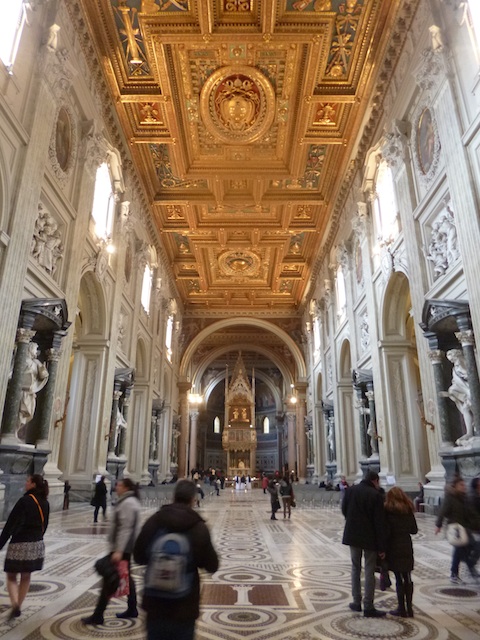
The interior of the church was redone in 1646 by Boromini with ornate Counter-Reformation exuberance. The nave is lined with statues of the apostles. Jacob was excited to see Jacob Major (James the Greater) was one of the statues!

Nave

Amazing ceiling (click to enlarge)

Apostle John

Jacob Major!

Peter, who is at the front, naturally

The main altar in the center of the church is the Papal Altar. Only the pope celebrates Mass here.

Main altar

Baby Jesus

Behind the main altar, in the apse, is the Pope's chair or cathedra, from which "cathedral" is derived. It is his chair as bishop of Rome.

Apse and papal cathedra

Mosaic detail

In addition to the Baby Jesus by the main altar, two side altars had Christmas nativities.

Side altar as you enter the cathedral

Simple nativity

More elaborate nativity further up

Many side chapels are dedicated to different popes, including this one for Leo XIII.

Leo XIII memorial

Side altar

Dome to the side altar

Side altar with fresco

Even the floor impressed me with its fancy designs.

Floor design

Holy Spirit on the floor!

As we left, we saw the typical line of merchants who were sheltering from the on-again, off-again January rain. Luckily, they were off to the side and easy to avoid.

The shopping gauntlet