We went on a quick trip to St. Marys City, Maryland. It was the first capital of colonial Maryland. The colony was established as a haven for English Catholics, though the Calvert family wanted to create a place where Protestants and Catholics could live together in harmony (a radical idea in the 1600s). The initial colonists landed on St. Clement Island nearby. They established St. Marys City on the peninsula between the mouth of the Potomac River and the Chesapeake Bay. The city grew and housed the government until a Protestant take-over of the government. They moved the capital to Annapolis. St. Marys had no other industry to keep it going so it more or less vanished. Archeology in the twentieth century has found the sites of various buildings and many restorations have happened. The area is now an outdoor museum with several buildings re-created fin seventeenth-century style.
We parked at one of the visitor centers and were promptly greeted with an overview of the area.
 |
| Reading about the past |
We followed a trail to where the main sites and re-enactors were. We visited on a Friday, so demonstrations were scheduled throughout the day.
 |
| Old-style fence |
 |
| Recreation of a native village |
 |
| A native who is still hanging around |
 |
| We weren't sure if these were works in progress |
We walked past the print house and the smith's ordinary (which had suspiciously modern roofs) to the docents in the town center.
 |
| Printer's and Smith's |
The docents were making candles of various sizes. Some of them (the docents, that is) looked like summer interns and were not as skillful at candle making. They dipped the wicks in hot wax and let them cool a bit and dipped again. This process seems laborious. At least they were working with bee's wax, which is the sort of candles the rich would use. Poor people used the cheaper (but smellier) tallow candles, made from rendered animal fat that the butcher couldn't sell.
 |
| Talking about candle making |
 |
| John Wick |
The docents taught us a few of the games that children (and adults) would play back in the 1600s.
Quoits is a type of ring toss with rope rings and wooden pegs.
Hoop and stick was a dexterity game trying to keep a hoop rolling along the ground using a stick to add momentum.
 |
| Quoits |
 |
| Hoop and stick |
 |
| Trying a different style |
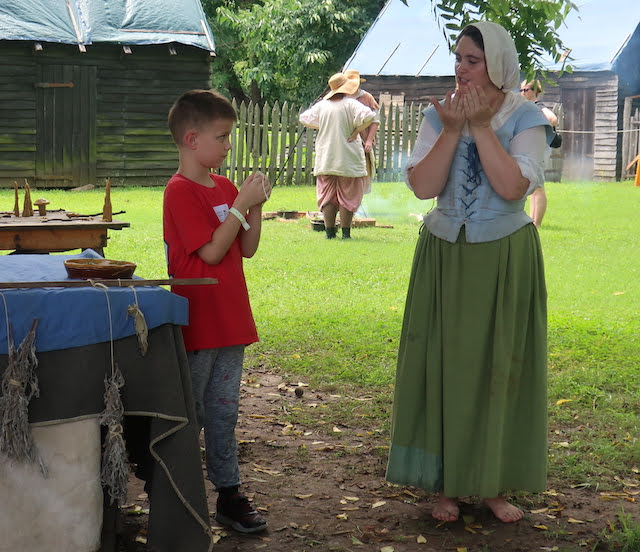
The docents then had a presentation on medicine in the colonial period. The only pharmacies back then were herb gardens. Medical practices had a mixture of folklore and fact. One practice was to make a small cloth pouch with herbs for smelling in case you ran into some foul situation or needed a little refreshment on a hot day and didn't have any water. My son was selected out of the audience to help make a bag.
 |
| The medicine cabinet |
 |
| Looking for good herbs |
 |
| Rubbing them to get the oils out |
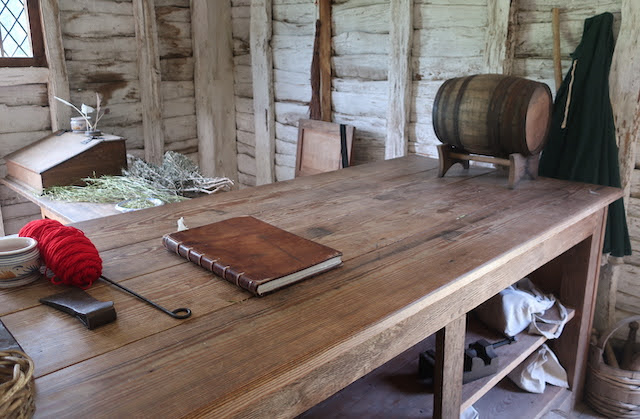
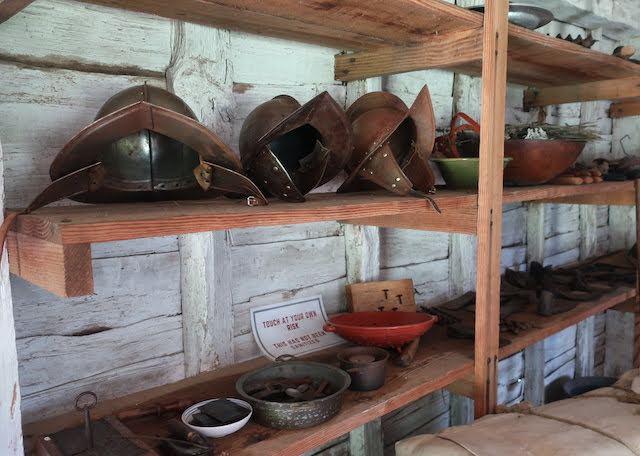
Nearby is Cordea's Hope, a house that is set up as an old market (the Target or Walmart of its day). The interior had lots of items that would be available for purchase. Almost all would have been brought from Europe. The American colonies sent back raw goods, tobacco, and furs, and received housewares and other items that would make life more like the old country.
 |
| Cordea's Hope |
 |
| Warning label! |
 |
| The main counter |
 |
| Imports from the old country |
 |
| Tool section |
 |
| A chandelier! |
Archeologists discovered the location of
Leonard Calvert's house. He was the first governor in the colony of Maryland. The house was built around 1636 out of wood. The house was large enough that it became the government's meeting house when the property was purchase by the government in 1662. After they built the brick state house nearby, John Baker bought Calvert's home and turned it into a public inn. He and his wife Elizabeth added the brickwork. Modern brickwork sits over the original to mark the site and protect the original brick.
 |
| Location of the Calvert House |
A replica of an inn is nearby--Van Sweringen's Inn. We were not able to go inside.
 |
| Van Sweringen's Inn |
A nearby plaque commemorates Mathias de Sousa, the first black Marylander. He came with the initial colonists on
The Ark and The Dove as an indentured servant (one of the nine indentured servants onboard). He was free of his indentures in 1638 and took up fur trading and sailing. He even served in the Maryland legislature in 1642.
 |
| De Sousa plaque |
We continued our visit by going down to the water and seeing a recreation of The Dove, the smaller of the two vessels that carried the colonists to Maryland. The boat is more of an approximation of what The Dove would have been like since the records are spotty and getting a custom-made old-time ship is not cheap. The shipwrights used the typical plans for a seventeenth-century pinnace as their guide.
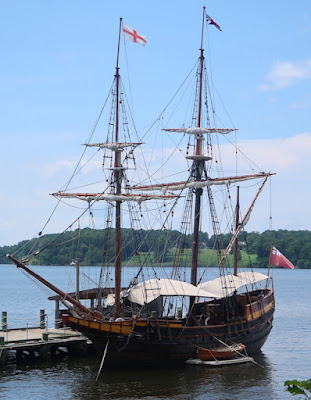 |
| Dove-like vessel |
 |
| Going aboard |
 |
| Dinner set |
 |
| Captain's cabin |
 |
| Crew bunks |
 |
| The front deck |
 |
| View ahead |
The docents were going to fire the small cannon on deck. Such cannons were not used for combat since they were too small and too inaccurate for sea combat. The guns were used by merchants as a way of signaling to other boats or to towns when they were arriving in port (letting the locals know to come and buy the best of the merchandise).
 |
| One-pound gun |
 |
| Bilge pumps |
I tried to get a picture of the gun going off but was too slow. Naturally, we watched from far away on the pier near the shore.
 |
| Clouds or smoke? |
More of our visit in the next post!






 Posts
Posts

