Leeds has a fine museum in the heart of the city that includes exhibits on the ancient world, the modern world, life on earth, and the story of Leeds. On our visit, we saw everything but the story of Leeds. We'll have to go back (without the children!). Here's what we saw.
Our first stop was naturally the cafe for a snack and a bit of a warm up (we visited in late November). After that, we looked around the Life on Earth exhibit on the ground floor. The exhibit had plenty of stuffed and unstuffed animals as well as interactive exhibits that J and L enjoyed.
Upstairs is an exhibit of items collected by seven local people. The collection was wide-ranging, including Roman statuary, china porcelain, and other nicknacks.
Further upstairs is the Ancient Worlds and Special Exhibitions. When we visited, the special exhibit was Through the Magic Mirror: The World of Anthony Browne, who is a Yorkshire children's author and graduate of Leeds College of Art. Plenty of children's activities were available but not many photographic opportunities, except for children who wanted to hang out in a cage with a gorilla from one of Browne's stories.
The Ancient Worlds exhibit shows a variety of items from Rome, Greece, and Egypt.
The Wolf and Twins mosaic depicts Romulus and Remus suckled by a she-wolf. The legend goes that they were abandoned in the Tiber River but came ashore and were raised by a she-wolf. They went on to found the city of Rome. The mosaic is from the Roman ruins in Aldborough, which the Romans called Isurium Birgantum.
Some busts from that period are also on display.
One interactive exhibit here is archeology-based. Patrons can try to reconstruct pottery from the various bits that have been dug up.
Another exhibit has a Roman altar used by a local family in Catterick, North Yorkshire, at the end of the second century. The inscription translates as "To the mother goddesses of the household, Julius Victor willingly and deservedly fulfilled his vow for himself and his family."
The Greek exhibit includes various gravestones and tomb doors. The dead were washed and a coin put in their mouths to pay Charon to ferry them across the river Styx to the realm of the dead.
This copy of the Rosetta Stone shows a decree from Pharoah Ptolemy V on taxes and putting up statues. The stone is significant because, after its discovery in the 1800s, French scholar Jean-Francois Champollion used it to decipher Egyptian hieroglyphics, which had been untranslatable until that time.
The Egpytian samplings also include a variety of jewelry and figurines.
The star of the exhibit is the Nesyamun, a 3000 year-old mummy. Pictures weren't allowed but visiting the museum is worth it just to see the mummy up close. The corpse is out of the sarcophagus and many of the linens have deteriorated, leaving a spooky-looking mummy. J and L were still in the Special Exhibit, which was probably good for them. Also, Mommy and I might have a hard time explaining a mummy to them.
 |
| The Leeds City Museum, with some of the 2013 Christmas Market outside |
Our first stop was naturally the cafe for a snack and a bit of a warm up (we visited in late November). After that, we looked around the Life on Earth exhibit on the ground floor. The exhibit had plenty of stuffed and unstuffed animals as well as interactive exhibits that J and L enjoyed.
 |
| L interacts! |
 |
| An unstuffed animal! |
Upstairs is an exhibit of items collected by seven local people. The collection was wide-ranging, including Roman statuary, china porcelain, and other nicknacks.
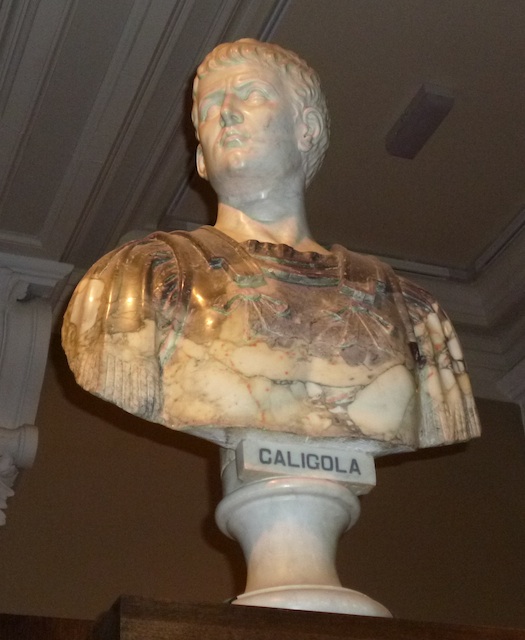 |
| Caligula bust |
 |
| Nero bust |
 |
| Stained-glass coats-of-arms |
Further upstairs is the Ancient Worlds and Special Exhibitions. When we visited, the special exhibit was Through the Magic Mirror: The World of Anthony Browne, who is a Yorkshire children's author and graduate of Leeds College of Art. Plenty of children's activities were available but not many photographic opportunities, except for children who wanted to hang out in a cage with a gorilla from one of Browne's stories.
 |
| Shooting the sign for the exhibit is allowed |
 |
| J tries to escape the cage! |
The Ancient Worlds exhibit shows a variety of items from Rome, Greece, and Egypt.
The Wolf and Twins mosaic depicts Romulus and Remus suckled by a she-wolf. The legend goes that they were abandoned in the Tiber River but came ashore and were raised by a she-wolf. They went on to found the city of Rome. The mosaic is from the Roman ruins in Aldborough, which the Romans called Isurium Birgantum.
 |
| The Wolf and Twins, circa 300-400 AD |
Some busts from that period are also on display.
 |
| Roman heads |
One interactive exhibit here is archeology-based. Patrons can try to reconstruct pottery from the various bits that have been dug up.
 |
| We do this all the time at home |
Another exhibit has a Roman altar used by a local family in Catterick, North Yorkshire, at the end of the second century. The inscription translates as "To the mother goddesses of the household, Julius Victor willingly and deservedly fulfilled his vow for himself and his family."
 |
| Roman Altar circa 200 AD |
The Greek exhibit includes various gravestones and tomb doors. The dead were washed and a coin put in their mouths to pay Charon to ferry them across the river Styx to the realm of the dead.
 |
| Greek tombstones, from 400 to 100 BC |
 |
| Greek Tomb Doors circa 200 BC |
This copy of the Rosetta Stone shows a decree from Pharoah Ptolemy V on taxes and putting up statues. The stone is significant because, after its discovery in the 1800s, French scholar Jean-Francois Champollion used it to decipher Egyptian hieroglyphics, which had been untranslatable until that time.
 |
| Copy of the Rosetta Stone, circa 196 BC |
The Egpytian samplings also include a variety of jewelry and figurines.
 |
| Egyptian jewelry |
 |
| Egyptian figurines |
The star of the exhibit is the Nesyamun, a 3000 year-old mummy. Pictures weren't allowed but visiting the museum is worth it just to see the mummy up close. The corpse is out of the sarcophagus and many of the linens have deteriorated, leaving a spooky-looking mummy. J and L were still in the Special Exhibit, which was probably good for them. Also, Mommy and I might have a hard time explaining a mummy to them.


 Posts

