Showing posts with label Crete. Show all posts

Wednesday, November 25, 2015

An Icon from Crete

While visiting Crete we hoped to buy an icon. We have no real advice on how to shop for one. We went to an religious goods shop in Heraklion, a town on the north shore of the island. Selecting an icon was a little challenging. It would have been nice to get an icon of one of our patron saints but we couldn't decide on which of the four of us. We weren't going to buy four icon. A long time ago in America I'd seen an icon of the Wedding Feast at Cana but the store didn't have any. The lady recommended one for scholars, featuring three of the greats of the Eastern Church.

Click to enlarge

On the icon are the Three Holy Hierarchs--Saints Basil, John Chrysostom, and Gregory Nazianzen. They were bishops in the 300s who had a major impact on Christian theology through their teaching and their holy lives. In the Eastern Church, they have a special feast day on January 30 dedicated to all three. They are venerated in the Western Church as doctors of the church but do not have a combined feast day.

Icons themselves have an interesting history. As an artistic tradition, they grew out of the Egyptian mummy portraits of the first to fourth centuries AD. These portraits featured large eyes and formal settings, a step away from the naturalistic depictions of Roman and Greek art from the same time. The style also flows from the Platonic tradition of the world of idealized Forms, so that the icons represent archetypes of Christ or Mary or whatever they portray. The images invoked the sort of reverence that could be misconstrued as idolatry, leading Emperor Leo III of Byzantium to start the first wave on iconoclasm in 726. The persecution lasted for about one hundred years. Afterwards, the Byzantine church spread north through Eastern Europe all the way to current-day Russia. They brought the tradition of making icons with them.

Of course, icons are not considered art properly in the East, they are a way of praying for both the artisan and the viewer. The icon is incarnational, communicating a spiritual reality through material means. The icon gives a focal point and rich details for meditating on the person or event depicted. It raises the mind and heart to God, the classical definition of prayer.

In other ancient icon news, I bought one in Jerusalem when I visited back in 2000. I'd been looking for a Nativity but I had special criteria. Most icons have Saint Joseph off in a corner moping which I don't particularly care for. I understand the theology behind it--he's not the father of the baby. But surely he wasn't whiny about it. He accepted his position and worked hard to do what he needed to do. I came across an icon where he was by the manger and knew I had to get it right away. It's a triptych which we usually open for the Christmas season.

Nativity icon closed (click to enlarge)

Nativity icon open (click to enlarge)

Of course, photos never do justice to icons, so don't miss an opportunity if you can see them. Eastern rite churches are loaded with icons, including the iconostasis that separates the nave from the sanctuary. Symbolically, it's a doorway between earth and heaven. It includes images of Jesus, Mary, the evangelists, the patriarchs, the apostles, and the patron of the church. It's worth the visit, plus there's probably other icons around the church.

Read more about icons in this slim, illustrated volume:


Sunday, June 9, 2013

Agioi Deka Church, Crete

The Agioi Deka church in the village of Agioi Deka commemorates ten Christian martyrs who lost their lives in 250 A.D. while Christians were persecuted under Roman emperor Trajanus Decius. The church in the town is the site where they were executed, formerly the Roman amphitheater of Gortyna (the Roman capital of Crete). It was not open when we visited.

Agioi Deka Church, with the sun in just the right spot!

A bit of the town, just because the architecture is so cool!

Down the road is a small chapel dedicated to St. Ephraim. The chapel is little more than a small room and was open.

St. Ephraim Chapel

A red-roofed church further down the road is also dedicated to the ten martyrs. This church has a crypt accessible from outside showing where the martyrs might be buried.

Church with the tombs

Burial place of the martyrs?

A small niche altar

Icons by the tombs (click to enlarge)

The church itself is not very large but has fantastic icons inside.

Another icon of the ten martyrs (click to enlarge)

St. Karalamnos (?) and St. Titus

Icon of the execution

Who were the Ten Martyrs of Crete?

Christianity had been present in Crete since apostolic times, when Paul sent Titus to evangelize the island. At the time Gortyna was the capital and the community of believers grew strong. In 249 A.D., the Roman emperor Decius demanded that all his subjects worship him as a god. Many people just went through the motions, even in mostly Christians towns like Gortyna. Ten men would not sacrifice to the emperor, saying that the only truly divine person was Jesus Christ. The men were arrested and imprisoned for a month. During that time they were tortured in hopes that they would give in. They did not and the governor of Crete ordered their execution. They were killed and buried in the town. Under the reign of Constantine, permission was granted to exhume and move the bodies of the martyrs. Their final resting place is unclear, though further archeology may reveal their tombs.

Interestingly the protest was planned. Five of the men came from Gortyna: Theodoulos, Satornilos, Euporos, Gelasios, and Eunikianos. The others came from other cities around the island. Pompios came from Lebena, Agathapos from Panormos, Basiliedes from Kydonia (Chania), Zotikos from Knossos and Euarestos from Irakleon.

Sunday, June 2, 2013

Church of the Assumption, Chania, Crete

The Church of the Assumption is the Roman Catholic church right across the street from the Greek Orthodox church in Chania. A row of buildings sits in front of the Catholic church, making it a little hard to find. But not too hard since a small sign that says "Ecclesia Katholika" points down the alleyway.

Alleyway to Catholic church

Church of the Assumption, Chania

The church was built in the 19th century and the small complex served as the first girls' school in Chania. The courtyard is still open and has a nice statue of St. Francis (whose nearby Venetian church has been turned into the Archaeological Museum).

St. Francis in the garden

J admires the crazy plants

Wall-mounted sun dial!

The interior of the church is small, white, and bright. Since it served a girls' school, it was probably designed for the students to use rather than the local Catholic population.

Nave and sanctuary

One of the cool things to see was a banner for the Year of Faith, which is being celebrated world-wide by Catholics. I've enjoyed spotting the same logo surrounded by different languages as we have wandered around Europe.

Year of Faith in Greek!

They have a nice painting of St. Joseph and a lovely Pieta statue along with other typical decorations.

St. Joseph

Pieta

More saints!

The votive candles are definitely Greek style--long stick-like candles pushed into sand or, in this case, sand and water.

Votive candles

Wednesday, May 29, 2013

Cretan Dancing

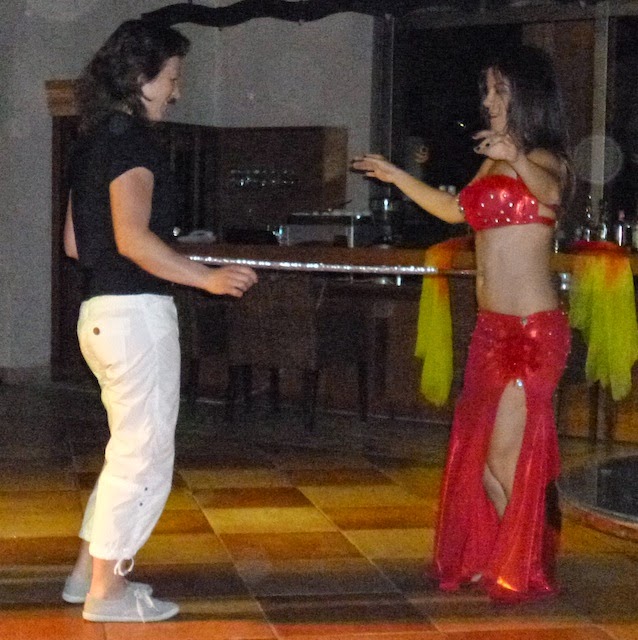
One night at our hotel on Crete they transformed the bar area into a dance floor for what was advertised as "Oriental Dancing." The name doesn't immediately conjure up a specific image like "belly dancing" would. Perhaps "belly dancing" is too demeaning a name for the dancers? They certainly wouldn't call it "Turkish dancing" because "Turk" is a four-letter word in Crete thanks to the abysmal memories of the Ottoman occupation. Perhaps there is a more apt term that hasn't made it into English yet. I'll call it "Cretan dancing" since I saw it on Crete.

The dance was at night, so the kids were in bed before things started. My wife volunteered to stay with them in the room so I could go collect information and photos for the blog. I found a small table on the edge of the floor and had a little drink of dessert wine as I watched.

The first few dances were more of what you'd think of as "belly dancing." Pretty soon, audience members were invited to join in the dancing, which was fun to watch.


Dancing with the professionals

Cretan dancing, now with tambourines!

Later on, the ladies danced with walking canes which was fun. Again, the audience joined in the second song.


Learning to control your tummy and dance as one!

Training future dancers

For an extra challenge, one lady danced with swords, including on her belly!

Ready to dance!


In case you are wondering, there was no audience participation with the sword dancing!

My favorite of the dances were the ones with the veils or cloaks whirling around. Such dances are colorful and look both effortless and challenging. The audience did not get to join these dances either.


For those who are curious, yes I did participate a few times. Since my wife and children were asleep back in the room, no one was able to take pictures or video of me dancing, which is probably very fortunate for you, dear readers.

Also this will be the last post from our trip to Crete, except for a few more churches on Sundays. We'll see some more of England before I start posting on our next trip to Brussels!

Sunday, May 26, 2013

Church of the Three Martyrs, Chania, Crete

The Greek Orthodox cathedral of Chania is the Trimartyre, or Three Martyrs Church. It was built in the 19th century by a Turk, who wanted to give thanks to the Blessed Virgin Mary for a miracle that saved the life of his son.

Church of the Three Martyrs, Chania

The courtyard outside the church has a few statues dedicated to Cretan heroes. Anaghnostis Mantakas was a 19th century freedom fighter on Crete. Ecumenical Patriarch Athinagoras I was patriarch of Constantinople from 1948 to 1972.

J admires Mantakes statue

Ecumenical Patriarch Athinagoras I

The doorway has a beautiful icon, the presentation of the child Mary at the temple.

Doorway Icon

The interior is quite breath-taking. Orthodox churches are traditionally quite ornate. Everywhere the eye looks, it is drawn to holy things.

Nave of the church

The pulpit

Several icons are found throughout the church. Some of the icons have small metal panels, often with body parts depicted on them. They are requests to the saints for help with illnesses or injuries.

Icon

Icon with panels

It is a beautiful building and well worth visiting.

Thursday, May 23, 2013

Cretan Drink

Most every country has some local brands or styles of alcohol, and in the interest of informing my public, I did some research on Crete. Oh, the sacrifices we make!

As in all countries, there is a brand of beer that is the popular local brew. In Crete, this brand is Mythos, whose name fits with the Greek penchant for mythology. Unfortunately, the beer is not legendary. Like other popular local brands, Mythos is an unremarkable lager. I also tried Finkbrau, which was an unimpressive German import.

Finkbrau and Mythos, take a pass if you can!

More appealing is the local wines. We tried a few bottles from the stores and often had wine with dinner when dining out. Red wines were our preference. Some restaurants had local or even home-made wines, which were all lovely.

Local yumminess

The surprise for us was the after dinner wines, known as raki in the local lingo. Raki is distilled from the grape stems and seed husks and is as strong as the producer wants it. Often it's made locally. It can be flavored with herbs or honey. If anise seed is used, the result is called Ouzo, which is potent and palatable.

Our airport acquisitions

It's best served chilled, as I discovered at home. The honey version has a good blend of sweetness and punch.

Our next trip will be to Belgium, so the alcohol paradigm will shift and the beers will be good while the wines will be unremarkable. At least, that is my prediction!

Wednesday, May 22, 2013

Cretan Food

The food on Crete is quite wonderful. Being a sun-drenched island has its advantages. Olive trees grow everywhere. Grapes for wine are plentiful (though alcohol will be tomorrow's post). Plenty of grazing animals like sheep and goats provide meat and dairy products. The seafood is fresh and plentiful. What's not to like?

Kefalotyri cheese is made from sheep's and goat's milk and has a nice little tang to it. J objected to it because it was white (he loves orange/red cheese, no matter what the flavor) but eventually tried it. Graviera cheese is also from sheep's and goat's milk and is a little milder flavored. J like this a lot more than the other. We parents preferred the kefalotyri. Both are yummy. Of course, feta cheese is the most popular and we had plenty of that too, though it was too soft for J.

One staple of the Cretan diet is olive oil. Almost everything is made with it. Meats, fish, and vegetables are often cooked and/or drizzled in it. Olive oil also substitutes for butter on morning toast. Most cooks brag about using local olive oil, either from their home town or even their home garden. Home brewing here includes olive oil!

"Extra-native" olive oil

Even soap has olive oil in it!

Baklava has many variants here, all of them tasty. I've enjoyed baklava back in the States but found it rather rich and overly sugary. In the stores, the baklava labels say they are "syrup-based pastries," which is a pretty good description. Here the syrup is lighter than what is used in the States, which helps preserve the flakeyness of the pastry. We had several different types while we were here, often as a little free extra after a meal or a snack. Even if you don't like it in America, it's worth a try in Crete.

Store-bought still isn't as good as from a bakery or restaurant

 The other style of dessert is kataifa, a shredded pastry with nuts and syrup. It looks a bit like a bird's nest but is quite tasty.

Stores have the usual assortment of foods. Here J found something he did like and since we were on vacation we thought we'd let it slide.

I'm sure that Greek bit explains how nutritious the cereal is

One thing they have a lot of on Crete is art. Art is in such great abundance, they are willing to eat some of it. Especially the foreign, i.e. barbarian, art.

Mona Lisa's unhappy fate

One important thing to remember is how generous the portions are in restaurants. Like this plate of meat!

J, you need to help out with this meat!

So many times we'd finish a meal at a taverna and then they would bring out some fresh fruit and baklava for dessert. It was a tough job, but we did our best. If we were really lucky, they'd bring out some raki, which is a dessert wine or aperitif. But that will be discussed in tomorrow's blog.

Monday, May 20, 2013

Gortyna, Crete

The ancient city of Gortyna is located on the plain of Messara, which has been inhabited since the Neolithic period. By the classical era (5th to 4th century B.C.), the city was quite large and powerful, even minting the first Cretan silver coins in 470. In the Roman period, substantial improvements were made including a large water supply and drainage system. Gortyna was the Roman capital of Crete. St. Titus, a disciple of the apostle Paul, founded the first Christian Cretan church and was martyred here. The city continued to flourish under the Romans and the Byzantines, eventually being destroyed by the Saracens in the 9th century A.D. The site has been uninhabited ever since.

Gortyna ruins

We drove into the town of Agii Deka and walked through some of the ruins to the main archeological site. My wife had the brilliant idea of calling it a "ghost town," having the children on their guard and ready to protect us from any danger.

Idyllic or ominous red flowers?

Old walls

The first site we came upon was the old Roman Praetorium, the governor's palace. Nearby were clear signs of preservation work.

Praetorium at a distance

View from the other side

Columns protected from the rain

Also nearby was a small flock of sheep wandering through the area. We were able to get close but not too close to the action. The shepherd eventually showed up following along behind the sheep.

L, Daddy, sheep

J was busy thinking about other things than sheep

Nearby are two temples. One is to Pythian Apollo (a native Greek god) dating from the 7th century B.C., the other to Egyptian deities dating from the 4th to the 1st century B.C.

Temple to Apollo, dates from Roman period

Temple to Egyptian gods

More of the Egyptian temple ruins

After crossing a road, we came to the main archeological area, i.e. we had to pay to get inside. The best preserved buildings are in this area. The church of St. Titus was described in yesterday's post. In addition, there is the Odeon from the first century A.D. The Odeon was a roofed theater that would have musical concerts and plays.

Theater in the round!

View from backstage

Behind the Odeon is a building with the Great Inscription. Dating from the 5th century B.C., the blocks contain amendments to Dorian law of that period, including topics like divorce, adultery, inheritance, and property rights. There are no references to criminal or commercial laws. The text reads from left to right with the subsequent line reading right to left, presumably to make faster reading.

The Great Inscription wall

Wall detail

Laws that didn't make it in

L wants to amend the laws

Other areas include the Agora or marketplace for the town.

Agora

Base of a column, good for an action shot

This would be a grate place for a shop!

Ruins being restored

On the hill above is the Acropolis and a temple to Athena. We didn't make it quite that far.

Too far for children to walk

The area also has an extensive collection of statues from the Roman period, the most unique being this fellow whose either broken his arm or gotten entangled putting his toga on.

The folds by his legs are pretty amazing!

Three women

Two headless women

Two more headless women

We stopped for a snack in the open air gift shop. The tables had a sign nearby that we think is unique in all our travels.

Smoking...okay?