Showing posts with label Irakleon. Show all posts

Friday, May 10, 2013

Irakleon Archeological Museum--The Paid Part

After visiting the free part of the museum, we paid a small fee to go into the rest of the Irakleon Archeological Museum.

One of the first things to see is a cabinet full of ancient bronze weapons, jewelry and knickknacks.

Various items from antiquity

This set of tiles is possibly decoration for wooden chests. They represent various two- and three-story Minoan houses, with doors and windows and even staircases to the roof. They look like tiles from an ancient game of Carcassonne, if you ask me. They are from Knossos and the neopalatial period (1600-1450 B.C.).

Tiles of houses (click to enlarge)

An actually game related item is the Minoan Chessboard, a game board found in Knossos dating from the 1500s B.C. The board has ivory, rock crystal, glass paste, gold and silver leaf. The game was probably similar to games that were played in the Egyptian court. It's fun to imagine what kind of game they played on the board. No rules or game pieces were found with it, other than those at the top of the display case.

The "Chessboard" (click to enlarge)

A clay house from Archanes in the 1600s B.C. shows a typical Minoan house.

Model Minoan House (click to enlarge)

Three-quarters view (click to enlarge)

The double-headed axe is a common symbol on Crete, often depicted in religious ceremonies. This bronze axe head on a modern wood post is from Nirou and also dates from the neopalatial period.

Double-headed Axe

This libation vase is another common image on Crete. The vase was found at Knossos and is still in fantastic condition. Perhaps it is related to the Minotaur myth which comes from Crete, either as a result or as an inspiration. A hole in the back of the neck allows the libation offering to be poured in; a hole in the muzzle pours the libation out.

Bull's Head Libation Vase

The bronze statue of a cloaked youth dates from the late Hellenistic period (1st century B.C.) and might have been part of a tomb. The eyes may have had ivory or glass.

Bronze youth

J told us all about the jewelry and coins in this display, though his accuracy is in dispute.

Maybe he's picking out gifts for Mother's Day

The large jars in this picture were used for cremated remains. The small jars were used for sacrificing oil, grain, and other valuables to the gods. They date from the 800s to the 600s B.C.

Vases (click to enlarge)

The Bull-leaping Fresco depicts an ancient Minoan event where the young and agile would attempt to somersault over a bull the long way, i.e. from the bull's head to his tail. This fresco is also from Knossos but the late palatial period (1450-1400 B.C.).

Bull-leaping Fresco (click to enlarge)

One final display includes the famous fertility goddess holding two snakes over her head. This is another Cretan icon, appearing in shops and on shopping bags.

Fertility figurines and small double-headed axes (click to enlarge)

More figurines


Thursday, May 9, 2013

Irakleon Archeological Museum--The Free Part

The Irakleon Archeological Museum has some of the most famous treasures from Crete. We went there after exploring the harbor area. A side entrance leads to a free exhibit of statues and frescoes. This was our first stop.

The Dolphin Fresco was a decoration at Knossos Palace for the Queen's Megaron (a room with a bath and what must be the first water-flushed toilet), either on the wall or floor. It depicts two dolphins cavorting with some smaller fish in the sea. It dates from the Neopalatial period, 1600-1450 B.C.

Dolphin Fresco (click to enlarge)

Also from the Knossos Palace is the Blue Boy or Saffron Gatherer from the same period.

Blue Boy or Saffron Gatherer (click to enlarge)

The Ladies in Blue is a fresco restored based on other fragments. The blue background provides a nice contrast to the ladies, who are showing off their jewels and clothes, giving a sense of the richness and flirtatiousness of court women even 3500 years ago.

Ladies in Blue (click to enlarge)

These plaster relief frescoes depict two women richly dressed sitting on rocks. They might have been priestesses, since the fresco is assumed to come from a communal shrine in Pseira. This work also dates from the Neopalatial period.

Plaster relief (click to enlarge)

This lintel was possibly over the main entrance of Temple A at Prinias (known to the ancients as Rizenia) and dates from the Archaic period, around 600 B.C. The women have sacred headdresses and panthers lurk beneath their feet.

Lintel (click to enlarge)

Also from Temple A is this frieze of mounted soldiers. The horsemen are small relative to their horses and they face front to the viewer. These characteristics are typical of the period. The horsemen are shown to have a higher social status since the sculpture is found inside the temple.

Frieze from Temple A (click to enlarge)

This marble statue is a philosopher, probably Apollonios of Tyana, a neopythagorean teacher and doctor in Crete who visited Knossos and Gortyna. He's a mature man with a full beard and a walking staff, with books by his feet. The statue dates from 2nd or 3rd century A.D. and comes from the Roman town of Gortyna.

Philosopher (click to enlarge)

This marble statue of Athena Parthenos is a copy of the larger statue from Athens's Parthenon. Phidias sculpted the Parthenon version in the 5th century B.C. and this statue is from Gortyna in the 2nd century A.D. The original statue was iconic, symbolizing Athenian democracy and was a renowned masterpiece in the ancient world.

Copy of Athena Parthenos (click to enlarge)

This group of statues are the Greek gods Pluto and Persephone depicted as the Egyptian gods Sarapis and Isis. Pluto has an instrument to measure grain on his headdress. Persephone has the Isis symbols--the crescent moon, the solar disk, and a snake. She holds a sistrum (an Egyptian musical instrument) in one hand and probably had a leash that connected her to the statue of Cerberus, the three-headed dog that guards Hades (the Greek version of the underworld/afterlife). Cerberus does not have an equivalent in Egyptian mythology. The set is an interesting blend of Hellenistic and Egyptian beliefs. The statues were found in Gortyna and date from the 150s A.D.

Persephone/Isis and Pluto/Sarapis (click to enlarge)

A small statue of the Greek god Pan features the horns, eyes, and hide of an animal. This also dates from the Roman period (2nd century A.D.) and was found in Gortyna.

Pan (click to enlarge)

These statues are part of a group depicting the killing of Niobe's children. The myth goes that Niobe boasted about having fourteen children while Leto, mother of the twin gods Artemis and Apollo, only had two children. Artemis and Apollo hunted down and killed Niobe's children. The statues show Artemis in hunting garb and Niobe protecting her young daughter. The original statues date from 4th century B.C. but these copies are from the 2nd century B.C. and found in Inatos.

Killing of Niobe's Children (click enlarge)

In the next post, we'll visit the paid portion of the museum.

Tuesday, May 7, 2013

Irakleon Lunch

The main plaza in the center of Irakleon is the Plateia Venizelos. The Venetian Loggia is tucked into a corner of the plaza. First built in 1626 by Francesco Morozini (the Venetian governor at the time), it was intended as a gathering place for people. Reconstruction was required after an earthquake and war damages ravaged the building.

Venetian Loggia

Inner courtyard, sadly with graffiti

The fountain in the plaza was built by Morozini in 1628 and is named after him. Originally it had a statue of Neptune on top, which was removed by the Turks when they occupied the island.

Morozini Fountain

The fountain was not running, which made J unhappy. The plaza buzzed with activity. Lots of wandering merchants had helium balloons of various shapes and sizes, including cartoon characters. One aggressive merchant tried to shove a Hello Kitty balloon in L's hand, then a Spider-man balloon in J's, which made us parents unhappy. Our children resisted the overtures since they were more focused on finding food.

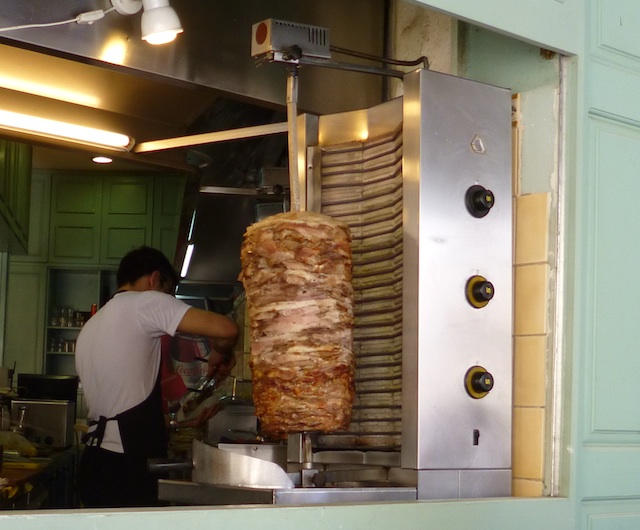
We had lunch at one of the restaurants. L was fascinated by the large hunk of meat rotating in the window. We told her that they carved the meat off as they needed it for the sandwiches. She made me take a picture.

A common sight on Crete

We had a plate of feta cheese (drenched in herbs (which turned J off) and olive oil (which turned L off)), bread, and some pitas stuffed with meat and toppings. They were tasty enough but not outstanding. The kids were uninterested in anything other than the bread. Eventually, J ate a few bits of cheese when we carved into the untainted center.

A lady with a guitar came up and spoke to the owner. He seemed pleased and she began playing and singing while we ate. After four or five songs, she came around with her hat in her hand (literally!). We gave her some money.

As we were getting ready to leave, a small girl with an accordion came up to our table and played some for us. I was out of change. Angie came up with something for L to give the girl. We beat a hasty retreat before we ran out of change.

We tried to go into Agios Titos, the large church near the plaza. The church dates from the 1600s, was converted to a mosque under the Turks, and returned to a church when they were ousted. The church is named after St. Titus, a compatriot of the apostle Paul who was sent by Paul to convert Crete. Titus became the first bishop of Crete and his remains were taken from the church to Venice when the Turks invaded. Titus's skull was returned in 1966 to the church. Unfortunately, we came to the church in the middle of the day while it was closed for the siesta and were unable to see the inside or the reliquary with the skull.

Agios Titos

We did see some fountains outside the church that did have water running, which made J happy.

Church fountain

Church bells

Monday, May 6, 2013

Irakleon Venetian History

After church, we explored some of the historical bits of Irakleon. The harbor area still shows signs of the Venetian influence on Crete, with a fort and several arsenals.

The Venetian part of the port

More modern machines

The fort, called Koules by the locals, was made to defend the port. It is impressively solid, made of yellow stone with walls several feet thick. Some scant decorations show its connection to Venice. The winged lion of St. Mark (Patron of Venice) is seen on each wall, including the sea-side wall, where it bares its teeth in warning.

Pier to the fort

Cannon hole

Sea-ward side

The Venetians called it Rocca al Mare or the Rock in the Sea, symbolic of its use as a defensive fortification. When we visited it was under reconstruction and we could not go inside.

No entry, alas!

Prosoke! Danger!

Many bikers and joggers went past us, so it must be popular to run out to the end of the rocky pier and back again. The weather was sunny but windy.

End of the pier

Too cool to run!

Across the bay are several Arsenali. These tall stone arches were buildings where ships could be constructed or repaired. The arches were built in the 1500s for the Venetian galley fleet.

Arsenali

Sunday, May 5, 2013

St. John the Baptist Church, Irakleon, Crete

On Sunday we went to one of the few Roman Catholic churches on Crete. St. John the Baptist is the Catholic parish of Irakleon, a port city on the northern coast of Crete.

St. John the Baptist, Irakleon

The church is small and was quite full. We arrived during the opening hymn (in Greek). Many others trickled in after us. It was tough to tell if they were other tourists who had a hard time finding parking as we did or people who just came late.

Nave after Mass was over

The liturgy was easier to follow since they had small books with four quadrants on each facing page, showing eight languages: Latin, Greek, French, English, German, Polish, Spanish, and one other language I couldn't identify. Many of the parts of the Mass were familiar, such as the Kyrie (which is Greek, after all) and various chants in Latin (Agnus Dei and such). They used familiar plain chant that was easy to sing along with. Interestingly, Kyrie eleison ("Lord, have mercy") was the reply during the petitions right after the Creed.

Communion was distributed by the priest by intinction, where the host is dipped in the consecrated wine before communicants receive. I don't know if that is the local custom or the priest's preference or it was a special occasion. At the end of Mass, many of the locals went to the front of the church to kiss the feet of Jesus on the crucifix, which was interesting, but again I don't know if that was just for Easter or is a local custom.

The congregation sang all the hymns with gusto. Strangely, the recessional hymn was a few verses of the Stabat Mater, a Latin hymn about the Way of the Cross. In the Orthodox church, Easter hadn't been celebrated yet (on our Roman calendar, it was the second Sunday after Easter), so maybe it was a show of solidarity with our separated brethren?

Church name in Greek!

It was a beautiful service and we were happy to attend Mass in another country.