Showing posts with label cheese. Show all posts

Tuesday, April 1, 2014

More from Gouda, The Netherlands

Gouda has many claims to fame. One is that the famous Desiderius Erasmus grew up in the town. Born circa 1467, he lived with his brother and mother for many years. She died of the plague and the two sons moved back to Gouda to be with their father. A trail with signs show some of the places where he played and worshiped while in Gouda. There's even a canal named after him...or maybe it's just the bridge.

Erasmus Brug=Erasmus bridge?

Erasmus trail sign

Nearby is the gate to the Jewish cemetery in Gouda.

Jewish Cemetery Gate

The town is famous for the cheese named after it. The market square has a cheese market on Thursday mornings. We weren't there on a Thursday, but there are plenty of other cheese shops in town to get one's slice, wedge, or wheel. One that we visited had a ton of cheeses, from serious to silly.

A Gouda cheese shop

The serious

The silly

We had lunch at the Cafe Central, where I had a nice local beer and L made herself busy recreating the event on her place mat.

Luscious local brew (though Brand is a pretty generic name, if you ask me)

L draws while we wait for food

Us at lunch (future posts may be only pictures by L...)

We were sad to leave behind such good food and good cheeses. Goodbye, Gouda!

Monday, March 31, 2014

Kaaswaag, Gouda, The Netherlands

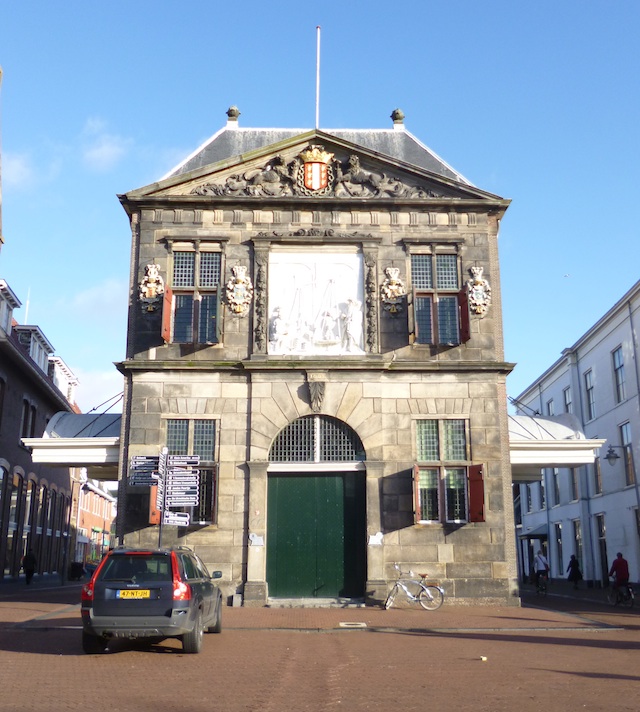
In the Northeast end of the Markt in Gouda is the Waag, a seventeenth-century building that was the cheese-weighing house and is now a museum dedicated to Dutch cheese.

Kaaswaag, Gouda

Back of the Kaaswaag

Just over the front door is a relief of cheese weighing in action. This sculpture is a copy of the original which is now stored inside, where it shows its signs of weathering.

Bas relief of cheese weighing

Original inside the museum

The ground floor of the building is a combination tourist center, shop, and a slice of the museum.

The shop

Cheese weighing and stained glass!

Cheese and a Dutch girl

Cheese press with L's cheesy smile

Visitors pay a modest fee to go upstairs for the rest of the museum. The friends who came with us were mistaken for relatives and we paid the family rate for everyone.

The first floor had exhibits about Gouda specifically and that's where the original bas relief is found.

Ye olde mappe of Gouda

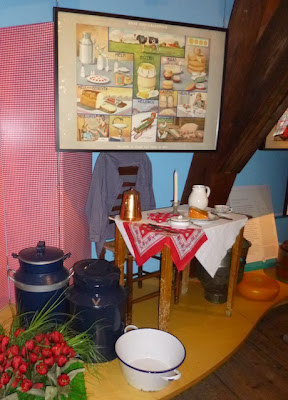
Up another flight of stairs is the exhibit on cheese making, which includes a video in Dutch with English subtitles. J and L loved watching the video which let us examine the cheese-making items in the room.

Standard cheese-making equipment

Standard cheese-consuming equipment

The process starts with cows though historically experts think that the first cheeses were made by accident. Ancient man stored milk in sacks make from calves' stomachs. As the milk sloshed around, the enzymes still in the stomach caused the milk to separate into a liquid and a white mass. The mass was taken out and then pressed to get additional liquid out, forming the first cheese. Cheese was (and is) handy since it is edible much longer than the milk from which it is made. The museum display continues on with the Dutch methods.

The first step is to have the right shoes!

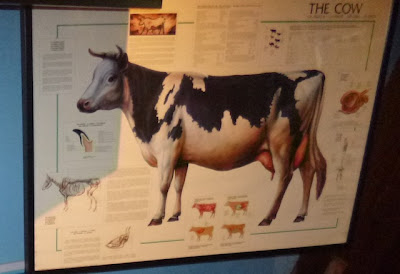
Anatomy of a cow

Tools for milking

With the milk, the next step is to mix it with rennet (based on the enzymes from the cow, though rennets have been developed from other sources for vegetarians), which will thicken the milk and separate out the whey (the liquid part). Also, lactic acid is added to help the rennet, to provide flavor, and to kill bad bacteria.

Mixing tools

The next step is to remove more whey by putting the cheese in molds and pressing.

Cheese presses and molds

After pressing, the cheese is cured in salt water. The salt helps to provide flavor and makes it stay fresh longer. A cheese mark may be added at this point to identify who made the cheese and where.

Pressed and cured, now for the aging process

The cheese is then aged. Young cheeses are mild and creamy while older cheeses are more flavorful and drier. The maturing process can go from one month to one year or more. Once it's ready for sale, a label is attached and it's off to market!

Many different local cheese labels

The Netherlands is an ideal area for cheese-making, since the low, moist lands provide excellent grazing for dairy cows. Farmers would often make cheese and then bring it to market day to sell along with their other produce. The Gouda city council was granted the right to tax cheese in 1667. They built the Waag in 1668 to weigh the cheese and determine how much tax should be paid.

More cheese-weighing equipment

The exhibit has a small display on butter making as well, though that was of much less interest to everyone.

Butter-making tools

After the second watching of the video, the kids went around admiring everything. They were done in about two minutes, so it was lucky for us that we had more time!

J ready to eat!

We also noted the industrial, table-mounted cheese grater.

This would be convenient

Soon enough we went back down all the stairs and bought some samples to take back to England. Truth be told, we ate a bunch of it on the way back to England.

Tuesday, February 25, 2014

Wensleydale Creamery, Hawes, England

Wensleydale is most famous for the cheese produced there. Cheesemaking in the Dales goes back at least as far as the Christian monasteries and has continued to the present day. We visited the Wensleydale Creamery, the home of real North Yorkshire Wensleydale cheese. In addition to their cheese production buildings, they have a museum, a visitor centre, a shop, and a restaurant. We visited them all!

The working part of the creamery

Our first stop was the museum where we saw a bit about the history of Wensleydale cheese. The first cheesemakers in the area were French Cistercian monks who came in 1150.

Monastic tools of the trade

When Henry VIII dissolved the monasteries in the 1530s, the monks gave the recipe to the wives of the farmers who had provided the milk to make cheese. The tradition was preserved in homes for about 450 years.

A sample farm kitchen with a sample J

In 1897 Edward Chapman built the first creamery to make Wensleydale cheese on an industrial scale. He bought milk from the local farmers and made a success of exporting the cheese.

Cheese presses (to get extra liquid out of the cheese)

Various cheese making implements

In the 1930s, the Great Depression almost closed the creamery but Kit Calvert drummed up enough support to save it. The company changed hands a few times until May 1992 when the creamery was closed by Dairy Crest, then the current owners. Some of the laid-off managers got together and bought the creamery and reopened it in time for cheese to be sold at Christmas. The place is still making hand-crafted cheese from local milk according to the classic local recipes.

Milking implements through the ages

A display on butter making, which they also do at the creamery

The museum includes an activity area for children which naturally drew J and L. A telly in the corner shows Wallace & Gromit animations (which caused a resurgence in people's interest in Wensleydale). They were more distracting for L than for J.

Children's activity area

After the museum, we went across the way to the Cheese-making Viewing Gallery, a grand name which I did not make up!

People go left; cars go right

The gallery has nice views of the men and women (about 200 people are currently employed by the creamery) making cheese. The windows were a little foggy so it was hard to get good pictures. The children were fascinated by the large tubs in use.

Gathering cheese ready for molding on left; draining large slabs of cheese on right

After the tub was emptied of cheese, one man started washing it out with a power washer. At one point he playfully shot our window which got a good laugh from us.

Stirring the proto-cheese

This area had a few items on display, including an old-fashioned delivery vehicle.

The cheese express!

The next building was the visitor centre with the cheese shop and a restaurant. The restaurant was rather full so we were unable to have a snack. We went into the cheese shop (a room with a controlled environment--cool enough to store cheese in the open!) where we sampled a good variety of their offerings. They make not only Wensleydale cheese, but cheddar and Gloucester and other combinations of flavors. My favorites were the Wensleydale with cranberries and the other with pineapple and the smoky cheddar. It was so delightful I forgot to take pictures!

We browsed a bit in the rest of the shop but did not buy anything (though L was pretty insistent that she needed a small stuffed sheep). It was a great visit though the whole place wasn't as large as I was expecting.

The surrounding hillsides are quite beautiful!


Tuesday, December 17, 2013

Ferry to and from Germany

We took the overnight ferry for our trip to Germany to visit the Spiel, a massive board game fair. This ferry went to Rotterdam, The Netherlands (more about that country in future posts!). We took our car and drove to Germany. I wish I had some harrowing stories of driving a British car on the other side of the road but it wasn't that difficult. Plenty of traffic meant it was easy to pick the proper side of the road. I did have to buy some stickers to put on the headlights. Somehow that re-aimed them appropriately for continental driving. The occasional parking garage was a challenge since the "take a ticket" machine was on my passenger side. Luckily I always had a passenger to do the job (including paying for the ticket on the way out!).

The ferry itself seemed pretty standard to us. It had a large play area where J and L could run around without disrupting other passengers.

L by herself in the play area

The same cutout poster from the other boats!

In the early morning, no other kids or parents were there!

We packed dinner and breakfast, so we ate at the coffee shop area across from the play area.

After the boat arrived, we drove for a while and decided to stop for a snack. The exit we took only had one option:

I'm lovin' it...not.

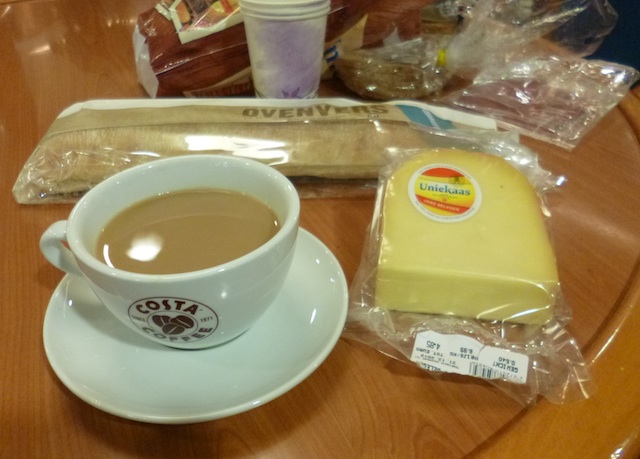
On the way back, we bought food before getting on the boat, which meant we ate Gouda cheese from Gouda. My wife also bought some salami-looking sausage slices at the store. When we opened it we discovered it was this special uncooked beef sausage called Amsterdam Ossenworst. We weren't sure if it was okay to eat with our bread and cheese but we did it anyway. Turns out it was meant to be eaten uncooked.

Our return dinner (you can't really see the meat right above the cheese, sorry)

Getting home was no big deal. I remembered to peel off the headlight stickers and drive on the proper British side of the road. We arrived home safe and sound in time for lunch!

But more on Germany in the next couple of posts...