Showing posts with label water mills. Show all posts

Thursday, November 6, 2014

Quarry Bank Mill, England--Inside

Having seen the outdoor attractions, we headed into the main building of Quarry Bank Mill to learn the history of thread and fabric making during the Industrial Revolution. The mill was built in 1784 by Samuel Greg, a textile merchant who saw the possibilities of water-powered spinning machines in a factory. Cotton was processed at this mill and we learned quite a bit.

Weighing a cotton bale

The fibers (or fibres as the locals spell them) were twisted into threads to make yarn. One display showed how flexible fibers are much easier to twist together than more solid ones.

Fiber challenge

The mill processed fibers from a wide variety of sources, even raw cotton shipped from the United States!

Fiber producing countries

We saw demonstrations of hand-operated looms.

Weaving demo

The mill includes some hands-on opportunities for the kids which J and L enjoyed.

Mill model with light-up sections telling what went on where

L and the mill puzzle

Just about finished building the mill

Operating a crane

The equipment for turning threads into fabrics and fabrics into patterned fabrics are on display as well.

E pluribus unum, Industrial Revolution-style

Block for putting patterns on cloth

Rollers to put on patterns!

The plant manager's and other offices are left as they were in the 1800s.

A cozy office with a big safe

Taking advantage of natural light for the clerk's desk

Another desk

Some equipment

Prior to the 1800s, dentistry consisted of little more than pulling out teeth that hurt. In the 1800s scientific and technological breakthroughs made dental health care both easier and more sophisticated. By the mid-1800s, the Royal College of Surgeons was certifying professionals in the art of dentistry. The Gregs recognized the importance of providing dental care for workers (a worker with a toothache was a lot less productive) and had dental services available for their employees. Their mill was the main employer for the town so they served just about everyone locally.

Late 1800s dental chair

At the bottom level of the plant is the very impressive plant floor, with dozens of machines powered by water. Most every step of the cloth production process was made easier and quicker.

The plant floor

First sign of a water wheel--the water below

Suspiciously modern-looking equipment

Here we saw displays on how the water was diverted from a local river and the various types of water wheels used to power different mills.

L redirects river water

J works one type of wheel

Undershot, breastshot, and overshot wheels

Quarry Banks' breastshot wheel

Water wheels weren't the only technology in use. Several other items were used at the mill to do the work. By the 1900s, coal was used to power the equipment.

Sample coal engine

One of the tricks with wheel-power is to convert the circular motion into up-and-down motion. An arm on the wheel can be attached to a beam to pull a piston up and down. The only difficulty is that the piston is pulled off its vertical line, resulting in jams. James Watt added some movable joints on the piston side creating a parallelogram that shifted it shape but left the piston in a straight line. Energy could be converted either way--from circular to vertical or from vertical to circular.

Parallel motion machine on right

Another device invented by James Watt is the Governor. One of the problems with a large plant is that various machines are turned on and off at different times, so the amount of power needed fluctuates throughout the day. If the same amount of power was fed into the system when only a few machines were working, power would be wasted and the machines still in use might run at speeds higher than intended.

The Governor has two weighted balls on levers. As the engine runs, the balls spin and fly up and out. If the engine goes faster (i.e., when other machines aren't using its power), the weights go higher. The levers lift a collar that limits the amount of steam in the system, reducing the power created. Waste is eliminated!

The Governor

Governor on a wheel

The mill is a fascinating place to visit for its historical and its scientific information.

Tuesday, April 8, 2014

York Castle Museum, England--Part II

One side of the York Castle Museum deals with the every day life of Yorkshire lads and lasses through the centuries. But the other side commemorates morally questionable people and generally groovy times. I write of the Debtors' Prison exhibit and the 1960s exhibit. They also have a nice mill outside.

The central part of the museum was used as a Debtors' Prison and displays show the tools of law enforcement.

A variety of restraints

A prison cell

An illegal weapon seized by the authorities!

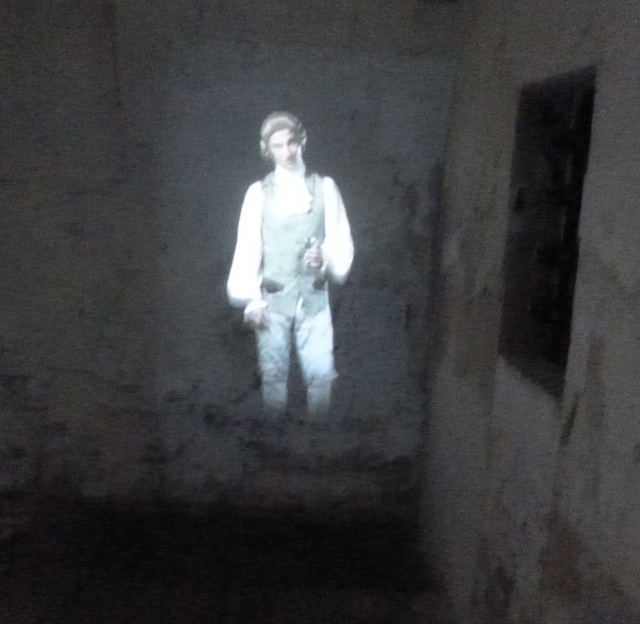
Many of the cells are still extant and are haunted. Or perhaps its just some sort of high-tech display that shows re-enactors dressed as typical criminals who describe their crimes and their treatment in the prison. It was still spooky.

A female prisoner/ghost/projection

A male prisoner/ghost/projection

Outside is a pillory that J and L enjoyed because they were only in it for a moment and no one was pelting them with rotten fruit and veg.

Welcome to the outside...not so sinister, or is it?

Js unhappy f'ate

L really doesn't fit

Back inside is a hall dedicated to the 1960s, an era of great change in England and the world. The exhibit included information on the Beatles, women's liberation, Vespas, and space missions. The children were only interested in the space missions.

L in the launch

J's turn

Two in one!

A token representation of the other exhibits

We went back outside where a small mill has been set up.

Walking to the mill

J ready to go inside

The mill wasn't very big but had plenty of information about the life of millers. The kids were more interesting in being silly than in learning at this point.

The mill's gear

The mill's gears

Silly kids ready for a photo

One more silly photo

The mill exit was on the other side of the building so we saw the wheel turning before exiting the museum.

A top-fed wheel!

Heading back to the castle wall and museum

York Castle Museum has lots of fun exhibits for young and old and is definitely worth the visit. The ticket included a year's admission, so we could go back; also, it includes admission to the Yorkshire Museum on the other side of town, which we've already visited here.

Saturday, November 23, 2013

Drumlish, Ireland

Going back to the ancestral home town (on my mother's side) of Drumish, Ireland, was not what I expected. It looks like most modern towns, with neat rows of almost exactly the same houses and a main street featuring a pub, a store, a church, a library, and a post office.

One little bit of history that survives is the Old Corn Mill on the edge of town. The mill was owned by the Rogers family and ran from the 1750s to the 1950s. It was used to grind corn and oatmeal. When the famine hit in 1846 and 1847, the local oat crop helped the town suffer less than other areas in Ireland. The mill was shut down in the 1950s and has recently undergone restoration. It is still not available for tours or wandering through, but I managed to get a few snaps through the fence.

The Old Corn Mill, Drumlish

Inside the mill

The walkway along the back

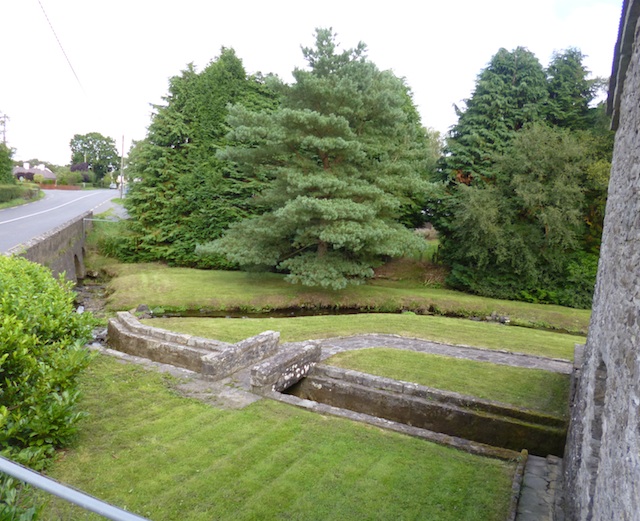
Good old waterpower!

Where the stream feeds from

Right by the Old Corn Mill is a nursing home with retirees aplenty. Across the way is a playground, which is a pretty smart thing to put next to a retirement community. The grandkids can come visit and have a fun time and the old folks can get out and enjoy the outdoors without going too far.

J and L loved the playground. An Archimedes screw is down near a small stream bed, which was unfortunately dry. Even so, a small puddle provided enough water for J and L to crank the screw and deliver a little water to the top of the screw. From there, the water could go down a trough and power a water wheel. Sadly, there wasn't enough water for the wheel to start going.

Water plus science equals fun

J screws around while L watches!

In the playground is a sit-and-spin that doesn't require the parents to put any effort in. That was awesome!


The playground also has some old favorites and new favorites, like a zip line and the spinning web (which did require parental power).

J the self-powered!

Coming back for another run

L and the spinning web

Only good shot of the moving spinning web (should have taken a video)

On our way out of town, we visited the Old Catholic Graveyard but did not see any family markers.

Old Catholic Cemetery