Thursday, March 28, 2013

RHS Harlow Carr Gardens in Lent

On a recent Sunday the weather seemed bright enough to go to the gardens after Mass, so we went to our old standby, RHS Harlow Carr. They had some seasonally colored flowers and an orchid show on in one of the buildings.

We are still amazed by all the hearty flowers that can survive in this Yorkshire "springtime" which includes plenty of snowy days. The flowers are perfect for Lent since they are mostly purple, just like the liturgical vestments the priest wore at Mass earlier in the day!

Field of purple

Ericaceae (known as heather or heath!)

Some white flowers anticipating Easter

In the Bramall Learning Centre and Library was an exhibit of orchids. The organizers looked like they were gearing up for a lecture so we only stayed briefly to admire the sights and smells.

Epidendrum stanfordianum and friend

Beallara Tahoma (white on top) and unidentified (below)

Lots of orchids

We managed to see some wildlife while we were at the garden, including some real ducks and some unreal rabbits (or possibly hares).

If a duck crosses your path, does it mean anything?

At first I thought these were deer, but clearly those are ears, not antlers!

No trip would be complete without a visit to the playground and the tree house. I took the obligatory tree house shot.

Would anyone notice if I kept using the same photo?!?

We had a fun visit to the gardens, even if we did have to wear winter jackets and gloves. Come on, Spring, we are waiting for you!

Wednesday, March 27, 2013

Random Bits of Paris

There are always spots that look like they're good for a photo but not for a whole blog post. Here's some of those random bits of Paris.

Near our hotel was the most unadorned (at least externally, we didn't go inside) church in Paris. St. Genevieve in Montmartre is a simple stone church, striking in its simplicity.

St. Genevieve, Paris

In the middle of town, as I walked off from my family to go see the Louvre, I walked by an amazing 14th century clock tower next to the Palace of Justice/Sainte-Chappel complex. The tower is called the Tour de l'Horloge, and was the first public clock in Paris, sculpted by Germain Pilon.

Tour de l'Horloge

Clock close up

Around the corner from the clock tower is the Conciergerie, the palace of the keeper of the King's mansion. It also dates back to the late 1300s, though during the Revolution it was used as a jail and Marie-Antoinette was held there. It's now part museum, part law courts.

Conciergerie

As I was crossing the river here I took a picture in the wrong direction and instead of photographing the famous Pont Neuf I immortalized the Pont Notre-Dame.

Pont Notre-Dame over the Seine River

Across the Seine was a tall column with a golden statue on top. It has refused identification in all my guide books.

Reward for reliable identification of Column Jean Doe

Speaking of Notre Dame, across the river from the church is Shakespeare and Company, a bookshop that has mostly English books and has been there forever. I somehow resisted the urge to go inside.

Shakespeare and Company, booksellers

Up the street is the Metro St.Michel, which has a large outdoor fountain dedicated to Saint Michael the Archangel. The bronze statue in the center is by Duret, but the fountain was by Davioud. The fountain was off, so J did not want a picture with it.

Place St-Michel

Tuesday, March 26, 2013

Playground and Canal in Paris

On our last day in Paris, we explored near the train station to kill some time before our ride out of town. We found a canal that was flanked by playgrounds!

Canal St-Martin bridge

Close up of those on the bridge

View from the bridge

The Canal St-Martin was opened in 1825 as a bypass for the loopiness of the Seine River. It's three miles (five kilometers) long and makes for a very picturesque part of Paris not by the central area. We had an excellent Italian lunch (perhaps not the best choice for our last meal in Paris) at one of the local restaurants before going to the playgrounds.

Left bank playground

Right bank playground

J ready to slide

On our way back to the train station, we found a playground in the Square des Recollets, which meant more fun for the kids.

Some of the big equipment

Spectacular Spider-J!

Pretty soon we were on our way to the train station to head off to Germany for more fun and adventures.

But the blogging about Paris is not over yet, we still have two biggies to go--Notre-Dame and the Louvre!

Monday, March 25, 2013

The Walking Dead Ep 315, "This Sorrowful Life"

The Walking Dead Season 3, Episode 15: This Sorrowful Life

TV rating

TV-14

ZPAA rating

Teens and up

Gore level

8.5 out of 10--Zombie kills a plenty with lots of heads being smashed or stomped or stabbed on screen; one decapitation by wire; a field of gory entrails; Merle describes how the Governor might torture Michonne.

Other offensive content

Foul language; human on human violence; lots of discussion about accepting the role of villain or bad man; drinking; loud rock music.

How much zombie mythology/content

Nothing new this episode.

How much fun

I didn't laugh at all this episode.

Synopsis & Review

Rick goes ahead with the plan to turn Michonne over to the Governor so that the prison and everyone else in it can be safe. He lets Hershel and Daryl in on the plan and then recruits Merle to help. Merle can't believe it and is pretty sure Rick does not have what it takes to follow through on the plan. He goes ahead just before Rick changes his mind, leading to a tough journey for Michonne and Merle and hot pursuit from Daryl, who insists that Rick stay behind and get the prison ready for war.

As is often the case, lots of interesting conversations and character interactions fuel the drama much more than the blood and guts. The show can make even a questionable fellow like Merle complex and sympathetic, even if the viewer does not like him. Merle grapples with the idea that he is an evil man that people keep around to do the "dirty" work. He learned to embrace that role under the Governor but it's a lot harder for him in the very different environment at the prison.

The very end of the episode is heart-breaking. One more to go, presumably the epic showdown between Rick's group and the Governor's Woodbury (if the Governor isn't too busy torturing Andrea)! 

Parisian Playground by Our Hotel

One of the playgrounds we visited toward the end of our Paris trip is near our hotel. The weather was a bit chilly but that did not stop the children from trying out the equipment at Square Marcel-Sembat.

There were plenty of ways to climb up.

L at the top of the mountain climb

The fruit climb

J goes up the uneven ladder

Coming down had more limited options. Most of the slides were dewy or icy. L found a fun way to go.

Stuck at the top

L and Mommy execute an escape!

They also had an interesting turtle for kids from 2 to 12. He was a bit damp too, so the kids did not ride on him.

The big-footed turtle

Across the street was an interesting building, at least interesting to me.

Interesting building by the Square Marcel-Sembat

More interesting was the man who approached us in the park. He tried to strike up a conversation. His English was much better than our French, which is not much of an accomplishment. His grasp of geography was pretty limited. When we said we were from America, he asked, "What state?" I said, "Maryland." He didn't understand and asked again. After about four attempts to tell him "Maryland," I finally tried "Virginia." He recognized that right away. He did know his local geography, though. He said if we were going to go for a walk, we should go that way (pointing south), not the other way. That way is Paris, the other way is not-Paris. The kids were getting cold so we broke off the conversation and headed off for a snack.


Sunday, March 24, 2013

Pantheon, Paris

Louis XV had a serious illness in 1744. When he recovered, he decided to build a splendid church in honor of St. Genevieve, the patron of Paris. French architect Jacques-Germain Soufflot designed the church in a Neo-Classical style. He wanted to make a rival to St. Peter's in Rome. Construction began in 1764 and was not complete till 1790. Soufflot had died ten years earlier and his assistant Rondelet finished the work.

Pantheon, with Etienne du Mont in the left background

Back of the Pantheon

The next year, the Revolution's leaders turned the building into a national Pantheon, a temple to house the remains of France's great men. Mirabeau was the first to have his ashes put there, though Voltaire, Jean-Jacques Rousseau, and Marat were soon to follow. Mirabeau and Marat were later removed when the political climate of the Revolution changed.

Rousseau's Tomb

Voltaire's Tomb

In the 1800s, the building was used for Christian worship during two separate periods. The building was finally given over to secular use in 1885 when Victor Hugo was buried in the crypt. Various other illustrious French citizens have been buried here throughout the years, including Marie Curie and her husband. Alexandre Dumas' remains were moved here in 2002.

Victor Hugo (left), Alexandre Dumas (center)

Marie (top) and Pierre Curie

They are all in the extensive crypt downstairs. Up above is main body of the Pantheon, with a large open area. Originally the design had many windows to allow natural light to flood into the building. With the Revolution's repurposing of the building, they bricked up most of the windows to create a more tomb-like atmosphere. They also removed the main altar and put in a statue honoring the National Convention, part of the Revolutionary government in 1792.

Main altar area

Mosaic above the altar, caption: Christ teaches the country's fate to France's guardian angel

In spite of the many attempts to secularize the use and decor of the building, much of the religious art from the periods when it was used as a church still survive. Several massive paintings follow the life and major events of St. Genevieve.

St. Genevieve comforts Parisians when Attila the Hun was coming

Other big events in French Catholic history are also recorded, including the martyrdom of the first bishop of Paris, St. Denis, and the crowning of Charlemagne by Pope Leo III.

St. Denis picks up his head after he is martyred!

Coronation of Charlemagne

A variety of sculptures from the early twentieth century are found throughout the main floor of the Pantheon.

Battle of Valmy, which did happen by a windmill

Sculpture called "The Avenger"

Hoche, general of the French army

Tomb

Off in a side room is a scale model of the Pantheon, including a cut-out section showing the interior.

Model of the building

Model of the interior

Under the dome of the building is Foucault's Pendulum. That is, the French physicist Leon Foucault installed it himself in 1851. It was taken down when Napoleon III returned the building to religious use and then put back up in the early 1900s.

THE Foucault's Pendulum

THE dome

The children enjoyed running around the large emptiness of the upstairs. Down in the crypt they were more sedate, as was fitting.

Running around a nice open area

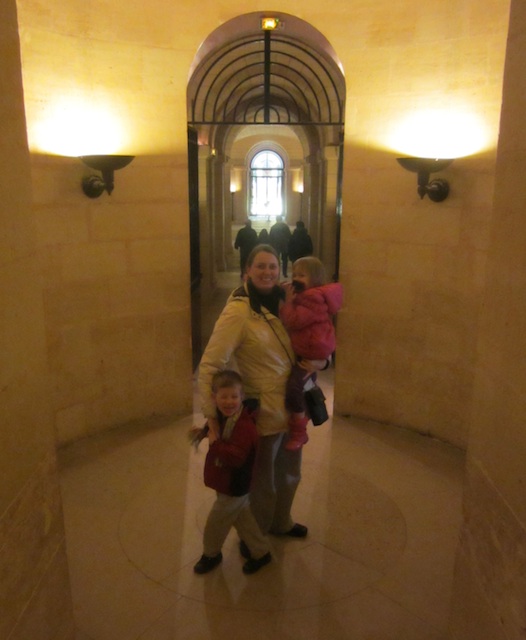
Posing in the crypt

When we came out, we caught another glimpse of the Eiffel Tower in the distance.

View down Rue Soufflot